
How to Track Brand Mentions in AI Conversations
AI chatbots like ChatGPT, Claude, and Gemini are reshaping how people discover and evaluate brands. Unlike traditional search engines, these tools provide direct answers, often mentioning brands without linking back to external sources. For businesses, this creates a challenge: how do you track when and how your brand is mentioned in AI-generated conversations?
Here’s the solution:
- Identify where your brand is mentioned: Focus on platforms like ChatGPT, Perplexity, Gemini, Grok, Microsoft Copilot, and Claude.
- Use the right prompts: Test customer-like queries (e.g., "Best CRM for small businesses") across platforms to see if your brand appears.
- Streamline tracking with tools like Spotlight: Automate monitoring for mentions, sentiment, and placement across AI platforms.
- Analyze metrics: Focus on mention rate, sentiment (neutral, positive, or negative), and ranking within responses.
- Track trends and adjust: Regularly review and refine your strategy to stay visible as AI models evolve.
Monitoring AI brand mentions is essential for understanding your visibility and reputation in this new AI-driven landscape. Tools like Spotlight simplify the process, offering automated tracking, sentiment analysis, and competitive benchmarking across multiple platforms.
Your Brand Is Being Mentioned in AI Search. Are You Tracking It?
sbb-itb-da7512d
Step 1: Identify Where AI Platforms Mention Your Brand
Before you can effectively track mentions, you need to figure out where your brand is being referenced. This is the first step in managing and improving your brand’s reputation. AI platforms don’t offer public dashboards to show when your brand is mentioned, so you’ll need to use specific prompts to query them and document their responses [4][7].
Interestingly, the way AI platforms mention brands varies a lot. A 2025 study revealed that 62% of brands are not mentioned at all on at least one major AI platform [5]. This makes it clear that a one-size-fits-all approach won’t work – you’ll need strategies tailored to each platform to ensure your brand is visible.
Each AI platform also uses unique logic to recommend brands. For example, ChatGPT leans on broad authority from its training data, Perplexity cites live web data and real-time searches, Gemini pulls from Google’s search index, and Copilot integrates Bing search with professional tools [4]. Knowing these differences can help you decide which platforms to focus on for your brand. For more in-depth analysis, explore our AI visibility resources.
Platforms You Should Monitor
Start by focusing on six major AI platforms where most customer interactions happen: ChatGPT, Perplexity, Google Gemini, Grok, Microsoft Copilot, and Claude. These platforms target different audiences and serve various use cases, so your brand’s visibility will likely vary across them.
Pay special attention to platforms that provide direct links for easier citation tracking. Placement also matters – platforms like Perplexity and Grok often list brand mentions early (median rank of 1 or 2), while Claude tends to place mentions later, with a median rank of 3 [1].
Once you’ve identified the platforms, refine your monitoring strategy by using tools for writing content optimized for AI search and experimenting with targeted queries.
Find the Right Prompts and Queries
Instead of simply searching your brand name, test queries that mimic what your customers might ask. For example, try prompts like:
- "What’s the best project management tool for remote teams?"
- "Compare the top CRM software for small businesses."
These types of queries can reveal whether your brand appears organically in customer-focused searches [5].
To establish a baseline, run 10–15 specific prompts across all major platforms. This will help you monitor your brand’s visibility over time. Try different query formats, such as:
- Category queries: "Best [category] tools for [audience]."
- Comparison queries: "[Competitor] alternatives."
- Problem-solution queries: "How do I [problem your product solves]?" [5][6].
Run each prompt multiple times since AI responses can vary. If your brand appears even once out of three tries, it suggests inconsistent visibility [4][5].
For accurate results, always use a new chat or incognito mode to avoid bias from previous search history [5][8]. Revisit your key prompts at least every two weeks because AI recommendations for competitive queries tend to change every 2–3 weeks on average [5].
Step 2: Use Spotlight to Track AI Mentions
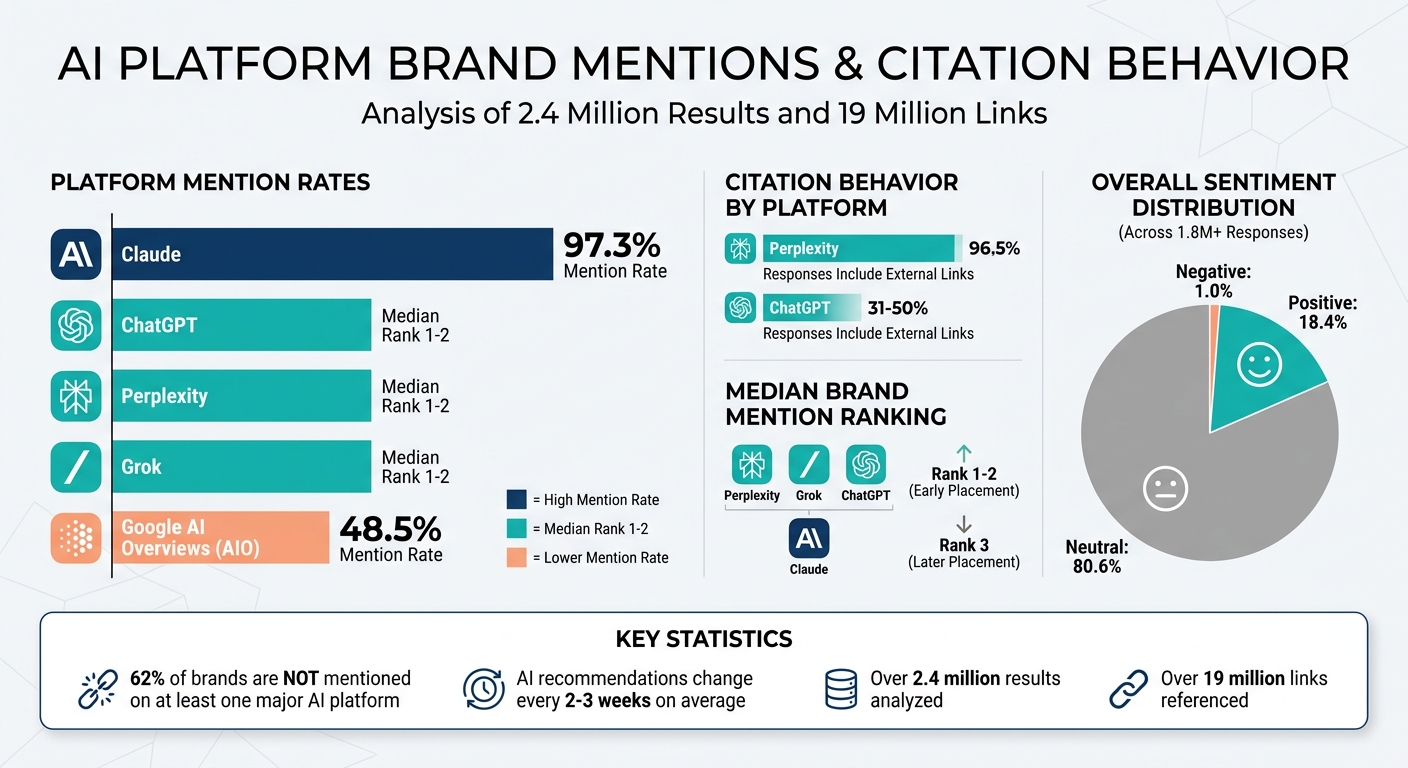
AI Platform Brand Mention Statistics and Citation Behavior Comparison
Once you’ve identified where your brand is being mentioned in AI-generated responses, the next step is to streamline the tracking process. This is where Spotlight shines, offering an automated solution that makes monitoring both efficient and accurate. Instead of relying on manual checks – which can be time-consuming and impractical – Spotlight handles the heavy lifting, tracking mentions across eight major AI platforms. It pinpoints exactly how, when, and where your brand appears in AI-driven outputs.
Spotlight has already analyzed over 2.4 million results and referenced more than 19 million links to uncover patterns in AI behavior [1]. This wealth of data enables it to go beyond just tracking mentions, offering insights into sentiment, citation trends, and even competitive positioning. Platforms covered include ChatGPT, Perplexity, Gemini, Grok, Copilot, Claude, Google AI Mode, and Google AI Overviews [1][9].
Spotlight Features for Tracking AI Mentions
Spotlight focuses on three key metrics to help you manage your brand’s visibility and reputation:
- Mention Rate: This shows the percentage of AI-generated responses that include your brand. For example, Claude mentions brands in 97.3% of responses, while Google AI Overviews only include them 48.5% of the time [1].
- Mention Rank: This tracks where your brand appears within the AI response. Early placement is crucial because it drives higher visibility.
- Citation Behavior: This reveals which URLs and content sources AI models link to when referencing your brand.
Beyond these metrics, Spotlight’s proprietary prompt discovery tool identifies the most-searched queries in your category. This means you don’t have to guess which prompts to monitor – Spotlight highlights the questions generating the most interest. It also includes sentiment analysis, categorizing mentions as positive, neutral, or negative. According to Spotlight’s analysis of over 1.8 million responses, 80.6% of AI brand mentions are neutral, 18.4% are positive, and only 1% are negative [1].
Spotlight also offers competitive benchmarking, allowing you to compare your brand’s visibility, sentiment, and positioning against competitors – all from one dashboard [9]. To tie it all together, you can integrate Spotlight with Google Analytics (GA4), connecting AI mentions to your site traffic and identifying which platforms are driving visitors to your website [1][9].
| Plan | Price | Tracked Prompts | Report Frequency | AI Models Covered |
|---|---|---|---|---|
| Growth | $199/month | 100 | Weekly | 5 (ChatGPT, Gemini, Perplexity, Grok, Google AI Overviews) |
| Pro | $499/month | 300 | Weekly | 6 (adds AI Mode, includes API access and Prompt Search Volume) |
| Custom | Contact Sales | Custom | Daily | All 8 (adds Copilot and Claude, includes dedicated strategist) |
Set Up Spotlight for Your Brand
With these tools at your disposal, setting up Spotlight becomes a straightforward process tailored to your specific needs.
Start by identifying the AI platforms most relevant to your audience. For example, if you’re in a research-heavy industry, Perplexity is a strong choice since it cites external sources in 96.5% of its responses [1]. For general consumer-focused queries, ChatGPT and Gemini are solid options.
Next, use Spotlight’s prompt discovery tool to create a library of prompts. Group these into categories like direct queries, competitor comparisons, and broader category searches. This organization simplifies performance analysis later [1].
Finally, automate weekly tracking to ensure your prompts stay up-to-date as AI models continue to evolve [1]. Connect your Google Analytics account to measure the ROI of AI mentions, tracking which platforms are driving the most traffic to your site [1][9].
"Monitoring brand mentions in AI chatbot answers is crucial for understanding visibility, reputation, and how AI influences customer perception." – Michael Hermon, Founder of Spotlight [1]
Step 3: Set Up Automated Alerts and Reports
Keeping tabs on eight AI platforms manually? Not realistic. That’s why automating alerts and reports is a game-changer. With Spotlight, you can stay ahead of reputation risks through real-time notifications while also tracking long-term trends with scheduled reports. Let’s break down how to set these up for seamless monitoring.
Configure Real-Time Alerts
Think of real-time alerts as your early warning system. For example, you can set alerts to go off if your mention rate drops by 20% or if negative sentiment creeps past the 1% baseline threshold [1]. This way, you can catch visibility dips before they snowball into bigger problems. You can also check your current AI visibility across top platforms to establish a baseline.
Pay close attention to your mention rank. A shift from positions 1–2 to 4–5 could mean a significant drop in visibility. Since early placement is key to staying prominent, monitoring this metric is critical.
Spotlight delivers these alerts straight to your dashboard, making it easy for your marketing team to act fast when issues arise.
Create Scheduled Reports
Real-time alerts handle immediate concerns, but scheduled reports provide the bigger picture. With Spotlight, weekly reports are included in the Growth and Pro plans, while daily reporting is an option on the Custom plan [2][1].
You can export these reports in CSV format or sync them directly with Google Sheets. This makes it simple to share insights across teams like Product, Sales, and Customer Success [2].
Before generating reports, organize your prompts into categories – such as direct queries, competitor comparisons, and category searches. This structure helps you pinpoint which queries boost visibility and which might need more attention [2].
Reports should cover essential metrics like mention rate for each of the eight AI models, sentiment distribution, mention rank, and citation sources. Since platforms vary widely – Claude mentions brands 97.3% of the time, while AIO does so only 48.5% – tracking each one individually helps you focus your optimization efforts where they’re needed most [1].
Set your reports to arrive on a consistent schedule, whether it’s every Monday or the first of the month. This consistency makes it easier to identify trends and measure performance over time.
Step 4: Analyze AI Mentions and Measure Performance
Once your alerts and reports are up and running, it’s time to dig into the data. This step is all about turning raw information into insights you can act on.
Start by focusing on key metrics that reveal how your brand is performing in AI-driven conversations.
Metrics to Track
One essential metric is the Mention Rate – the percentage of AI-generated responses that include your brand name. Next, pay attention to Sentiment Polarity: data shows that 80.6% of mentions are neutral, 18.4% are positive, and only 1% are negative. Placement matters too, so track your Mention Rank. For instance, tools like Perplexity, ChatGPT, and Grok typically feature brands at median ranks of 1 or 2, while Claude tends to rank brands at 3. Another critical metric is your Share of Voice, which compares your presence to competitors. Finally, evaluate Citation Behavior – Perplexity includes external links in 96.5% of its responses, while ChatGPT links between 31% and 50% of the time [1].
By centralizing these metrics, you can uncover patterns and opportunities for improvement.
Use Spotlight Dashboards for Analysis
Spotlight dashboards make it easier to track and analyze all these metrics in one place. They provide a clear view of your performance across platforms like ChatGPT, Claude, and Gemini. With automated sentiment categorization, you won’t need to manually sift through thousands of responses. These dashboards also highlight content gaps – if competitors show up in queries where your brand doesn’t, it’s a signal to create targeted, authoritative content to fill that void.
Spotlight also integrates with Google Analytics, linking AI mentions directly to your website traffic. This connection helps you measure how your AI presence translates into real-world business outcomes. By grouping prompts by topic, you can identify which areas generate the most mentions and benchmark your performance against industry standards. It’s also crucial to monitor trends over time. For example, recurring negative sentiment or a drop in mention rates could indicate issues that need immediate attention [2].
This approach ensures you’re not just collecting data but using it to refine your strategies and protect your brand’s reputation in AI-driven spaces.
Step 5: Track Trends and Adjust Your Strategy
AI models are constantly evolving, which means your brand’s visibility can shift unexpectedly [10][11]. By analyzing trends over time, you can see how AI platforms position your brand – whether as "budget-friendly" or "premium" – and determine if that aligns with your messaging goals [10]. According to Gartner, traditional search engine usage is expected to decline by 25% by 2026 due to the growing popularity of AI chatbots and virtual agents [3]. This makes ongoing monitoring a critical part of your strategy. Regular reviews ensure that your approach stays relevant and effective.
Review Monthly Trends
Once you’ve started analyzing data, consistent trend reviews are essential for refining your long-term strategy. Here’s a good rhythm to follow: check high-priority queries daily, dive deeper into your prompt library weekly, and conduct comprehensive audits with competitive analysis on a monthly basis [11].
Keep a close eye on sentiment trends over time. If you notice significant changes in sentiment or how often your brand is mentioned, it’s a signal to reassess your strategy [11][12]. Additionally, track which URLs AI models reference most often. This will help you understand which content types – like FAQs, blog posts, or corporate pages – are driving the best results [1].
Tools like Spotlight make this easier by grouping prompts by topic and analyzing search volume patterns. These insights can reveal high-intent queries where your brand is underrepresented, highlighting opportunities to create stronger, more authoritative content [10][11].
Improve Your Brand Strategy
Using trend data effectively allows you to fine-tune both your content and technical strategies. If your brand is frequently mentioned by one AI model but overlooked by another, it points to platform-specific gaps. For example, if Claude references your brand in 97.3% of its responses but AIO only includes it 48.5% of the time [1], you’ll need tailored optimization strategies for each platform.
Outdated information, such as pricing or product features, can weaken your brand’s presence. Make sure to update your source material promptly across your website, Wikipedia, and industry directories [11][12]. Adding structured data, like FAQ and Product schemas, can also improve visibility. This is especially important since 91% of AI-cited content uses bullet points, and 35% includes FAQs [1].
Prioritize queries that show clear buying intent rather than chasing high-volume informational searches. It’s also worth double-checking your robots.txt file to ensure bots like GPTBot, ClaudeBot, or PerplexityBot aren’t blocked from accessing your most critical content [3]. These adjustments will help keep your brand aligned with its reputation goals as AI-driven conversations continue to evolve.
Conclusion
Keeping track of brand mentions in AI-driven conversations is becoming increasingly important as chatbots gain popularity over traditional search engines. The five-step approach in this guide offers a straightforward way to stay on top of things: pinpoint where AI platforms mention your brand, use Spotlight to monitor those mentions across various models, set up automated alerts, evaluate performance metrics, and keep an eye on trends to fine-tune your strategy. These steps equip you to adjust as the AI conversation landscape continues to shift.
Spotlight makes monitoring easier by automating the process across eight AI platforms. With one dashboard, you can gather actionable insights from platforms like ChatGPT, Claude, Gemini, Perplexity, Grok, Copilot, Google AI Mode, and AIO [1].
Spotlight also offers tools to measure the real impact of your AI visibility efforts. For instance, its integration with Google Analytics helps track traffic, while API access allows for custom workflows. These features work hand-in-hand with the automated monitoring techniques outlined earlier.
It’s worth noting that AI models can vary significantly in how they present information. This highlights the importance of consistent, multi-platform monitoring to ensure you don’t miss key opportunities. As more users turn to AI chatbots instead of traditional search, your brand’s visibility in these conversations will play a crucial role in shaping customer opinions and driving revenue.
Staying vigilant and refining your approach regularly will help you stay ahead as AI chatbots transform how customers interact with brands.
FAQs
How do I pick the best prompts to track my brand in AI chats?
To keep tabs on your brand in AI chat interactions, start by identifying key prompts that align with how people might talk about your brand. These could include common customer questions, product comparisons, or general inquiries. Pay attention to the phrases your audience typically uses when discussing your brand.
When creating these prompts, strike a balance: make them broad enough to catch variations in phrasing but specific enough to minimize irrelevant results. Regularly monitor these prompts to see how effectively they capture mentions of your brand. Over time, adjust and refine them as new trends emerge or as people start referencing your brand in different ways.
Why do AI platforms mention my brand on one model but not another?
AI platforms can reference your brand in varying ways depending on their training data, algorithms, and how they generate responses. Each platform pulls from different data sources and uses distinct processing methods, which can influence how well they recognize and represent your brand. For instance, some models focus on the latest trends or updates, while others depend on fixed knowledge bases that may not reflect recent changes. Keeping an eye on multiple AI models is essential to gauge how your brand is being portrayed across these platforms.
How can I tie AI brand mentions to real website traffic and ROI?
To link AI brand mentions to website traffic and ROI, you can use tactics such as referral tracking, citation monitoring, and pipeline attribution. These methods help trace how mentions lead to conversions and revenue. Additionally, AI visibility tools can break down citation sources and audience reactions, offering insights into how these mentions translate into website visits. By keeping an eye on higher conversion rates from AI-driven search traffic, you can better measure ROI and connect mentions to tangible results.

Michael Hermon
Before Spotlight, Michael led Innovation and AI at monday.com after exiting his previous startup. He learned to code at 13 at MIT and later attended Columbia’s MBA program.
https://linkedin.com/in/michaelhermon