
ChatGPT vs Gemini: Which Shows Your Brand More Often?

AI tools like ChatGPT and Gemini are reshaping how brands are discovered. Instead of browsing traditional search results, users now turn to AI for recommendations. But here’s the challenge: 60% of brands are misrepresented or entirely overlooked by AI models.
Key insights from the article:
- ChatGPT mentions brands in 24.2% of queries, pulling data from Bing and third-party sources like Wikipedia. It prioritizes relevance and citation frequency but often ranks brands lower in results.
- Gemini mentions brands less often (14.1%) but ranks them higher (#1.97 on average). It heavily relies on brand-owned content and Google’s ecosystem.
- Only 11% of brands appear on both platforms for the same queries, requiring tailored strategies for each.
- Tracking tools like Spotlight can monitor visibility across platforms and identify optimization opportunities.
Quick Comparison:
| Metric | ChatGPT | Gemini |
|---|---|---|
| Mention Rate | 24.2% | 14.1% |
| Avg. Rank Position | #3.50 | #1.97 |
| Data Source | Bing, third-party | Google, brand-owned |
| Sentiment Score | 0.552 | 0.649 |
Takeaway: ChatGPT offers broader exposure, while Gemini provides better placement and positivity. To stay visible, brands must optimize for both platforms with AI-focused strategies like entity clarity, schema markup, and consistent online presence.
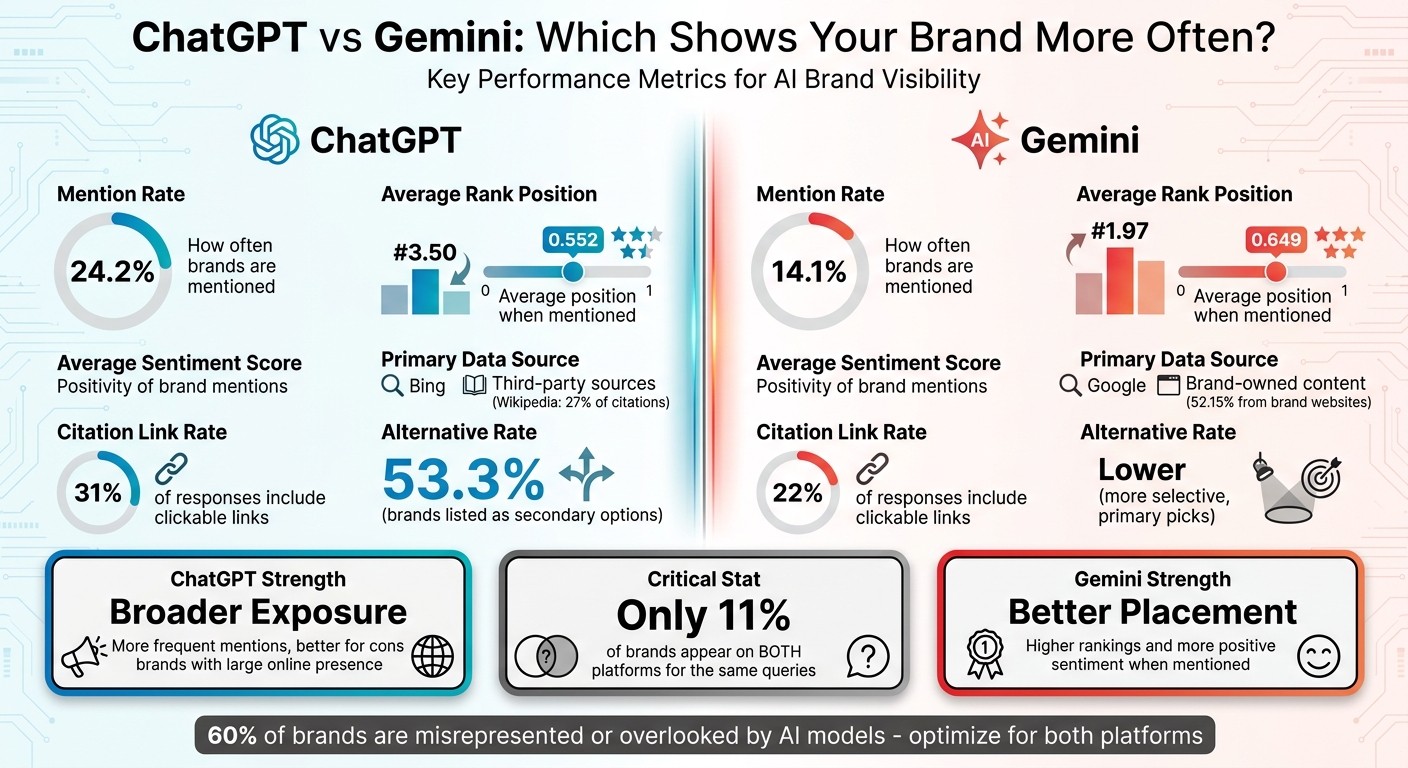
ChatGPT vs Gemini Brand Visibility Comparison: Key Metrics and Performance Data
How To Track (and Improve) Your Brand’s Visibility in LLMs
sbb-itb-da7512d
How ChatGPT Handles Brand Visibility
To optimize your brand’s presence in AI-driven search results, it’s important to understand how ChatGPT determines visibility. The system relies on both static training data and real-time Bing search data through Retrieval-Augmented Generation (RAG) [9][10]. Essentially, your brand’s visibility is shaped by its historical online footprint and its current performance on Bing.
ChatGPT uses pattern recognition to link brands with relevant keywords. For instance, if your brand frequently appears alongside terms like "CRM for startups" or "project management for remote teams", it’s more likely to surface in related queries [9]. However, ChatGPT leans heavily on credible, third-party sources rather than branded content. Notably, Wikipedia makes up 27% of its dataset citations [12], and pages featuring original research or proprietary data are cited more often (52.2%) than those with aggregated content (23.1%) [11].
Brand Mentions and Citation Frequency
ChatGPT includes brand mentions in about 24.2% of queries related to specific categories and typically highlights 3–4 brands per response [6][10]. The likelihood of a citation heavily depends on Bing rankings. For example, a concise 20-30 word factual summary – often called an "answer capsule" – appears in 72.4% of the pages ChatGPT cites [11]. Ensuring your brand name is consistently used and clearly identifiable helps ChatGPT associate your brand with relevant content.
Citation patterns are further refined through semantic analysis, which evaluates how well your brand aligns with user queries.
User Query Relevance and Brand Prioritization
ChatGPT doesn’t just rely on citation frequency; it also considers how closely brand mentions match the intent of a user’s query. For example, if someone asks, "What’s the best CRM for small businesses?" ChatGPT prioritizes brands that frequently appear in contexts matching those terms. Brands with a strong, consistent presence in third-party mentions stand out. Interestingly, traditional Google rankings don’t strongly influence ChatGPT’s visibility. There’s only a 0.034 correlation between Google rankings and ChatGPT citations, and 90% of pages cited by ChatGPT rank at position 21 or lower on Google [10][4].
"Visibility starts upstream of ranking. If your brand does not exist within the retrieval pathway activated by a specific query, it will not appear in the answer." [1]
- Paula Cionca, Cofounder & CMO at Genezio
Performance Data and Metrics
Brands mentioned by ChatGPT generally register an average sentiment score of 0.552, reflecting a neutral to moderately positive tone, and typically appear at position #3.50 in responses [6]. Bing rankings play a significant role in citation likelihood:
| Bing Ranking Position | ChatGPT Citation Rate |
|---|---|
| Position 1–3 | 62.8% |
| Position 4–10 | 24.6% |
| Position 11–20 | 8.9% |
| Not indexed on Bing | 0.6% |
Content freshness is another key factor. About 71% of ChatGPT citations refer to content published between 2023 and 2025 [10][13], and pages updated within the last 90 days are cited 2.3 times more often than older ones [11].
ChatGPT also uses the OAI-SearchBot crawler to access real-time web content. If your site blocks this bot in its robots.txt file, it won’t be included in real-time citations [11]. To improve visibility, make sure your site is indexed on Bing, accessible to OAI-SearchBot, and mentioned in reliable sources like industry publications, Reddit, or expert roundups.
These metrics provide a foundation for comparing ChatGPT’s methods to those of Gemini.
How Gemini Handles Brand Visibility
Gemini approaches brand visibility differently than ChatGPT. While ChatGPT leans heavily on third-party directories and consensus-based information, Gemini operates as a more selective platform. It mentions brands less frequently but gives them far better placement when it does [6]. This is largely due to its deep integration with Google’s search infrastructure, which allows it to pull data from the Google Search index and Knowledge Graph. As a result, Gemini prioritizes SEO principles and emphasizes E-E-A-T signals – Experience, Expertise, Authoritativeness, and Trustworthiness.
A key distinction lies in Gemini’s reliance on brand-owned content. Approximately 52.15% of Gemini’s citations come directly from brand websites [2][4], unlike ChatGPT, which favors third-party sources. Lauryn Chamberlain from Yext explains it succinctly:
"Gemini trusts what your brand says" [2].
This means that elements like your domain, structured data, and first-party content carry more weight than external mentions or directory listings. In contrast to ChatGPT’s broader citation methods, Gemini’s selective approach underscores the importance of tailored brand strategies.
Recent Trends in Gemini’s Visibility
Gemini’s market presence has grown significantly, jumping from 5.4% in January 2025 to 18.2% by January 2026 [4]. This growth highlights its increasing role in brand discovery and AI search visibility, particularly within the Google ecosystem.
The platform has shifted toward "selective curation", a practice where it avoids listing numerous brands for every query. Instead, it provides generic category descriptions unless it has high confidence in a specific recommendation. A study of over 12,500 prompts revealed that Gemini assigned 216 "primary picks" but only 155 "alternatives" [6]. This shows its preference for strong, singular recommendations over exhaustive lists. While getting mentioned by Gemini is more challenging, the rewards for brands that do make the cut are significant.
Citation Accuracy and Brand Relevance
Gemini determines brand relevance using a concept called "entity coherence", which evaluates how closely tied a brand is to a specific query. It places a strong emphasis on structured data and schema markup to verify facts, making technical SEO a critical factor for brands. Proper schema implementation and consistent domain information are essential for appearing in Gemini’s results.
Google Business Profiles (GBP) also play a role, especially for local and service-based searches. While Gemini might not directly cite GBP, it uses the data to verify and inform its responses. Notably, brands that block Google’s crawlers from accessing their content are excluded from Gemini’s citations. For instance, Amazon had zero citations in Gemini results in January 2026 after restricting crawler access to its product pages [14].
Performance Data and Metrics
Gemini’s brand mention rate is around 14.1% to 14.4%, which is lower than ChatGPT’s 24.2% and Perplexity‘s 25.4% [6]. However, when Gemini does mention a brand, the quality of that mention stands out. On average, brands appear at a rank position of #1.97, placing them in the top two spots, compared to ChatGPT’s average rank of #3.50 [6]. Additionally, Gemini boasts the highest average sentiment score at 0.649 (on a 0–1 scale), reflecting more positive framing than any other major AI platform [6].
Gemini’s citation patterns further highlight its priorities. For example, Reddit accounts for only 0.1% of its total citations, compared to 24% on Perplexity [14]. This reinforces Gemini’s preference for authoritative, brand-owned sources and its focus on unique, curated selections over widely shared sources.
ChatGPT vs Gemini: Side-by-Side Comparison
Key Metrics Comparison
Let’s break down the performance metrics of ChatGPT and Gemini to see how they stack up against each other. ChatGPT mentions brands more often, with a mention rate of 24.2%, compared to Gemini’s 14.1% [6]. However, Gemini tends to rank brands higher when it does mention them, with an average rank position of #1.97, while ChatGPT averages #3.50 [6].
When it comes to sentiment, Gemini edges out ChatGPT with an average sentiment score of 0.649 on a 0–1 scale, compared to ChatGPT’s 0.552 [6]. ChatGPT also has a higher "Alternative Trap" rate of 53.3%, meaning it frequently lists brands as secondary options [18].
| Metric | ChatGPT | Gemini |
|---|---|---|
| Mention Rate | 24.2% [6] | 14.1% [6] |
| Avg. Rank Position | #3.50 [6] | #1.97 [6] |
| Avg. Sentiment Score | 0.552 [6] | 0.649 [6] |
| Alternative Rate | 53.3% [18] | Lower [18] |
| Search Index | Bing [4] | Google [4] |
Another key difference is in source citations. ChatGPT includes clickable links in 31% of its responses, whereas Gemini does so in 22% of cases [17]. Gemini’s focus on official brand websites often results in higher factual accuracy for brand-specific details.
These metrics highlight how each platform has its own distinct approach, strengths, and limitations.
Strengths and Weaknesses
The data reveals clear differences in how ChatGPT and Gemini handle brand visibility. ChatGPT relies heavily on third-party directories and Wikipedia, which make up 7.8% of its citations [7]. This broad approach works well for consumer brands with a large online presence. Over a 60-day period, ChatGPT provided brands with more exposure opportunities than Gemini [18]. However, only 17% of queries returned the same brand recommendations across both platforms [17].
Gemini, on the other hand, operates as a more selective recommender. It often places brands in prominent positions with positive framing, thanks to its integration with Google’s ecosystem, including Maps, Shopping, and the Knowledge Graph. This makes Gemini particularly effective for local businesses and service-focused searches. Its emphasis on structured data and schema markup highlights the importance of technical foundations for AI search. That said, Gemini’s personalization bias can lead to results that favor a user’s own business or previously preferred brands based on search history [15].
Both platforms face challenges. ChatGPT’s reliance on static training data can delay updates and reduce real-time accuracy [16]. Meanwhile, Gemini’s strict selection criteria mean that 44% of brands analyzed in 2026 had no visibility across major AI engines [8]. Furthermore, only 11% of cited domains overlap across AI platforms for identical queries, showing that optimizing for one platform doesn’t guarantee results on another [4].
Understanding these nuances allows brands to refine their strategies and maximize their visibility on both platforms.
How to Improve Brand Visibility in ChatGPT and Gemini
Content Strategies for AI Optimization
The move from traditional SEO to AI-focused strategies demands a fresh approach to content creation. One of the most important steps is entity-first optimization. Both ChatGPT and Gemini favor brands, individuals, and products that are clearly defined. To achieve this "entity clarity", ensure your brand description is consistent across platforms like LinkedIn, Crunchbase, Wikipedia, and industry-specific directories [19][20].
Another key tactic is creating topical clusters using a hub-and-spoke model. This approach helps establish your authority in a specific niche [19]. A study conducted in 2026, which analyzed 240 websites, revealed that only 10% scored above 80 in Answer Engine Optimization readiness. The median score was just 46, compared to 85 for traditional SEO [3].
For content structure, aim for concise chunks of 300–800 tokens. Use a clear question-answer-evidence format: begin with a question (H2 or H3), follow with a direct 40–80 word answer, and then add supporting data [22]. Spotlight data indicates that 91% of AI-cited content includes bullet points, while 35% incorporates FAQs [21]. Additionally, implementing an llms.txt file in your root directory can help AI crawlers easily locate your most important content [3][19].
To further enhance visibility, get your brand featured in industry roundups, review sites like G2 and Capterra, and active online discussions on platforms like Reddit [3][20]. On the technical side, ensure your robots.txt file allows access to both GPTBot and Google-Extended, and use comprehensive schema markup to make your content AI-friendly [3].
"Traditional SEO was about ranking pages. AI Search is about becoming the answer." – Sophie Brannon, Co-founder & Director, StudioHawk [19]
By adopting these strategies, you can better position your brand for visibility in AI-driven search environments.
Using Spotlight to Improve Visibility
Pair these content strategies with effective performance tracking tools. Spotlight, for example, monitors your brand’s presence across eight AI platforms, including ChatGPT, Gemini, Claude, Grok, Perplexity, and Copilot [21]. Start with a free assessment to establish baseline metrics, such as mention rates and sentiment analysis. Spotlight has already analyzed over 2.4 million results and 19 million cited links to understand AI model behavior [21].
The platform offers two subscription plans:
- The Growth plan ($199/month) provides 100 prompts per report, weekly tracking on platforms like ChatGPT and Gemini, three competitor reports, and LLM source tracking to identify which pages AI models cite [21].
- The Pro plan ($499/month) increases coverage to 300 prompts per report, includes custom perception properties, and offers API access for deeper integration with your analytics tools [21].
Spotlight’s automated prompt analysis identifies the specific questions users ask AI assistants about your industry. This insight allows you to focus your optimization efforts on high-impact areas [21]. The platform also integrates with Google Analytics, linking AI visibility to website traffic and showing which AI models are driving visitors to your site. Research from Spotlight reveals that ChatGPT mentions brands in 73.6% of responses, compared to Gemini’s 48.5% [21].
Set up automated weekly or biweekly trackers to monitor changes in AI model behavior and competitor activity [21]. Spotlight’s citation tracking highlights which content structures are most effective, enabling you to replicate successful strategies across your site. With 80.6% of AI brand mentions being neutral, 18.4% positive, and only 1% negative, early monitoring through Spotlight can help address potential issues before they escalate [21].
Conclusion
ChatGPT provides broad visibility by frequently mentioning brands and securing mid-tier rankings, often relying on third-party directories. On the other hand, Gemini takes a more selective approach, mentioning brands less often (14.1% of the time) but positioning them higher in search results. Notably, Gemini emphasizes brand-owned content, with 52.15% of its citations derived directly from company websites [2][4].
These metrics highlight a clear trade-off: ChatGPT excels in exposure, while Gemini offers better positioning and sentiment. Interestingly, only 11% of cited domains appear on multiple AI platforms for the same queries [4]. This means focusing on just one platform won’t guarantee widespread visibility.
With 62% of consumers trusting AI to guide their brand decisions and Gartner predicting that half of all search sessions will involve AI by 2027 [5][3], the stakes are high. Yet, 44% of brands remain invisible to AI engines, and 70% struggle with minimal or no visibility [8].
"The brands that figure this out early will hold a significant structural advantage… The brands that wait will find themselves invisible in conversations they did not even know were happening."
– Kai Williams, Prompt Insider [4]
To stay competitive, start by tracking your visibility on both platforms using AI brand monitoring tools like Spotlight. This software helps identify high-impact prompts and monitor your market position. As ChatGPT’s market share dropped from 87.2% to 68% between January 2025 and January 2026, and Gemini surged from 5.4% to 18.2% [4], it’s clear the AI search space is becoming more fragmented. ChatGPT delivers reach, while Gemini emphasizes precision. Navigating this duality requires a multi-platform strategy, ensuring your brand stays relevant in today’s evolving AI-driven search environment. This includes leveraging tools for writing content optimized for AI search to maintain a competitive edge.
FAQs
Why does my brand show up in ChatGPT but not in Gemini (or vice versa)?
Each platform has its own way of handling citations, ranking sources, and assessing trustworthiness when it comes to brand mentions. For example, ChatGPT might lean toward sources like Wikipedia or major news outlets, whereas Gemini could prioritize entirely different sources based on its specific algorithms. Because of these variations, a brand that shows up prominently on one platform might remain unseen on another. This makes it crucial to adapt strategies for each platform to ensure maximum visibility.
What should I do first to get my brand cited more often by AI answers?
If you want AI tools to reference your brand more frequently, you need to position yourself as a trusted authority in your niche. Here’s how you can do it:
- Create AI-Friendly Content: Structure your content to answer clear, specific questions. Use direct, concise language and formats like FAQ schema to make it easier for AI to extract information.
- Earn Third-Party Validation: Build credibility by getting your brand mentioned in reputable media outlets, industry directories, or well-known publications. These external endorsements help establish trust.
- Target Long-Tail Questions: Focus on answering niche, detailed questions that users are likely to search for. This increases the chances of your content being cited in AI-generated responses.
By combining these strategies, you can boost your brand’s visibility in AI-driven answers and solidify your online authority.
How can I measure my brand’s mention rate, rank, and sentiment in AI results?
To understand how often your brand is mentioned, its ranking, and the sentiment surrounding it in AI-generated results, leverage AI brand monitoring tools. These tools can track how frequently your brand appears in AI responses, where it ranks, and whether the mentions are positive, negative, or neutral.
It’s also helpful to test various prompts to establish a baseline for your brand’s visibility and detect any shifts over time. Automated analysis can provide insights into trends in visibility and sentiment, giving you the data needed to fine-tune your strategy and enhance how your brand is represented.
Related Blog Posts

Michael Hermon
Before Spotlight, Michael led Innovation and AI at monday.com after exiting his previous startup. He learned to code at 13 at MIT and later attended Columbia’s MBA program.
https://linkedin.com/in/michaelhermon