
7 Ways AI Chatbots Are Changing Brand Visibility
AI chatbots like ChatGPT and Perplexity are reshaping how brands are discovered and engaged with. Here’s what you need to know:
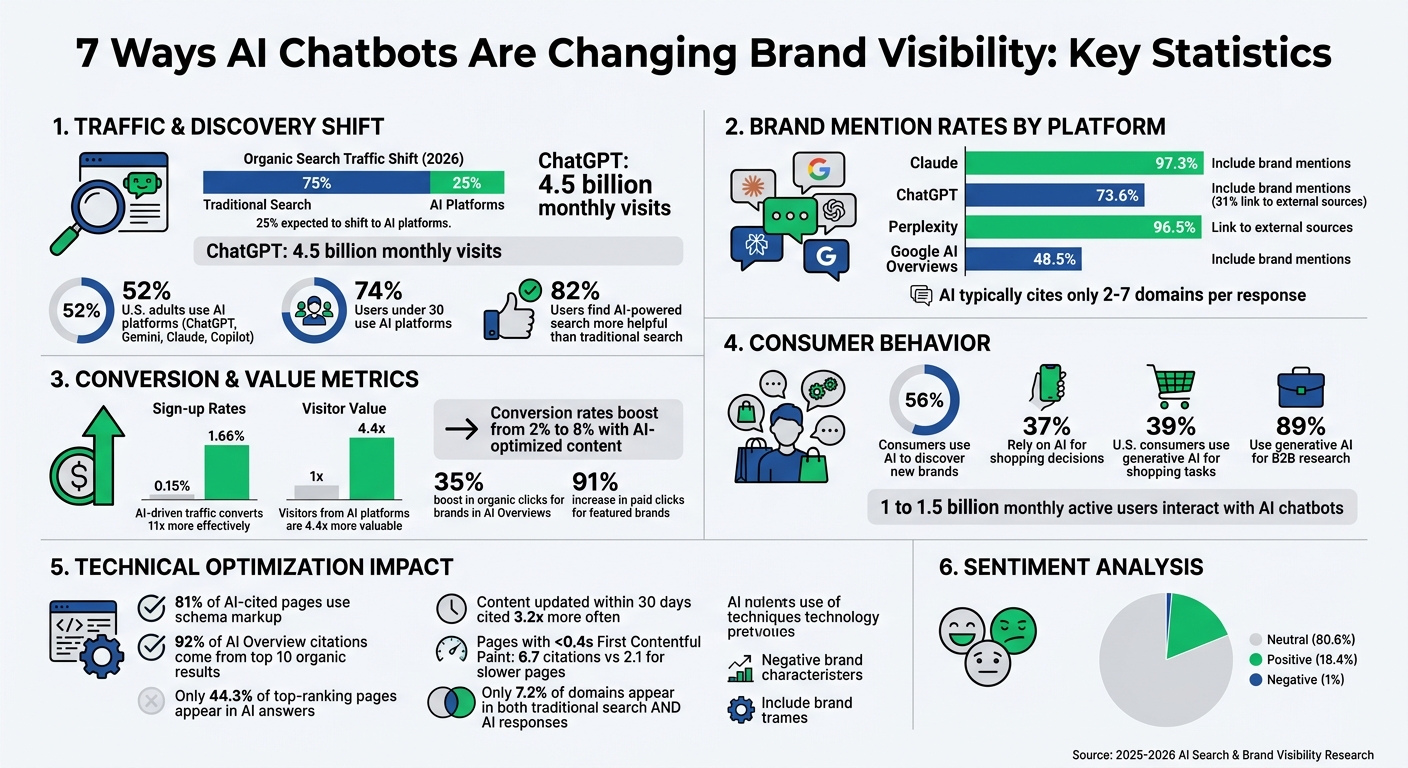
- AI is taking over search: By 2026, 25% of organic search traffic is expected to shift to AI platforms. Tools like ChatGPT, with 4.5 billion monthly visits, are becoming key discovery channels.
- Visibility is all-or-nothing: AI systems often feature only a few brands per response, making mentions critical. For instance, Claude cites brands in 97.3% of responses, while ChatGPT does so in about 31%.
- SEO is evolving: Traditional tactics are no longer enough. Brands need to focus on structured data, schema markup, and creating content that AI platforms can easily recommend.
- Personalization matters: AI chatbots are improving customer interactions by using sentiment analysis, intent extraction, and CRM integration to deliver tailored responses.
- Real-time support builds trust: Instant answers during key moments can influence purchase decisions and improve customer satisfaction.
- AI-driven traffic converts better: Visitors from AI platforms are 4.4 times more valuable and convert 11 times more effectively than traditional search traffic.
- Content optimization is crucial: AI prioritizes clear, well-structured, and regularly updated content. Schema markup and tools like IndexNow help ensure your content gets noticed.
The rise of AI chatbots demands a new approach to brand visibility. Monitoring mentions, optimizing content, and leveraging AI-driven insights are now essential for staying competitive.
AI Chatbot Impact on Brand Visibility: Key Statistics and Conversion Metrics
1. Spotlight: Monitor and Improve Your Brand’s AI Visibility
Impact on Brand Visibility
AI-driven visibility is a whole different game compared to traditional search rankings. When a user interacts with tools like ChatGPT or Perplexity, your brand either makes it into that single, synthesized answer – or it doesn’t show up at all. There’s no "second page" safety net. Unlike the familiar 10 blue links of search engines, large language models typically cite only 2–7 domains per response [1]. This makes it critical to keep tabs on how your brand appears across these platforms.
Some interesting stats highlight the differences in how various AI tools mention brands. For instance, Claude includes brand mentions in a whopping 97.3% of its responses, while AI Overviews do so in just 48.5%. Perplexity and ChatGPT are also worth noting – Perplexity links to external sources in 96.5% of its responses, while ChatGPT does so in about 31% [9]. Understanding these nuances is key to gauging your brand’s standing in the AI-generated content space.
These insights provide the foundation for using advanced tools to sharpen your brand’s AI visibility strategy.
Integration with Search Engines and Analytics Tools
Spotlight takes monitoring a step further by seamlessly integrating with search engine and analytics tools to fine-tune your brand’s online presence. It tracks essential metrics like AI share of voice, citation frequency, and entity accuracy [1]. To assess your brand’s visibility, Spotlight runs prompt audits with queries such as “What are the best CRM tools for small teams?” or “Compare Brand X vs. Brand Y.”
A deep dive into 1.8 million AI responses reveals some telling trends: 80.6% of brand mentions are neutral, 18.4% are positive, and just 1% are negative [9]. By connecting with Google Analytics, Spotlight also helps measure the real-world impact of these mentions, linking them to website traffic and conversions [9].
Technical optimization plays a big role here too. Did you know that 81% of AI-cited pages use schema markup? Spotlight identifies gaps in your structured data, focusing on elements like Organization, Product, or FAQ schema. Addressing these gaps can enhance how AI tools interpret and display your content. Additionally, the platform monitors how quickly your content gets indexed, which is critical for real-time AI systems like Perplexity and Copilot that rely on up-to-date web data through retrieval-augmented generation. Using tools like IndexNow can speed up this process, pushing updates to Bing-powered AI systems within hours instead of days [4][5].
sbb-itb-da7512d
2. Personalized Customer Interactions at Scale
Impact on Brand Visibility
AI chatbots equipped with a consistent and recognizable tone essentially act as digital brand ambassadors. This matters because 86% of customers say brand consistency influences their decision to buy and remain loyal, and companies that achieve this consistency can see revenue increases of up to 23% [12]. Every interaction with these chatbots reinforces trust and strengthens the brand’s image.
The visibility gains are impossible to ignore. For instance, 56% of consumers have used AI to discover new brands, while 37% rely on AI for shopping decisions [14]. With an estimated 1 to 1.5 billion monthly active users interacting with AI chatbots [14], these tools aren’t just about customer service – they’re also key to making your brand discoverable and memorable in a crowded marketplace. These personalized experiences set the stage for more advanced strategies.
AI-Driven Personalization Capabilities
Today’s AI chatbots go well beyond pre-written responses. Using sentiment analysis, they can adjust their tone based on a user’s mood or escalate conversations to human agents when necessary [13]. Features like intent and entity extraction help chatbots understand what users are asking for and capture specific details, such as dates, locations, or product IDs, to deliver precise and tailored responses [13].
Machine learning takes this personalization even further by clustering user data to identify audience segments – whether it’s loyal repeat customers or deal-seekers. When paired with CRM systems, chatbots gain a 360-degree view of each customer, enabling them to recognize returning visitors, reference past purchases, and even greet users by name with messages like, “Welcome back, Sarah!” [12]. This eliminates the frustration of having to repeat information, creating a seamless and enjoyable experience.
"In the near future, customers won’t just remember what you sold them, they’ll remember how your AI made them feel." – VINASAI INC [12]
Real-Time Engagement and Support Effectiveness
AI chatbots with emotional intelligence are reshaping how brands connect with their customers. Acting as “intelligent, unbiased advisors,” these chatbots provide personalized recommendations that feel like trusted endorsements rather than algorithm-driven suggestions. This builds credibility and positions your brand as a leader in its space [3].
The benefits are clear. AI chat solutions can cut customer service costs by up to 30% while boosting satisfaction scores [12]. To maximize these results, ensure your chatbot integrates with CRM systems in real time and uses tone libraries aligned with your marketing materials [12]. Proactive features, like triggers that engage users based on specific actions – such as abandoned carts or long visits to pricing pages – can also boost visibility during critical decision points [13]. These strategies ensure your brand stays top of mind when it matters most.
3. Instant Customer Support That Builds Trust
Impact on Brand Visibility
Instant support doesn’t just resolve issues – it actively boosts trust and strengthens brand visibility. AI chatbots play a key role here, turning customer interactions into meaningful recommendations that influence how people perceive a brand. In fact, getting mentioned in an AI-generated response can feel as impactful as receiving advice from a trusted colleague[5]. This is especially relevant since 82% of users find AI-powered search more helpful than traditional search engines[8]. Unlike traditional search results that offer a long list of links, AI responses usually highlight just three brands. This makes every mention incredibly valuable for getting noticed[15].
Even better, traffic from AI platforms tends to perform at a much higher level. For example, AI-driven traffic converts 11 times more effectively, with sign-up rates of 1.66% compared to 0.15%. Visitors from these platforms are also 4.4 times more valuable[11][10].
Real-Time Engagement and Support Effectiveness
AI chatbots shine during those critical moments when a customer is deciding whether to buy. By providing immediate, personalized answers, they address common concerns about things like warranties, product durability, or overall reliability[7]. This kind of real-time engagement builds trust, making customers feel as though they’re getting advice from a knowledgeable expert.
"AI chatbots effectively alleviate uncertainties and build confidence in the consumer’s choice. Immediate support and reassurance at any critical moment can significantly influence a consumer’s readiness to proceed with a purchase, enhancing conversion rates and customer satisfaction." – Made by XDS[7]
The numbers back this up: 89% of consumers now turn to generative AI for B2B research, solidifying these platforms as a go-to source for self-guided information[11]. However, only 8% of users who encounter Google AI Overviews consistently click on the source text[10]. This makes it crucial to deliver accurate, high-quality responses that meet user needs right away. Real-time support also integrates seamlessly with analytics tools, helping businesses measure its impact effectively.
Integration with Search Engines and Analytics Tools
Today’s AI visibility platforms work hand-in-hand with tools like Google Analytics, linking mentions in AI chatbot responses to actual website traffic[9]. These integrations provide valuable insights, showing which AI models – whether it’s ChatGPT, Claude, or Perplexity – are driving traffic to specific pages. Automated tracking features such as "Mention Rate", "Sentiment Distribution", and "Mention Rank" help quantify how well your brand is performing in these interactions[9]. For instance, Claude mentions brands in 97.3% of its responses, ChatGPT in 73.6%, and Google’s AIO in 48.5%[9].
To make the most of these opportunities, implement the IndexNow protocol for faster indexing. Adding FAQPage and Product schema markup can also improve how AI models interpret and display your support content. Notably, 91% of content cited by AI models uses bullet points, and 35% includes FAQs[9].
"Using tools that link AI mentions to Google Analytics data helps measure real business impact. For example, Spotlight shows which AI model drove traffic to which page." – Michael Hermon, Founder, Spotlight[9]
4. Better Search Engine Performance Through AI Integration
Impact on Brand Visibility
AI chatbots are changing how search discovery works. While traditional search rankings still matter, they aren’t the whole story. For example, 92% of citations in Google’s AI Overviews come from websites already ranking in the top 10 organic results [17]. That said, only 44.3% of these top-ranking pages actually appear in AI-generated answers [16]. So, ranking high in traditional search is important, but it’s no longer enough.
The rewards for brands that get cited in AI Overviews are huge. Brands featured in these overviews can experience a 35% boost in organic clicks and a 91% increase in paid clicks [17]. Even more impressive, visitors coming from AI platforms convert at rates 4 to 5 times higher than those from traditional organic search traffic [17]. Hostinger, a web hosting company, demonstrated this in March 2026 by earning mentions in over 51,000 AI-generated answers and citations on 40,100 pages across various AI platforms [16]. These examples highlight how using real-time indexing and structured data can drive even higher AI citation rates.
Integration with Search Engines and Analytics Tools
AI chatbots use Retrieval-Augmented Generation (RAG) to pull real-time information from search engines like Google and Bing, adding fresh data to their responses [3][17]. For your content to be part of this process, it needs to be properly indexed and structured so that AI can easily extract it.
The IndexNow protocol is a key tool here, as it instantly alerts search engines and AI models when your content is updated [5][4]. This is important because content updated within 30 days is cited 3.2 times more often by AI platforms [19].
Structured data is equally important. Adding schema markup (like Organization, FAQPage, and Product schemas) can increase your brand’s discoverability by 67% [19]. Plus, site speed matters too. Pages with a First Contentful Paint under 0.4 seconds earn an average of 6.7 AI citations, compared to just 2.1 for slower pages [19].
"AI search visitors convert at 4-5x the rate of normal organic – this is a revenue channel, not a vanity metric." – JP Garbaccio, Head of SEO & AEO, Searchable [17]
AI-Driven Personalization Capabilities
AI is also shifting its focus to signals that establish your brand’s authority. Unlike traditional search engines, AI models prioritize entity-based authority and structured, easily extractable content [17][19]. In fact, brand search volume has a 0.334 correlation with AI citations, making it a stronger predictor than backlinks [19][20].
As conversational search grows, AI platforms are becoming more like trusted advisors than simple search tools. When ChatGPT recommends your brand, users treat it as a credible endorsement rather than just another link [3]. This shift is particularly relevant as Google’s global search market share has dipped below 90% for the first time since 2015, with more users turning to AI-driven platforms [18]. AI Overviews now appear in about 48% of all search queries, up from 34.5% in late 2025 [18].
To stay ahead, structure your content with clear headings (H1–H3) and use "answer-first" formatting – placing direct answers at the top of sections to make it easier for AI to extract and cite your information [16][17]. Community platforms also play a big role. For instance, Wikipedia leads as the top source in ChatGPT responses at 47.9%, followed by Reddit at 11.3% [17]. Building a presence on these platforms strengthens the entity authority that AI models value. By combining smarter indexing strategies with optimized content, brands can thrive in the evolving world of AI-driven search.
5. Control Brand Perception Through Conversation Data
Impact on Brand Visibility
Controlling how your brand is perceived hinges on understanding and leveraging conversation data. Every interaction with a chatbot leaves behind valuable insights into how customers view your brand. These exchanges help shape your reputation – whether you’re seen as a market leader, a budget-friendly option, or a niche player – based on patterns AI systems like ChatGPT or Perplexity have learned from diverse sources [3][2].
This data is incredibly powerful. Consider this: 82% of consumers now prefer using chatbots over waiting for a human representative [21]. Meanwhile, 92% of companies have already integrated AI-powered tools [22]. With such widespread adoption, analyzing conversation data isn’t just helpful – it’s a must. Beyond gauging customer sentiment, this data enables precise personalization, as explained below.
AI-Driven Personalization Capabilities
Conversation data uncovers customer intent in ways traditional analytics can’t. Nathan Etter, Senior Vice President at Adobe, highlights this benefit:
"Crucially, these conversational experiences also give us deeper insight into customer intent. By understanding what matters most to customers in the moment, we can continuously refine Adobe.com and deliver more relevant, personalized engagement" [24].
This level of insight allows brands to fine-tune their messaging and focus on features that resonate most with their audience. For instance, research shows that chatbots incorporating human-like cues can make interactions feel more personal, which, in turn, increases customers’ willingness to pay premium prices [23]. These insights provide the foundation for real-time adjustments in customer support, which reinforces a positive brand image.
Real-Time Engagement and Support Effectiveness
The way your chatbot handles interactions plays a direct role in how AI platforms portray your brand. Poor experiences, reported by 68% of customers when bots fail to meet their needs, can create negative patterns that impact how AI systems evaluate your brand [22]. To combat this, it’s crucial to implement structured feedback loops, including expert reviews, to maintain accuracy and ensure your brand messaging stays consistent [24].
Regularly testing your chatbot prompts across platforms like ChatGPT, Claude, and Perplexity can help identify and correct any gaps in how your brand is positioned [3][4]. With 80% of consumers now relying on AI-generated summaries for at least 40% of their online searches [24], taking control of this narrative has never been more critical.
6. Track Brand Mentions Across AI Platforms
Impact on Brand Visibility
Tracking how your brand appears across AI platforms is no longer optional – it’s essential. Unlike traditional search results, where you might still get some visibility on page two or three, AI-driven visibility is all-or-nothing: you’re either part of the conversation, or you’re completely absent [2]. When users turn to tools like ChatGPT, Perplexity, or Claude for recommendations, these platforms generate responses based on their training data and real-time sources. If your brand isn’t part of the mix, you’ve lost that customer before they even knew you existed.
Here’s the reality: only 7.2% of domains show up in both traditional search results and AI-generated responses [8]. That leaves most brands visible in just one channel, or worse, in neither. Even more striking, 82% of users now prefer AI-powered search over traditional engines [8]. This shift is happening fast. For example, Claude mentions brands in 97.3% of its responses, ChatGPT in 73.6%, and Google’s AI Overviews in only 48.5% [9]. This stark difference highlights the need for brands to monitor their presence and adapt quickly.
Integration with Search Engines and Analytics Tools
To stay visible in this new landscape, you need a systematic approach to tracking your brand mentions. Each AI platform uses different data sources, so monitoring across multiple platforms is key. Start by creating a library of 15–20 queries that reflect a variety of user intents [25]. Specialized tools can automate this process, running daily or even hourly queries on major AI platforms. These tools track two critical elements: "mentions" (your brand name appearing in the text) and "citations" (clickable links to your site) [6]. By analyzing this data, you can calculate your "Share of AI Voice", comparing how often your brand is mentioned versus your competitors across different platforms and queries [25][8].
Take it a step further by integrating these AI insights with your analytics tools to see how mentions directly impact website traffic [9]. The data shows that brands with the most mentions online are up to 10 times more likely to appear in AI-generated results compared to their competitors [8]. Regular monitoring also helps you spot gaps where competitors are mentioned but your brand isn’t, giving you clear opportunities to create content that boosts your visibility [25]. These strategies are essential for refining your AI search optimization efforts and staying ahead of the competition.
7. Create Content That AI Chatbots Recommend
Impact on Brand Visibility
Getting your content recommended by AI chatbots can make a huge difference in how your brand is perceived. When tools like ChatGPT suggest your brand in their responses, it feels like an endorsement to users, not just a random mention. For example, 82% of clients in a 2025 study reported referral traffic from AI-powered search engines [26]. With 39% of U.S. consumers already using generative AI for shopping tasks [27] and 89% relying on it for B2B research [11], it’s clear how important this is for staying relevant.
Unlike traditional search engines, AI models don’t just focus on keywords – they look for well-structured, meaningful content. This difference can directly impact your bottom line. Content optimized for AI recommendations has been shown to boost conversion rates from 2% to 8% because AI-referred traffic often comes with higher purchase intent [28]. However, only 62% of websites ranking on Google’s first page make it into ChatGPT answers [28]. This means relying on standard SEO techniques isn’t enough anymore. To stand out, you need to create content that AI systems can easily understand, summarize, and recommend with confidence.
Integration with Search Engines and Analytics Tools
To take advantage of this opportunity, your content needs to be structured in a way that AI can easily process. Break your content into 120–180 word segments using clear headers, bullet points, and comparison tables. These shorter, organized sections are 50% more likely to be selected by AI models [28]. Additionally, applying Schema markup – like Organization, Product, and FAQ schemas – helps AI tools interpret your content more effectively [5].
Keeping your content fresh is also critical. AI models tend to favor newer citations, with AI-generated results being 25.7% fresher on average than traditional Google results [28]. Pages updated within the last three months receive about 6 citations compared to 3.6 for older pages, a significant 70% improvement [28]. Using tools like the IndexNow protocol can speed up the process by notifying search engines as soon as you update your content, ensuring AI models with real-time access can find it quickly [5].
To track your progress, use Google Analytics 4 to filter the "Page Referrer" for domains like "chatgpt.com" or "perplexity.ai." This will show you which of your pages are being recommended by AI [26]. You can also spot opportunities by identifying prompts that mention competitors but leave out your brand, giving you a chance to fill those gaps [5]. These strategies highlight the importance of adapting your content to thrive in an AI-driven search environment.
AI Visibility Secrets: How to Get Your Brand Recommended by ChatGPT, Gemini & AI Models | Nik Ranger
Conclusion
The way people discover brands has shifted dramatically. Instead of relying on traditional search methods, 52% of U.S. adults now turn to AI platforms like ChatGPT, Gemini, Claude, or Copilot for information [29]. Among users under 30, this number jumps to 74% [29]. This shift means your brand either shows up in AI-generated answers or risks being overlooked. As Jeff Mikos from McFadyen Digital explains:
"It’s no longer enough to rank well. You must be cited, mentioned, and recommended by AI systems" [1].
The strategies outlined earlier – like using tools such as Spotlight to monitor AI visibility and creating content that AI platforms prioritize – are crucial for staying relevant. With AI-driven summaries appearing in over 50% of Google search results [29] and AI-referred sessions increasing significantly [1], it’s clear that AI discovery is already reshaping how users find brands.
Taking action now is critical. AI systems learn from established patterns, so building authority early gives your brand a head start that’s difficult for competitors to catch up with [1][5]. Start by assessing your current AI visibility, optimizing your content for AI extraction, and securing mentions on trusted platforms like G2, Capterra, or industry-specific outlets. These steps will help position your brand to thrive in this rapidly changing landscape.
FAQs
How can I tell if AI chatbots are recommending my brand?
Tracking whether AI chatbots are recommending your brand can be done by keeping an eye on how often your brand is mentioned in their responses. To do this, you can use monitoring tools designed to track mentions across various platforms. These tools allow you to audit your brand’s presence in AI-generated answers, giving you a clear picture of where and how frequently your brand is appearing in chatbot interactions. This insight ensures you’re making the most of AI to enhance your brand’s visibility.
What schema markup matters most for AI visibility?
Schema markup plays a key role in showcasing authoritative signals. By using structured data for elements like organizations, reviews, and product details, you make your content more accessible and trustworthy for AI systems. AI chatbots depend on well-organized, reliable data to correctly recognize and recommend brands. Prioritize schema that boosts your credibility and clearly communicates accurate information about your business.
How do I track AI-driven traffic in GA4?
In Google Analytics 4 (GA4), AI-driven traffic often gets categorized as "Direct" or "Unassigned." This happens because many browsers don’t properly handle referrer headers when traffic originates from AI platforms.
To fix this and improve how traffic is attributed, you can take two simple but effective steps:
- Use UTM parameters: Add UTM tags to the links you share via AI platforms. These tags help GA4 track and label traffic sources more accurately.
- Configure GA4 for AI traffic: Adjust your GA4 settings to recognize patterns specific to AI-generated traffic. This ensures that visits from AI platforms are correctly identified.
By implementing these practices, you’ll gain a clearer picture of how AI platforms contribute to your website traffic.

Michael Hermon
Before Spotlight, Michael led Innovation and AI at monday.com after exiting his previous startup. He learned to code at 13 at MIT and later attended Columbia’s MBA program.
https://linkedin.com/in/michaelhermon