
Share of Voice SEO: How to Measure and Win Your Market

You're probably seeing this already in your reporting. A few target keywords moved up. Traffic looks stable enough. Yet when sales asks whether the brand is becoming more visible in the market, the ranking report doesn't give a satisfying answer.
That gap gets wider when search no longer means ten blue links. Buyers now discover brands through standard organic listings, paid placements, AI Overviews, and chatbot answers that summarize options before a click ever happens. A rank tracker can tell you where one URL sits for one query. It can't tell you whether your brand is owning the category.
That's where Share of Voice SEO becomes useful. It turns scattered visibility data into a competitive KPI you can compare, benchmark, and act on across the full discovery journey.
Table of Contents
- Why Your SEO Rankings Don't Tell the Whole Story
- What Is SEO Share of Voice Really Measuring
- How to Calculate Share of Voice in SEO
- Tools and Data Sources for SOV Measurement
- Benchmarking SOV Across Organic Paid and AI Search
- An Action Plan to Increase Your SEO Share of Voice
- Frequently Asked Questions About Share of Voice
Why Your SEO Rankings Don't Tell the Whole Story
A ranking report can make a weak search program look healthy. If you rank well for a handful of terms, the dashboard looks green. But if competitors own the rest of the category, dominate the SERP features, and get cited in AI summaries, your business does not control much attention.
That's the central problem with position-first reporting. It treats each keyword as an isolated win or loss. Buyers don't search that way. They move across comparison terms, product-led queries, alternatives searches, reviews, local intent, and follow-up questions. Your team needs a metric that reflects that broader reality.
Search has also fragmented. A user can see an ad, an AI Overview, a featured snippet, product listings, and an organic result before deciding what to trust. If your brand ranks fifth but is absent from the rest of that page experience, the practical visibility is weaker than the ranking suggests. That's one reason many teams are rethinking old SEO reporting models, especially in light of the great decoupling in modern search behavior.
Rankings tell you where a page appears. Share of voice tells you how much of the market your brand actually owns.
The distinction matters most in competitive categories. One brand may lead on a few head terms while another captures the majority of discovery across comparison queries and answer-style searches. The second brand often has the stronger strategic position even if the first team celebrates more top rankings in a limited list.
Share of voice SEO fixes this by moving the conversation from isolated rankings to market visibility. It gives leadership a single lens for answering a harder question: are we becoming more present where demand is created and captured?
What Is SEO Share of Voice Really Measuring
SEO share of voice measures how much of the searchable demand in a category your brand captures compared with the competitors you track. The percentage matters, but the real value is what sits underneath it: coverage across the queries, SERP features, and discovery surfaces that shape buying decisions.
In a traditional SEO model, teams usually express SOV as visibility share or estimated traffic share. The stronger models weight rankings by search volume and expected click-through rate because a brand showing in position one for a high-intent query carries more market presence than a low-ranking result on a marginal term, as explained in Brandwatch's guide to share of voice.
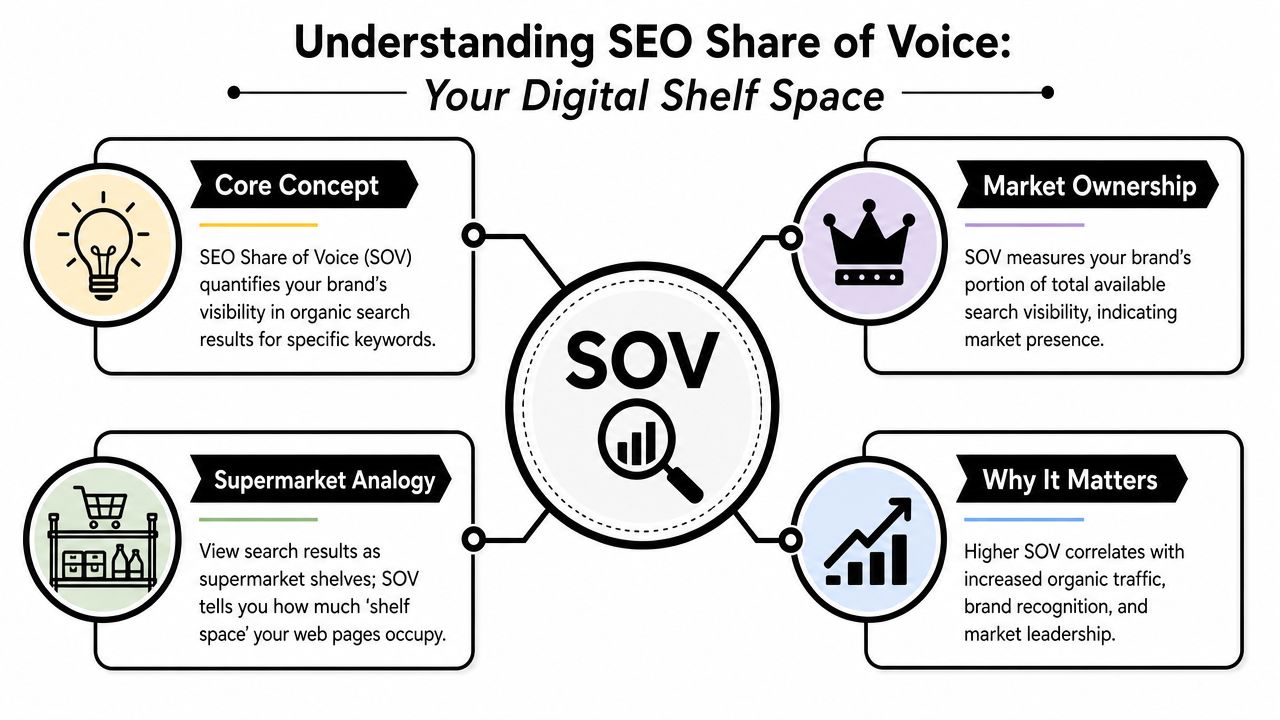
In 2026, that definition needs to be wider.
A useful SOV model now tracks whether your brand appears across the full search experience: standard organic listings, paid placements, AI Overviews, local packs, product results, featured snippets, and the answer layers that feed conversational search tools. A brand can hold steady organic rankings and still lose practical share of voice if competitors own the paid inventory, the AI summary, and the follow-up questions users see before they ever click.
That is why SOV is not just a rank aggregation metric. It is a market visibility metric. It answers a harder question than “where do we rank?” It answers “how often are we present when demand is being captured, influenced, or redirected?”
The same logic applies in local and regional programs. This guide on calculating local market share is useful because it starts with the right discipline: define the market boundary first, then measure your portion of attention inside that boundary.
Why executives care about this KPI
Leadership teams use SOV because it connects SEO reporting to competitive position and growth potential. A ranking improvement only matters if it changes visibility across the terms and surfaces that bring in qualified demand.
There is also a broader marketing principle behind it. Brands that consistently hold more voice in a category tend to build stronger market position over time. In search, that relationship is never perfectly linear because click behavior varies by SERP layout, brand recognition, and intent. Still, the directional signal is strong enough to make SOV one of the few SEO metrics an executive team can use in planning discussions.
Practical rule: If you can't explain your keyword set, your share of voice number won't survive executive scrutiny.
That is why clean market definition matters so much. A useful SOV model starts with a specific segment, a realistic competitor set, and a clear purpose. If the tracked query set is padded with low-intent informational noise, the metric gets inflated and the decisions that follow get worse.
The teams that use SOV well do one thing differently. They treat it as a measure of category presence across discovery channels, not a prettier rankings report.
How to Calculate Share of Voice in SEO
A rank tracker can show five keywords in positions 1 through 3 and still hide a market-share problem. If those rankings sit on low-volume terms while competitors control the high-intent queries, your report looks healthy and your pipeline does not. That is why SOV needs to be calculated as weighted visibility, not as a simple count of rankings.

Start with the simple version
The base formula is still useful:
Share of voice = (Your brand visibility ÷ Total market visibility) × 100
For an early model, visibility can mean keyword presence. You count how often your domain appears across a defined query set, then divide that by the total appearances from all tracked competitors. It is fast, easy to audit, and good enough to spot obvious gaps.
It also breaks quickly.
A presence-based model treats a marginal ranking and a dominant ranking too similarly. It ignores search demand, click concentration, SERP features, and channel differences. In 2026, that gap matters even more because the same query may produce ten blue links, ads, AI Overviews, shopping units, and chatbot answers that influence the buyer before a click happens.
Use a weighted model for decisions
A stronger calculation weights each keyword by opportunity. In practice, that usually means search volume multiplied by expected click-through rate for the position you hold.
Portent explains this approach as traffic share of voice. The logic is straightforward. A ranking only deserves more credit if it is likely to generate more visibility or traffic.
Use these formulas in a spreadsheet or BI model:
- Estimated traffic per keyword = Monthly search volume × CTR for ranking position
- Brand visibility = Sum of estimated traffic across all tracked keywords
- Market visibility = Sum of estimated traffic for your brand plus all competitors
- SEO SOV = Brand visibility ÷ Market visibility × 100
That gives you a traditional organic SOV score. For a modern reporting model, keep the same logic and calculate separate SOV views for paid search, AI Overview presence, and conversational AI citations, then compare them side by side. Teams building that layer usually start with AI search monitoring tools for tracking brand visibility in 2026 because rank tracking alone will not capture those surfaces.
If two brands both appear for a keyword, the brand in the position that wins clicks owns more voice.
A practical workflow
The calculation is simple. The setup determines whether the number is useful.
| Step | What to do | What to avoid |
|---|---|---|
| Build the keyword set | Group terms by product line, use case, funnel stage, or geography | Combining every informational and commercial query into one score |
| Select the competitor set | Track domains that repeatedly appear in the same results, including publishers or aggregators if they take visibility | Limiting the list to named business competitors |
| Capture search context | Pull rank, search volume, SERP features, device, and location | Using a single generic ranking export for every market |
| Apply weighting | Use CTR curves and adjust for branded vs. non-branded terms when needed | Treating all rankings as equal or using one CTR assumption for every SERP type |
| Split by channel | Report organic, paid, and AI visibility separately before combining them into an executive view | Forcing everything into one blended number with no explanation |
| Track the same model over time | Keep the query set and methodology stable for trend analysis | Changing the universe every month and calling it growth |
A small keyword set can be managed in a spreadsheet. Once you need segmentation by country, device, intent, or AI surface, use a system that exports clean data and keeps your methodology consistent.
I usually tell teams to build two versions. One is a strict organic SOV model for SEO operations. The second is a broader discovery SOV model that includes paid and AI visibility. The first helps diagnose ranking and content issues. The second is what leadership wants, which is a view of how much category attention the brand owns across the places buyers now discover options.
Tools and Data Sources for SOV Measurement
Good SOV reporting depends less on the formula than on the inputs. If your ranking data is inconsistent, your competitor set is incomplete, or your keyword segmentation is messy, the output won't help your team make decisions.
Traditional SEO platforms
For classic organic SOV, the core tools are still SEO suites like Ahrefs and Semrush. They're useful for tracking rankings, estimating visibility across keyword groups, and comparing domains in overlapping search spaces.
What they do well:
- Keyword tracking: Monitor your domain and competitors across a defined keyword set.
- Competitive overlap: Surface which domains repeatedly appear in the same SERPs.
- Segmentation: Break performance out by location, device, or tag-based keyword groups.
What they don't do well is measure AI-native discovery. They weren't built to tell you whether your brand appears in chatbot recommendations, cited source lists, or generated answer summaries.
AI visibility platforms
That gap matters now because buyers are often forming a shortlist before they ever click through to your site. If your brand gets omitted from AI responses, your standard rank tracker may never show the full loss.

Platforms built for AI visibility solve a different measurement problem. They track prompt-level brand presence, citation sources, recurring competitor mentions, and how often a brand appears across systems like ChatGPT, Gemini, Perplexity, and AI Overviews. If you're evaluating vendors in that category, this review of AI search monitoring tools for tracking brand visibility in 2026 is a practical starting point.
One option in that category is Spotlight, which monitors brand mentions across major AI platforms, surfaces prompt patterns, and shows citation sources tied to visibility. That makes it different from a standard SEO suite, which is mostly focused on pages, keywords, and rankings.
What a modern stack looks like
A useful measurement stack in practice usually looks like this:
- SEO suite for organic SOV: Use Ahrefs or Semrush for keyword rankings, competitor overlap, and segmented visibility reporting.
- Google Ads for paid visibility: Pull impression-based competitive data for commercial query groups.
- AI monitoring platform for AI SOV: Track brand inclusion, prompt-level coverage, and source citations across conversational systems.
- Analytics platform for validation: Use GA4 or your attribution stack to connect visibility changes with assisted conversions and downstream traffic patterns.
The point isn't to force everything into one metric. It's to give your team one operating model for measuring visibility across surfaces that buyers use.
Benchmarking SOV Across Organic Paid and AI Search
Share of voice stops being useful when teams compare unlike things as if they're the same. Organic SOV, paid visibility, and AI mention share all describe competitive presence, but they behave differently and should be interpreted differently.
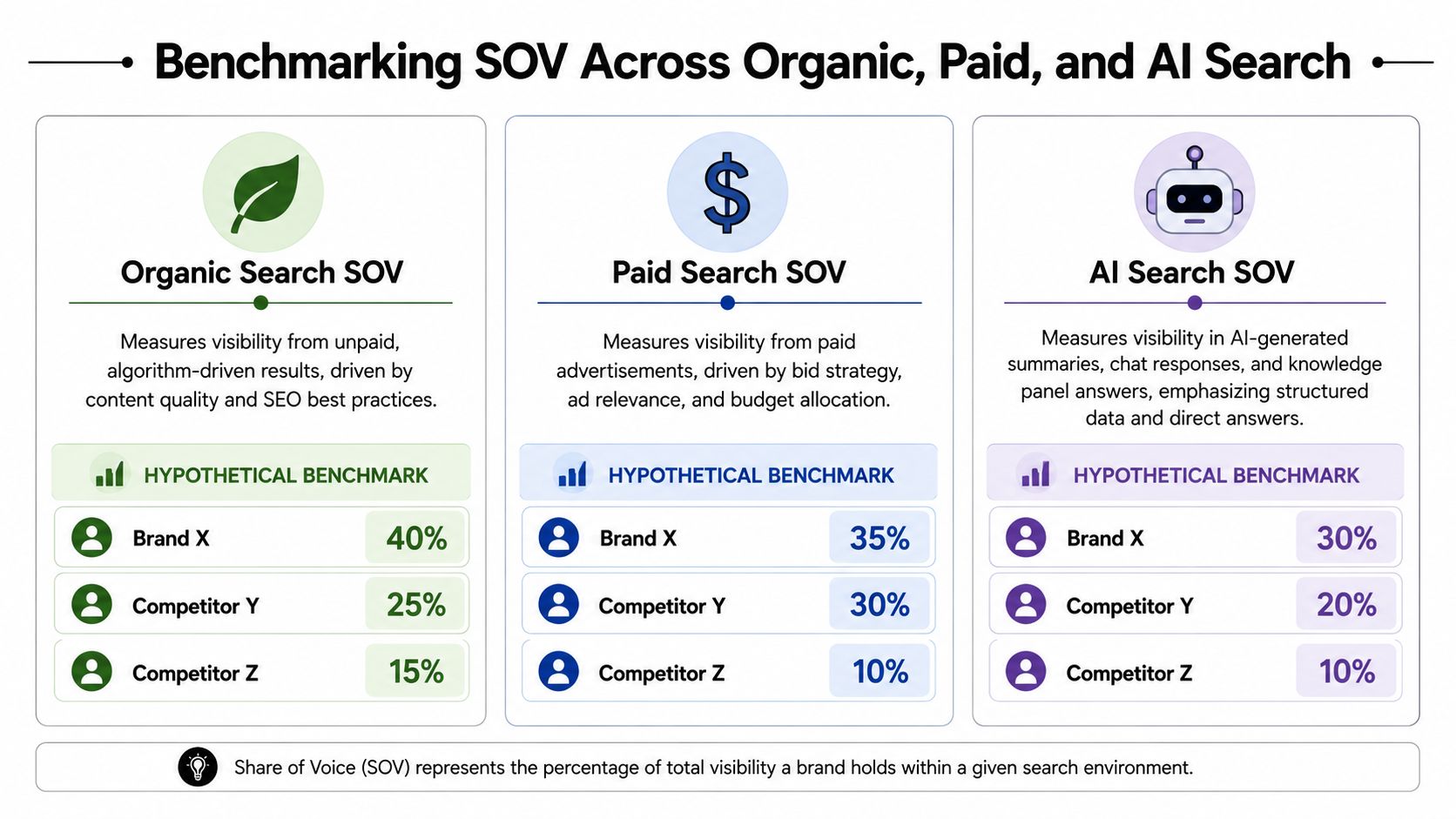
Organic search SOV
Organic SOV is closest to the classic SEO model. You're measuring how much visible demand your brand captures across a defined keyword set.
In practice, benchmark it with nuance:
- SERP features matter: A standard rank can understate visibility if you also own snippets, product modules, or other rich placements.
- Intent clusters matter more than broad totals: Commercial comparisons, alternatives, and solution queries usually say more about category control than a massive informational list.
- Competitor overlap matters: Your real search competitors aren't always your sales competitors.
A healthy organic benchmark isn't one universal number. It's a pattern: your brand should be visible across the query groups that map to evaluation and purchase behavior.
Paid search SOV
Paid SOV is usually closer to impression share thinking. Instead of asking how strongly your content ranks, you're asking how often your ads appeared when they were eligible to appear.
That makes paid SOV more operational. Budget, bidding, ad rank, and campaign structure all change the outcome faster than they do in organic search.
A short comparison helps:
| Channel | Primary driver | Common blind spot |
|---|---|---|
| Organic | Content quality, relevance, authority, technical execution | Overvaluing rank without considering SERP layout |
| Paid | Budget, bids, ad relevance, targeting | Assuming missed share is only a budget problem |
| AI | Brand mention frequency, citation sources, answer inclusion | Measuring only links and ignoring recommendation presence |
AI search SOV
AI search SOV is newer, but the operating idea is simple. Measure how often your brand appears in generated responses for prompts that matter, whether the mention is positive, neutral, or absent, and which sources the model appears to rely on.
That means your benchmark view should include:
- Prompt coverage: Are you present for category, comparison, and recommendation prompts?
- Competitive frequency: Which brands get repeatedly surfaced as the default answer?
- Citation patterns: Which publishers or owned assets are supporting those mentions?
If you’re building this reporting layer, this guide to measuring and improving brand share of voice in AI chatbots and LLMs is useful because it frames AI visibility as a repeatable measurement practice, not a one-off experiment.
The benchmark that matters isn’t whether one channel looks good in isolation. It’s whether your brand is present across the moments buyers use to narrow their options.
An Action Plan to Increase Your SEO Share of Voice
Teams usually lose share of voice in one of three ways. They target too many low-value keywords. They leave technical visibility on the table. Or they underestimate how much off-page reputation shapes discoverability in both classic search and AI answers.
Content that takes market share
The best content strategy for SOV is narrower than often expected. Recent guidance argues that broad keyword lists distort the metric and recommends focusing on a small set of high-intent, bottom-of-funnel terms because those better reflect buying intent and business impact, according to BrightEdge’s view on share of voice.
That changes how content teams should prioritize work.
- Close commercial gaps first: Build or refresh pages for comparison, alternatives, pricing-adjacent, and use-case queries where competitors repeatedly appear and you don’t.
- Consolidate overlap: If multiple weak pages compete for the same commercial intent, merge them into one stronger asset.
- Write for retrieval, not just ranking: Clear entities, direct answers, strong headings, and clean source attribution improve the odds that search systems and AI systems can use your content.
For editorial teams, a useful companion resource is this guide on how to optimize content strategy for publishers. It’s especially relevant if your brand depends on topic depth and repeat publication rather than a small set of landing pages.
Technical work that protects visibility
Technical SEO rarely creates SOV on its own, but weak technical execution can suppress it fast. When pages are hard to crawl, duplicate each other, or load poorly enough to erode engagement, your content can’t compete consistently.
Prioritize the fixes that directly support discoverability:
- Clean indexation: Remove duplicate or low-value pages that dilute topic ownership.
- Strengthen internal linking: Route authority into revenue pages and supporting topic clusters.
- Improve structured clarity: Use schema where it helps machines understand entities, products, organizations, and page purpose.
A lot of teams spread technical effort too evenly. Don’t. If a page set maps to your most valuable intent cluster, that’s where technical QA should be toughest.
Off-page signals and reputation
SOV grows faster when your brand is seen as a reliable answer outside your own website. That applies to standard search and even more to AI systems that synthesize information from multiple sources.
Focus on signals that expand trusted presence:
- Earn citations in relevant publications: Industry roundups, reviews, partner ecosystems, and expert commentary often shape both click behavior and machine-readable brand associations.
- Strengthen brand consistency: Make sure the way your company, product, and category language appear across the web is coherent.
- Support subject-matter visibility: Executives, practitioners, and specialists should publish where buyers and analysts already pay attention.
Field note: Brands usually don’t lose share of voice because they lack content volume. They lose it because competitors own the commercial moments that influence selection.
Frequently Asked Questions About Share of Voice
Is share of voice the same as impression share
No. They overlap, but they aren’t the same metric.
Impression share is usually a paid media metric tied to ad eligibility and delivery. Share of voice is broader. In SEO and AI discovery, it describes how much of the available market visibility your brand captures compared with competitors. Paid impression share can be one input into a cross-channel SOV model, but it isn’t the whole thing.
How often should teams measure it
Track it often enough to spot movement, but don’t overreact to noise.
Typically, a weekly collection cadence with monthly reporting works well. Weekly data helps you catch shifts caused by content launches, SERP changes, or competitor moves. Monthly reporting gives leadership a cleaner trend line. If the keyword set is small and highly commercial, shorter review cycles can make sense.
Can smaller companies use SOV effectively
Yes, and they often benefit more from it because it forces focus.
A smaller company shouldn’t try to measure “the whole market” at first. Pick one niche, one service line, or one high-intent query cluster. Track the competitors that appear in that search space. Then use SOV to find where the brand can become the default answer in a narrow but valuable segment.
That’s often more useful than chasing broad visibility with limited resources.
What should be included in an AI-era SOV report
At minimum, include classic organic visibility, paid visibility for your commercial query groups, and AI presence for prompts buyers use during research and evaluation. The report should also show which competitors appear most often and where your brand is absent. That’s what turns SOV from a dashboard metric into a prioritization tool.
If your team needs a practical way to measure visibility beyond rankings, Spotlight is worth evaluating. It’s built for brands that want to track how often they appear across AI search and conversational platforms, understand which prompts trigger mentions, and see the citation sources behind those answers so they can improve coverage with clearer SEO and content decisions.

Michael Hermon
Before Spotlight, Michael led Innovation and AI at monday.com after exiting his previous startup. He learned to code at 13 at MIT and later attended Columbia’s MBA program.
https://linkedin.com/in/michaelhermon