
The Complete Guide to AI-Optimized Content Strategy

Want your content to be quoted by AI systems like ChatGPT or Google AI? Here’s what you need to know: AI-optimized content strategy, also called Generative Engine Optimization (GEO), focuses on making your content the go-to source for AI-generated answers. Unlike traditional SEO, where the goal is to rank high in search results, GEO prioritizes being cited directly in AI responses.
Key Takeaways:
- Goal Shift: From ranking for keywords to being the cited answer in AI outputs.
- What Works: Clear, structured, and concise content that AI can extract easily.
- Metrics That Matter: Citation frequency, share of voice, and sentiment in AI-generated responses.
- Content Signals: Use FAQ schema, concise summaries, and data-rich sections to boost AI visibility.
- External Credibility: AI systems rely heavily on third-party mentions, not just your website.
AI platforms like Google AI and ChatGPT handle billions of queries daily, and being cited can drive massive traffic to your brand. But if your content isn’t optimized for AI, you risk being invisible to this growing audience. The strategy? Write answer-first, modular content, backed by data, and structured for easy extraction. Tools like Spotlight can help track your AI visibility and identify content gaps. Ready to make your content AI-friendly? Let’s dive in.
Generative Engine Optimization Strategy & Tactics [Deep Dive]
sbb-itb-da7512d
Core Principles of AI Search Visibility
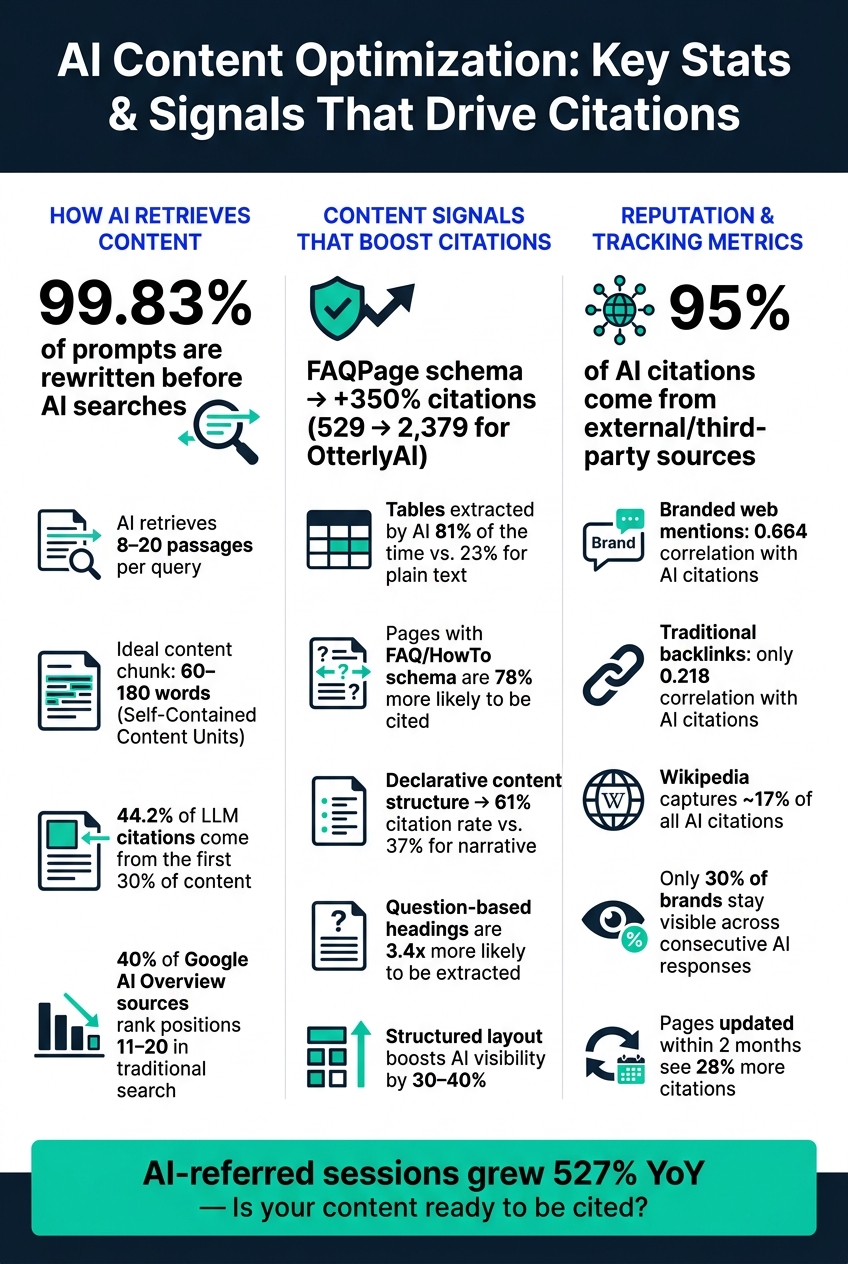
AI Content Optimization: Key Stats & Signals That Drive Citations
How AI Search and Generative Answers Work
ChatGPT and Google AI Overviews generate answers using a process called Retrieval-Augmented Generation (RAG). This involves three key steps: first, the system retrieves 8–20 specific passages from its index based on semantic relevance. These aren’t entire pages but smaller chunks of information. Next, a large language model synthesizes these passages into a single, cohesive response. Finally, it cites 3–6 sources that contributed most to the answer [7]. This process underscores the value of creating clear, easy-to-extract content.
Interestingly, 99.83% of prompts are rewritten before the system begins its search. These rewrites often include modifiers like years, format-specific keywords such as "comparison", or even brand names [8]. This means your content needs to align with the intent behind queries, not just their exact wording.
AI systems retrieve what are known as Self-Contained Content Units (SCUs) – short passages, typically 60–180 words, that independently address a single question [1][5]. If your content doesn’t provide a clear, stand-alone answer, it’s unlikely to be selected.
"There is no page 2 in AI search – you’re either in the answer or you’re not." – Trakkr [8]
Content Signals That Matter for AI Platforms
AI systems prioritize extractability over keyword density. The easier it is to pull a passage from your content and integrate it into a synthesized answer, the better your chances of being cited. Structured elements like tables, numbered lists, and concise direct-answer paragraphs tend to outperform unstructured text [4][2].
Certain content signals carry disproportionate weight. For example, using FAQPage schema can dramatically boost AI citations. OtterlyAI demonstrated this in 2026 when they added FAQ content with proper schema markup to their homepage. Their citations jumped from 529 to 2,379 – a 350% increase [1]. Similarly, evidence density is critical. Content that includes specific statistics, named sources, and verifiable data aligns with the patterns AI models associate with trustworthy information [5]. Placing your most direct and impactful answer in the first 30% of your content is also effective, as 44.2% of LLM citations are drawn from that initial section [2].
"Content dense with citations and data points matches the patterns these models associate with reliable, cite-worthy information." – ZipTie.dev [5]
Here’s a surprising insight: 40% of sources cited in Google AI Overviews rank between positions 11–20 in traditional search [5]. This means strong organic rankings don’t guarantee AI visibility – and conversely, weaker rankings don’t rule it out.
How Reputation Shapes AI Responses
Your brand’s external credibility plays a significant role in securing AI citations. These systems build a profile of your brand by aggregating signals from third-party sources. In fact, 95% of AI citations come from external sources, not from a brand’s own website [1]. What others say about you carries far more weight than your own claims.
Off-site reputation is a direct factor in AI visibility. Branded web mentions show a 0.664 correlation with AI citations, compared to just 0.218 for traditional backlinks [3]. High-authority platforms like Wikipedia dominate this space, capturing roughly 17% of all AI citations across major platforms [8].
"AI search does not rank pages. It cites entities. If your brand is not structured as a recognizable, credible entity in the knowledge layer, no amount of keyword optimization will help." – Martial Notarangelo, Founder, Authority Specialist [9]
Sentiment also plays a role. AI models mirror the tone of their source material, meaning negative press or poor reviews from authoritative sites can impact how your brand is portrayed in AI-generated summaries [5]. When faced with vague or conflicting information about a brand, AI often hedges its language with phrases like "capabilities are uncertain", which can subtly harm your credibility [6]. Keeping your brand information consistent, accurate, and positively reinforced across the web isn’t just good practice – it’s essential for earning AI’s trust and visibility. These reputation signals are key to ensuring your content is not only parsed but also recommended by AI systems.
Structuring Content for AI Parsing
Content Architecture That Works for AI
When it comes to AI systems, structuring your content isn’t just about aesthetics – it’s about making your information easy to extract and use. AI parses content by breaking it into small, independent passages to answer user queries. This means your page structure plays a critical role in how well your content is retrieved.
The best approach? Stick to a clear hierarchy: H2 → H3 → H4, with headings that are descriptive and self-explanatory. Avoid vague titles like "Overview" or "More Details." Instead, use question-based headings such as "How does X work?" or "What is the difference between Y and Z?" These types of headings are 3.4 times more likely to be extracted for AI-generated answers [12].
Here’s another key insight: declarative structures – those that get straight to the point – result in a 61% citation rate, compared to just 37% for more narrative-driven or context-heavy openings [14]. As Artur Ferreira, Founder of The GEO Lab, explains:
"A page can rank in position 1 and have zero AI citations if its sections are structured for human reading rather than machine retrieval." [14]
Keep paragraphs short – 40 to 60 words max – and focus on one idea per paragraph. Be explicit by naming the topic directly instead of relying on pronouns like "it" or "this." This helps AI systems understand context without needing to guess [14]. A well-structured page not only improves readability for humans but also ensures AI systems can easily extract your content, boosting your visibility in AI-driven search results.
Page Layout Practices for AI Readability
A well-organized page layout isn’t just nice to look at – it’s essential for AI readability. AI crawlers rely on the initial HTML your server delivers, so if key content is hidden behind JavaScript-rendered elements like accordions, tabs, or "read more" buttons, it might never be seen [11][13].
To avoid this, use clean, semantic HTML. Proper heading tags, <p> for paragraphs, and structured list tags are much better than styled <div> blocks that mimic formatting. If you have content in PDF format, always provide an HTML version. AI systems often struggle with PDFs, as they rely on less reliable optical character recognition (OCR) [15].
Don’t forget about alt text for images. Instead of generic descriptions like "chart image", use alt text to highlight the key insight or statistic the image conveys. AI crawlers can extract meaningful data from well-written alt text just as easily as from regular text [3].
These structural adjustments – writing in extractable chunks, cleaning up HTML, and adding alt text – can boost your AI search visibility by 30% to 40% [12]. Presenting data in organized formats further enhances AI extraction.
Using Tables and Summaries for AI Extraction
If you’re sharing comparative data, tables are your best friend. AI systems extract data from tables 81% of the time, compared to just 23% for plain text [12].
Use tables to present comparisons, technical details, or similar information. Keep the formatting clean: use clear column headers, consistent units, and avoid merging cells, which can confuse AI parsing. Similarly, summaries are highly effective. A concise 30–50 word block at the start of a section provides AI with a ready-to-use citation, eliminating the need for it to synthesize surrounding text [3].
"AI retrieval rewards clarity, answer directness, and structural parsability right now." – Tania Jabar, Marketing Manager, Wellows [3]
For even better results, use structured data formats like FAQPage or HowTo schema. Pages with these schemas are 78% more likely to be cited by AI search engines [12]. And just having well-organized headings can make your page 2.8 times more likely to earn citations, sometimes even beating out higher-authority domains [3]. In short, smart structuring can give you a competitive edge, even if your site lacks domain authority.
Writing Content That AI Systems Understand
Writing Practices for AI Comprehension
Start with the answer. To improve visibility in AI-driven search results, structure your content so that AI systems can easily extract and reference it. AI systems often rely on a method called Retrieval-Augmented Generation (RAG), which pulls short, standalone passages from your content. If your key points are buried deep in your text, they’re less likely to be cited.
Make your content fact-rich. AI systems favor pages packed with specific, verifiable information over vague claims. Cite your sources and include concrete data. For example, instead of general statements, provide precise details backed by evidence. Alicia Sandino, SEO Analyst and Strategist at Linkflow, highlights this shift:
"Traditional SEO rewards precision and repetition; generative engines prioritize content that is well-organized, easy to parse, and dense with meaning." [17]
Be explicit when naming entities. Replace pronouns like "it" with clear references to people, brands, or products. For instance, rather than saying "it helps users", specify "Spotlight helps marketing teams." This approach not only improves clarity but also strengthens brand credibility and aligns with AI systems that map relationships between named entities.
These strategies create content that aligns with how AI systems process and prioritize information.
Tailor Your Content to AI Queries
To align with AI search behavior, focus on longer, more detailed queries. AI systems are more likely to generate summaries for searches with 10 or more words – in fact, 53% of such searches trigger AI-generated responses, compared to only 8% for shorter, generic queries [18]. This means content that answers detailed, conversational questions is much more likely to be cited.
Organize your content to address clusters of related questions in one place. Each section should function as a self-contained content unit (SCU), designed to answer a single question completely within 60 to 180 words [10][1]. Casey Nifong, Digital Strategist, explains:
"AI systems don’t read content the way humans do. These systems extract information, break it into parts, and reuse it in new contexts. What matters is whether your content can be pulled into an AI-sourced answer cleanly." [10]
Content that requires rewriting or additional context to stand alone is less likely to be selected by AI. Aim for low-edit distance – content that can be quoted directly without modification.
Content Sections Designed for AI Extraction
Certain formats are particularly effective for AI extraction. A definition paragraph is one of the most reliable. Use this structure: "[Term] is [definition]. Unlike [related concept], it specifically refers to [distinguishing characteristic]." This format provides a clean, quotable block of text that AI systems can use as-is.
For instructional content, step-by-step guides work well, but each step must be self-contained. Avoid steps that depend on prior instructions to make sense. Additionally, include a 40–60 word TL;DR summary at the beginning of each section. These concise summaries allow AI systems to extract key points without synthesizing surrounding text [4].
The impact of these techniques can be significant. For example, Sagepath published a technical blog post on ChatGPT and schema markup, featuring a direct answer and real JSON-LD code examples. Despite being a smaller publisher, Sagepath earned citations across Google AI Overviews, ChatGPT, Gemini, and Perplexity [3]. The structured format played a key role in achieving this visibility.
Tracking and Improving AI Content Performance
Key Metrics for AI Content Performance
Once your content is optimized for AI extraction, the next step is understanding how well it performs. Start by tracking citation frequency, which reflects how often AI platforms reference your content or brand in response to relevant prompts. This metric is crucial because it directly measures your visibility. Alongside this, keep an eye on Share of Voice (SoV), which evaluates your brand’s visibility compared to competitors across a defined set of prompts. You can calculate SoV by assigning points: 1 for a mention, 2 for a recommendation, and 3 for a citation with a link. Then, divide your brand’s total points by the overall points from all brands [20].
But visibility alone isn’t enough. Pay attention to sentiment and citation context. For example, being referred to as an "industry leader" carries more weight than being listed as an "alternative option." These distinctions reveal not only how often you’re mentioned but also how you’re positioned, which is critical for guiding your strategy [21].
Here’s a summary of the key performance indicators (KPIs) you should monitor:
| KPI Category | Primary Metric | Key Indicator |
|---|---|---|
| Visibility | Citation Frequency | Mention Rate |
| Authority | Share of Voice (SoV) | Category Association |
| Trust | Sentiment Score | Citation Context (Primary vs. Alt) |
| Impact | AI Referral Traffic | Branded Search Volume |
| Stability | Consistency of AI Citations | Engine-level Deltas |
One often-overlooked metric is the consistency of AI citations. Studies show that only 30% of brands remain visible from one AI-generated response to the next, and just 20% maintain visibility across five consecutive AI answers [22]. This highlights the importance of staying consistent to avoid losing ground.
Keeping Content Accurate and Up to Date
Regular updates play a big role in maintaining AI visibility. In fact, pages updated within the past two months see a 28% boost in citations [2]. To signal updates effectively, use the dateModified property in your schema and add a short "What Changed Recently" section to your content. This 30- to 50-word summary, placed either at the top or bottom of the page, helps AI systems quickly identify what’s new without needing to reprocess the entire page [6].
Another critical factor is ensuring consistency across platforms. If your website says one thing but third-party reviews say another, AI systems might prioritize the conflicting version. Given that 85% of brand mentions in AI search come from third-party sources, aligning your messaging across all channels – both owned and external – is essential [22].
Once your content is accurate and consistent, you can use tools like Spotlight to refine your strategy further.
Refining Content Using Spotlight Insights
Spotlight provides a comprehensive view of your brand’s performance across eight major AI platforms, including ChatGPT, Gemini, Perplexity, Grok, Google AI Overviews, AI Mode, Copilot, and Claude. It highlights citation gaps and tracks prompt trends, giving you actionable insights.
One standout feature of Spotlight is prompt discovery. By analyzing real-time user behavior and correlating it with Google Search data, Spotlight identifies the most popular AI prompts. This allows you to focus on creating content that aligns with what people are asking AI systems, rather than just traditional search queries. Additionally, content gap analysis pinpoints areas where your brand is missing from AI-generated answers and offers targeted suggestions for addressing those gaps.
"As AI-driven search evolves, content optimization must shift from keyword focus to understanding how AI models learn and cite information. Tools that provide insights into AI prompt trends and citation patterns will be essential for future SEO success." – Dr. Kristina Podnar, Digital Marketing Researcher [19]
Spotlight also includes a content grading tool that evaluates your pages for both technical SEO and AI readability. It provides specific recommendations for improvement and integrates with Google Analytics to link AI-driven visibility to actual site traffic. To stay ahead, review prompt data and sentiment on a weekly basis to refine your strategy and maintain your competitive edge.
Building a Future-Ready AI Content Strategy
To keep pace with the rapid evolution of AI-driven search, adapting your content strategy is no longer optional – it’s essential. By October 2025, over half of consumers relied on AI-powered search as their primary tool for discovery, and AI-referred website sessions skyrocketed by 527% compared to the previous year [25]. This shift makes it clear: traditional SEO alone won’t be enough to maintain your brand’s visibility in this changing landscape.
To stay ahead, consistency in AI citations is key. This involves prioritizing an answer-first content structure, establishing topical authority through pillar-cluster models, leveraging proprietary data, and maintaining a regular schedule for content updates. Ahrefs provides a compelling example of this strategy in action: while AI-driven traffic made up just 0.5% of their total visitors over a 30-day period, it accounted for an impressive 12.1% of new signups. Why? Because the audience arriving via AI search tends to be highly qualified [3].
A future-ready strategy also requires looking beyond just one platform. Success depends on optimizing across four key discovery surfaces:
- Traditional SEO: For organic search visibility.
- Answer Engine Optimization (AEO): Tailored for voice assistants and direct answers.
- Generative Engine Optimization (GEO): Focused on large language model (LLM) citations.
- AI Overview Optimization (AIO): Specifically targeting Google’s generated summaries [23][16].
Relying on a single optimization strategy leaves a significant portion of potential visibility untapped. A well-rounded approach ensures you’re prepared to capture traffic from all angles.
Another challenge is the volatility of AI citations. For example, around 70% of pages cited in Google AI Overviews are replaced within a 2–3 month timeframe [24]. This makes consistent monitoring and updates a necessity. Tools like Spotlight, which tracks platforms such as ChatGPT, Gemini, and Perplexity weekly, can help you identify changes early and take action to sustain your visibility. Regularly refreshing content and using structured data are critical for building a strategy that can weather the constant shifts in AI search behavior.
FAQs
How do I turn an existing blog post into SCUs?
Transforming a blog post into SCUs (structured, citation-supported units) can help improve its visibility and usability for AI systems. Here’s how you can do it effectively:
- Define Key Entities: Identify and clearly outline important elements like brands, products, and features. This makes it easier for AI to understand and categorize your content.
- Structure for Clarity: Use headings, concise paragraphs, and FAQs to make the content more digestible and accessible for AI retrieval.
- Add Supporting Evidence: Include citations, dates, and factual evidence. This not only boosts the credibility of your content but also enhances its value for AI systems.
- Highlight High-Value Content: Focus on creating content that provides in-depth explanations of products or services. This type of content is often prioritized by AI.
- Refine and Monitor: Keep an eye on the accuracy of your citations and continuously update your content to maintain its relevance and visibility in AI-driven platforms.
By following these steps, you can make your blog posts more structured and AI-friendly, ensuring they reach a broader audience while maintaining credibility.
Which schema types help most with AI citations?
To increase AI citations, prioritize implementing FAQPage, HowTo, and Article schema types. These formats help create clear, machine-readable structures, making it easier for AI to extract content like Q&A pairs or detailed step-by-step instructions. Additionally, include Organization and author-level markup to improve entity recognition and establish credibility. Pair these efforts with well-organized header hierarchies to ensure your content is easy for AI to interpret and reference accurately.
How can I improve off-site credibility for AI visibility?
To enhance off-site credibility and improve AI visibility, focus on establishing a strong presence on well-known platforms such as Reddit and Quora. Consistency is key – make sure your brand, expertise, and products are described clearly and uniformly across all platforms to maintain entity consistency.
Boost your E-E-A-T signals (Experience, Expertise, Authoritativeness, Trust) by implementing strategies like adding author bylines to your content, keeping revision histories transparent, and earning mentions or backlinks from reliable and trusted sources. These steps help solidify your reputation and make your brand more credible to AI systems.
Related Blog Posts

Michael Hermon
Before Spotlight, Michael led Innovation and AI at monday.com after exiting his previous startup. He learned to code at 13 at MIT and later attended Columbia’s MBA program.
https://linkedin.com/in/michaelhermon