AI Reputation Management Checklist for 2026

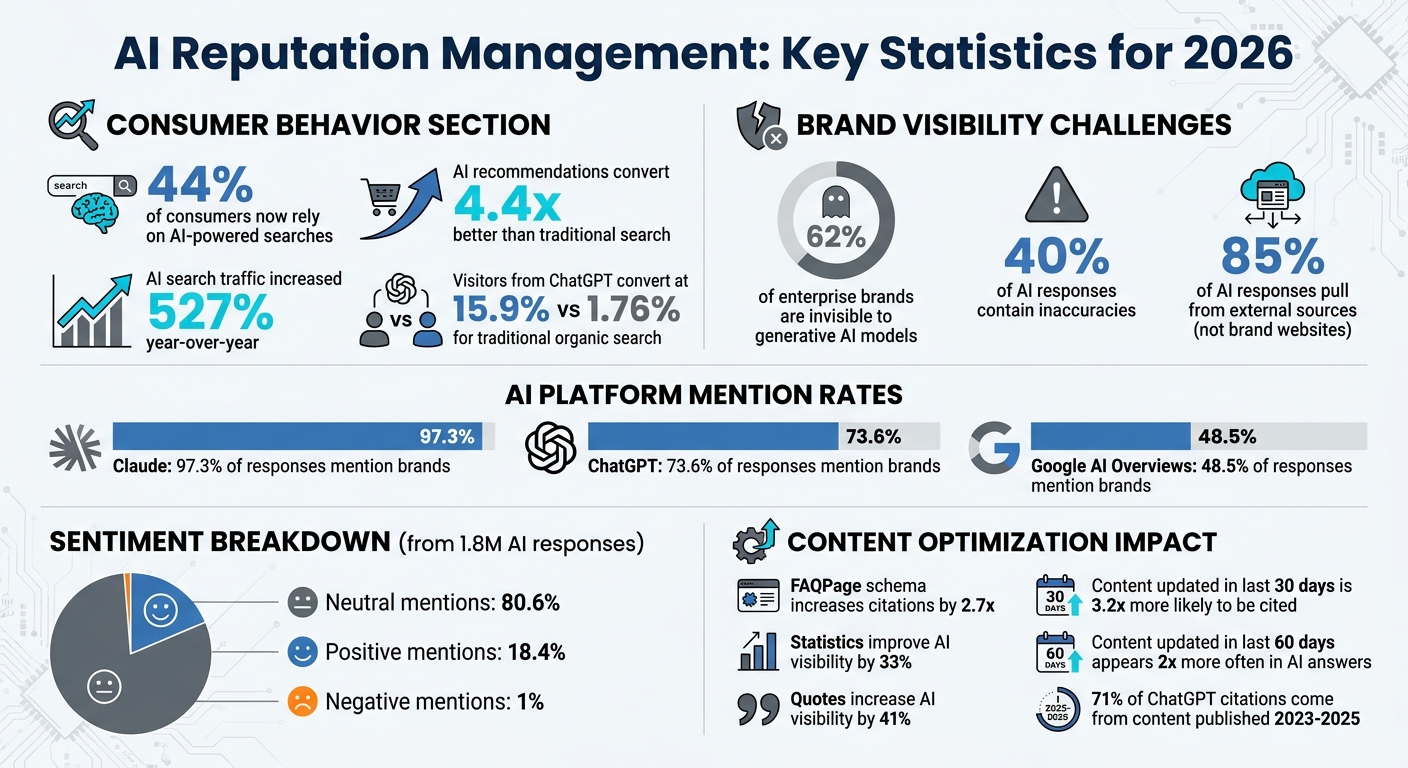
In 2026, managing your brand’s reputation on AI platforms like ChatGPT, Perplexity, and Google AI Overviews is more important than ever. Why? Because 44% of consumers now rely on AI-powered searches, and these platforms often recommend just 1–3 brands. If your brand isn’t visible in AI responses, you’re losing out on high-converting traffic – AI recommendations convert 4.4x better than traditional search.
Here’s the problem: 62% of enterprise brands have zero AI search visibility, despite heavy investments in SEO. AI platforms prioritize trust, accuracy, and up-to-date data. If your brand isn’t trusted, it won’t show up in recommendations.
Key Steps to Manage Your AI Reputation:
- Monitor AI visibility: Track how your brand appears across major AI platforms like ChatGPT, Claude, and Google AI Overviews.
- Audit perception: Check for inaccuracies, sentiment trends, and misinformation in AI-generated content.
- Fill content gaps: Identify missing topics and create AI-friendly, structured content that answers customer questions.
- Mitigate risks: Correct errors at the source (e.g., Wikipedia, LinkedIn) and address negative sentiment quickly.
- Stay compliant: Follow new AI regulations like the EU AI Act and U.S. state laws to avoid penalties.
- Optimize for AI: Use Schema markup, update content frequently, and ensure consistency across platforms.
AI reputation management is no longer optional. Brands that invest in monitoring, auditing, and optimizing their AI presence will dominate the digital landscape in 2026.
AI Reputation Management Statistics 2026: Consumer Behavior and Brand Visibility
Why Small Business Owners Ignoring AI Won’t Survive in 2026
sbb-itb-da7512d
1. Set Up AI Visibility Monitoring
Track Brand Mentions Across AI Platforms
Your brand’s visibility in AI platforms is critical, and it works differently than traditional search engines. While Google rankings were once the focus, AI platforms like ChatGPT, Perplexity, Claude, Gemini, Microsoft Copilot, Google AI Overviews, and Grok each handle citations uniquely. For example, Claude mentions brands in 97.3% of its responses, while Google AI Overviews does so only 48.5% of the time [6]. This means keeping tabs on multiple platforms is essential to understanding how your brand is represented across AI platforms.
Start by identifying 20–50 diverse queries that reflect how customers discover your brand. These should include direct brand-related questions (like "What do people think about [your brand]?"), category-based searches (such as "Best [your product category] in 2026"), and problem-solving prompts (e.g., "How do I solve [a problem your product addresses]?"). Use these queries to track mentions across the seven major AI platforms: ChatGPT, Gemini, Perplexity, Grok, Google AI Overviews, Microsoft Copilot, and Claude. This will give you a clear picture of your brand’s presence across these tools.
From an analysis of 1.8 million AI responses, mentions broke down as 80.6% neutral, 18.4% positive, and 1% negative [6]. Neutral mentions might seem fine, but they don’t necessarily drive engagement. Pay attention to your brand’s mention rank – where it appears in AI responses. Platforms like Perplexity and ChatGPT tend to place brands early (median rank 1 or 2), while Claude often lists them later (median rank 3) [6]. Early placement is key, as it boosts user recall and increases the likelihood of engagement.
Connect Analytics for Real-Time Data
Once you’ve started monitoring mentions, the next step is connecting this data to business outcomes. By integrating analytics tools, you can see how AI visibility translates into traffic and engagement. For example, rocketblue (previously Spotlight) connects directly with Google Analytics and WordPress, letting you track which AI platforms are driving traffic to your site. This setup also shows which pages are being cited most often by AI models, helping you fine-tune those pages to improve your Generative Engine Optimization (GEO) efforts.
Automate your monitoring process to stay ahead. Since AI models update their knowledge bases less frequently than traditional search engines, set up weekly monitoring and configure alerts. These alerts can notify you if your mention counts drop below a certain level or if negative sentiment appears on three or more platforms in the same week. This proactive system ensures you can address issues quickly and maintain a strong presence across AI platforms.
2. Run Regular Brand Perception Audits
Review Sentiment and Accuracy
Once you’ve monitored brand visibility, the next step is auditing how your brand is perceived. Here’s why: AI responses are wrong 40% of the time [7], which can lead to your brand being misrepresented. Since AI systems pull data from third-party sources, any outdated, biased, or incorrect information they ingest can spread inaccuracies.
To stay ahead, conduct weekly tests across at least three AI platforms. Use these three types of queries to evaluate how your brand is portrayed:
- Brand queries: For example, "Tell me about [your brand]."
- Comparison queries: Such as "[your brand] vs [competitor]."
- Sentiment queries: Like "[your brand] problems" or "[your brand] reviews" [3].
This approach helps uncover variations in how AI platforms describe your brand. Watch for perception drift – a slow shift in how your brand is depicted as AI models retrain on fresh data [3].
"LLMs almost never say ‘I don’t know.’ They are prediction engines, not fact engines. They keep talking even when they’re totally off-base." – Mitul Gandhi, Co-Founder and Chief Architect, seoClarity [7]
Tracking sentiment scores is key. Classify AI-generated descriptions as positive, neutral, or negative. Keep in mind that 85% of brand mentions in AI-generated responses come from third-party sources, not your own website [3]. This makes it critical to audit not only what AI platforms say about your brand but also where they source that information. By understanding sentiment trends, you can address inaccuracies and minimize risks effectively.
Find Sources and Correct Information
When you identify errors in AI-generated content, the next step is tracing those inaccuracies back to their sources. Use citation tracking tools to locate influential sources, such as Wikipedia, LinkedIn, and G2, which contribute to "entity confidence" [3]. These sources often include industry review platforms or news articles that AI systems rely on.
Instead of focusing on correcting the AI output directly, tackle the issue at its root. Update your Wikipedia page, LinkedIn profile, and Google Business Profile with accurate and current information. AI platforms tend to prioritize content updated within the last 60 days, weighting it twice as heavily as older material [2]. This means frequent updates to high-authority sources are crucial for maintaining accuracy.
Using tools like rocketblue (previously Spotlight)’s LLM source tracking feature can help you pinpoint which pages need immediate attention. By prioritizing these corrections, you can significantly influence how AI platforms represent your brand, ensuring that the narrative aligns with your goals.
3. Find and Fill Content Gaps
Spot Missing or Underrepresented Topics
AI platforms don’t always have a full picture of your brand. To pinpoint gaps, test how these systems respond to the kinds of natural language questions your potential customers might ask. A good starting point is running 8 prompts across 4 platforms – ChatGPT, Claude, Perplexity, and Gemini. This approach gives you 32+ data points, which provides a reliable baseline for analysis [9].
Pay close attention to how competitors are mentioned and in what order. If these platforms highlight your competitors’ features or use cases but fail to mention your brand, you’ve identified a clear content gap. Capture this information in a table that includes the question, the AI’s response about competitors, and the type of content you need to create. This documentation helps you focus on developing content that directly addresses these visibility gaps.
"AI models don’t just surface links – they form opinions." – Trysight.ai [10]
Another key metric to track is your Share of Voice (SoV) – the percentage of AI-generated responses that mention your brand for relevant keywords [8]. Build a library of 15–20 core questions spanning broad topics, specific use cases, comparisons, and problem-solving scenarios. Test these consistently over time to monitor how often your brand appears in AI responses and where you might need to improve.
Create Content for AI Knowledge Bases
Once you’ve identified the gaps, the next step is to create content tailored for AI systems. Structure your pages with clear, descriptive headings that directly answer questions. For instance, instead of vague marketing titles, use something like: "How [Your Product] Automates [Specific Task]" [19, 23]. Place the core answer at the beginning of each section since AI models tend to extract information more accurately when the key points are upfront [19, 23].
Consider developing pillar pages that include clear headings, bullet points, and Schema markup (such as Organization, Product, and FAQ). This ensures AI systems can easily extract and cite your content [19, 23].
For quicker results, use the IndexNow protocol to notify search engines as soon as you publish new content. This can reduce the time it takes for your updates to influence AI responses from weeks to just 24–48 hours [9]. Additionally, create a centralized "Company Facts" or "Press Kit" page with structured headers and FAQ schema. This provides AI platforms with a single, authoritative source for accurate brand information.
4. Build Reputation Risk Mitigation Strategies
Check for Bias and Errors in AI Responses
Addressing visibility and content gaps is just the beginning. To truly safeguard your brand, you need to actively prevent AI platforms from misrepresenting it. Since these platforms weigh sources differently, inaccuracies can creep in [3].
Here’s how to stay ahead: conduct weekly tests using three types of queries – brand-specific ("tell me about [your brand]"), comparative ("[your brand] vs [competitor]"), and sentiment-based ("[your brand] problems"). Run these tests across platforms like ChatGPT, Gemini, Perplexity, and Claude to identify biases or errors [3]. Be on the lookout for Perception Drift, which refers to the subtle changes in how AI describes your brand as models retrain using new data, including potentially negative third-party content [3].
"LLMs almost never say ‘I don’t know.’ They are prediction engines, not fact engines. They keep talking even when they’re totally off-base." – Mitul Gandhi, Co-Founder and Chief Architect, seoClarity [7]
To combat this, focus on the source of the problem. Update authoritative content on your own site to ensure AI pulls accurate information. Filling the "Authority Vacuum" – the gap where AI lacks reliable data – can prevent hallucinations (or fabricated responses). By providing detailed, accurate documentation on your site, you give AI a reliable source to reference [7][12]. Additionally, build an "Entity Moat" by ensuring consistent brand descriptions across key platforms like Wikipedia, LinkedIn, G2, and industry directories. This consistency strengthens AI’s confidence in your brand’s data [3].
Create an Incident Response Plan
If you detect bias or errors, a solid incident response plan is your best defense. This plan should outline clear steps for addressing misinformation quickly and effectively. Assign roles for monitoring, creating corrective content, and managing any crises that arise [12]. Since most AI mentions come from external sources, your efforts should focus on correcting inaccuracies on third-party sites rather than the AI model itself [3].
"Having a well-established protocol ensures you’re ready if and when the time comes. You won’t be scrambling and panicking trying to figure out what to do – you can just take action." – Macy Storm, Content Marketing Consultant, SEO.com [12]
Timeliness is key, but response times vary by platform: Perplexity can update in days, Gemini in weeks, and ChatGPT might take weeks or even months [3]. If AI generates outright fabrications – such as a made-up return policy – publish a dedicated page on your website immediately to serve as the definitive source of truth [12]. Human oversight is critical to catch and address AI-generated misinformation before it spreads [12].
5. Create and Optimize AI-Friendly Content
Match Content to AI Algorithms
To make your content AI-friendly, you’ll need to rethink how you present information. Start with an answer-first approach: provide the direct answer right at the beginning (in the first sentence or two), then follow up with additional context. AI models prioritize extracting facts over storytelling.
Technical details matter just as much as your content. Use Schema.org markup like FAQPage, HowTo, Product, and Organization to structure your pages for better AI extraction. For instance, pages utilizing the FAQPage schema are cited 2.7 times more often by AI compared to those that don’t [15]. Also, ensure your robots.txt file allows AI crawlers like GPTBot, ClaudeBot, and PerplexityBot. Adding an llms.txt file to your site’s root directory can further help AI tools understand your structure [14][15][16].
Formatting is key. Use Markdown for comparison tables, include relevant statistics, and add authoritative quotes. These elements can significantly boost your chances of being cited – statistics improve AI visibility by 33%, while quotes increase it by 41% [15]. Build topical authority by creating content clusters: start with a central pillar page and support it with related articles. AI models tend to prefer domains that demonstrate deep expertise in specific subjects [13][16].
Timeliness is another critical factor. Content updated within the last 30 days is 3.2 times more likely to be cited by AI. In fact, 71% of ChatGPT citations come from material published between 2023 and 2025 [15]. To stay relevant, schedule quarterly updates and use the IndexNow protocol to notify AI search engines about changes promptly [15][16].
Once your AI-friendly content is live, it’s time to track its performance.
Track Content Performance
Optimizing content for AI is just the first step – you’ll need to monitor its performance to see the results. Tools like rocketblue (previously Spotlight) can give you real-time insights into which pages AI models are referencing, how often they appear in responses, and whether you’re earning citations (your URLs being used as sources) or just mentions (your brand name being noted). Citations are especially valuable – they’re 40% more likely to drive repeat visibility across user sessions compared to mentions [17].
Conversion data can also reveal a lot. Visitors referred by ChatGPT, for example, convert at a rate of 15.9%, which is significantly higher than the 1.76% conversion rate for traditional organic search [15]. Use citation gap analysis to identify queries where competitors are being cited instead of your brand. Then, create targeted content to close those gaps [18].
"The brands that win in 2026 are the ones that optimize for citations, not clicks." – AI Search Tools [13]
During performance reviews, focus on metrics that highlight how AI is interacting with your content. Are your answer blocks being used in AI responses? Which schema types are driving the most citations? How quickly are your updates being reflected in AI platforms? Keep in mind that response times can vary between platforms, so tracking these patterns will help you set realistic expectations and refine your update schedule.
6. Monitor Competitor and Performance Metrics
Compare Your Brand to Competitors on AI Platforms
Understanding how your brand stacks up against competitors on AI platforms is crucial. One way to measure this is by tracking your citation share – the percentage of AI responses that mention your brand. This metric is more insightful than mere mention counts because it reflects whether AI models recognize your content as authoritative.
To get started, create a shared query set of 100–200 questions that span the entire customer journey. These should include queries from the awareness stage (e.g., "What is the best way to…") to the decision stage (e.g., "Which [product category] should I choose?"). Test these queries across platforms like ChatGPT, Claude, Perplexity, and Gemini to capture differences in how each platform handles brand mentions and searches the web. For example, ChatGPT mentions brands in 73.6% of responses, Claude in 97.3%, and Google AI Overviews only 48.5% [6]. These variations highlight why it’s essential to gather data from multiple sources.
Pay attention to both the frequency and the context of mentions. AI models often categorize brands as "industry leaders", "emerging alternatives", or "niche players." Tools like rocketblue (previously Spotlight) can help you identify these patterns and calculate visibility scores, which give more weight to first-position mentions. Additionally, perform an answer gap analysis to find prompts where competitors are mentioned but your brand isn’t. This can guide you in creating content that fills those gaps and improves your visibility.
"AI visibility on its own is a vanity metric… a raw ‘you were mentioned 40 times this week’ number tells you almost nothing without context – which prompts, which models, what sentiment, and whether any of it drove actual behavior." – Wil Reynolds, Founder, Seer Interactive [19]
These insights provide a foundation for using data to refine your AI strategy.
Use Data for Better Decisions
Once you’ve analyzed competitor performance, use the findings to make informed decisions about boosting your AI presence. Start by calculating your competitive share with this formula:
(Your Citations / Total Citations) × 100.
This percentage reveals your standing in AI-driven conversations. If competitors dominate high-intent queries like "best [category] for [use case]", examine their content to identify what sets them apart. It could be original research, in-depth guides, or clear demonstrations of expertise.
Keep an eye on AI crawler activity, such as ChatGPT-User and PerplexityBot, to detect early trends in citations. Establish a regular monitoring schedule: weekly in fast-changing industries and bi-weekly in more stable ones. Run your tests at the same time during each session to avoid skewed results. While improving your Share of Voice typically takes three to six months of consistent effort, platforms like Perplexity can show noticeable changes in as little as two to six weeks [8].
It’s important to note that traditional SEO metrics don’t always align with AI visibility. For instance, brands with strong Google rankings may still struggle with their AI Share of Voice [8]. Instead, focus on metrics tailored to AI environments, such as citation frequency, prompt coverage, and sentiment scoring. Use a 1–5 scoring system to differentiate between neutral mentions ("Brand X is an option") and enthusiastic endorsements ("Brand X outperforms competitors"). Finally, tie these insights to tangible business outcomes by tracking AI referral traffic in Google Analytics.
7. Maintain Compliance and Transparency
Once you’ve addressed risk mitigation, it’s critical to ensure your brand stays compliant with new AI regulations and maintains open, honest interactions with users.
Follow 2026 AI Regulations
Since 2026, regulatory enforcement has replaced voluntary guidelines, with fines reaching up to 35 million euros or 7% of global turnover for violations [22][23]. The EU AI Act, fully implemented in August 2026, mandates strict compliance for high-risk AI systems. These rules extend globally if your AI systems are accessible to users in the EU.
"73% of the companies I worked with didn’t even realize they needed to comply. They thought, ‘We’re not in Europe, so we’re safe.’ Spoiler alert: if your AI system is being used by anyone in the EU – even indirectly – you’re probably on the hook."
– Vicki Larson, AI Compliance Consultant [25]
In the U.S., Colorado SB 205 became the first state law requiring developers and operators of high-risk AI systems to safeguard consumers from algorithmic discrimination, effective February 1, 2026 [20][22]. Meanwhile, New York’s AI Disclosure Law, enacted in June 2026, mandates clear labeling for advertising content that is more than 50% AI-generated [21]. Additionally, the FTC’s "double disclosure" rule requires brands to disclose both paid sponsorships and AI-generated content, with penalties as high as $53,088 per violation [21][23].
To get started, create an AI inventory to catalog all tools processing customer or employee data and classify their risk levels [20][22]. Update contracts with vendors to ensure their data practices align with your compliance requirements [20]. Assign a team member to oversee AI outputs, conduct annual audits, and maintain detailed documentation for regulatory purposes [22][23]. These steps not only help you comply with the law but also strengthen your brand’s reputation in AI-driven environments.
"Every AI enforcement action made public in 2024 and 2025 targeted organizations that had no documented governance process, not organizations whose documentation was imperfect."
– Joey Pedras, Digital Marketing Strategist, TrueFuture Media [22]
Be Transparent in AI Interactions
Clearly label AI-generated content at the point of display, avoiding buried disclosures in terms of service or footnotes [23][25]. For high-stakes decisions like hiring or credit scoring, inform users when AI is involved and provide an option for human review [23][25]. Place these disclosures directly next to the relevant content rather than relying on generic disclaimers [21].
Maintain a "Facts" or "About" page with structured data so AI models can access accurate, brand-approved information [11][24]. Use FAQPage schema markup to make Q&A content machine-readable, ensuring accurate AI citations [3][24]. Also, keep your Name, Address, and Phone (NAP) data consistent across directories.
Explain the reasoning behind AI-driven decisions in simple terms, share accuracy rates, and disclose any known limitations to manage user expectations [25]. Offer straightforward opt-out options for AI interactions and let users know how to reach human oversight when necessary [23][25]. Tools like rocketblue (previously Spotlight) can help monitor how your brand is represented in AI systems and identify areas where transparency can be improved.
8. Create Continuous Improvement Processes
To keep your AI reputation management effective, you need a system that evolves alongside changing platforms, algorithm updates, and your brand’s growing digital presence. Regular review cycles allow you to catch potential problems early and take advantage of emerging opportunities.
Schedule Regular Content and Risk Reviews
Develop a layered audit schedule that balances being thorough with staying efficient. For instance, conduct quick 20-minute baseline audits each month, and take a deeper dive into the first three pages of search results every six months [11]. Why is this important? Content updated in the last 60 days shows up about twice as often in AI-generated answers compared to older material [2]. This means you should review your key web properties every two months, refreshing stats, case studies, and positioning statements as needed.
Assign a team member to monitor daily brand alerts, categorizing mentions as positive, neutral, or negative [11]. On a monthly basis, manually test queries across AI platforms like ChatGPT, Perplexity, Gemini, and Claude to document how these models represent your brand [24]. Set up automated alerts to flag major changes – like a 20% drop in share of voice or a sudden spike in negative sentiment – so you can act immediately instead of waiting for your next scheduled audit [27].
It’s also vital to ensure that essential brand details – such as your founding date, leadership team, and headquarters – are consistent across sources like Wikipedia, LinkedIn, Crunchbase, and your official site. This helps prevent AI models from generating incorrect or incomplete information [2]. Keep tabs on where your brand is mentioned in forums, news outlets, and industry publications, as these make up 90-95% of the sources AI platforms rely on [2]. Update your risk assessments every quarter or whenever there’s a significant platform update, new use cases, or an uptick in user complaints [23].
These regular check-ins build the foundation for scaling your efforts with more advanced tools.
Scale with Advanced Tools and Features
Once your review routines are in place, advanced tools can take your processes to the next level. Specialized platforms go beyond traditional monitoring tools by enabling action loops – systems that not only identify content gaps but also assist in creating optimized content to address them [4]. Configure sentiment alerts to notify you of unexpected changes in AI descriptions, so you don’t have to wait for weekly reports [28]. For larger operations, consider building a prompt portfolio that tracks 20 to 100 prompts covering areas like commercial intent, product comparisons, and risk-related queries [28]. Use insights from AI tools to directly inform your content calendar, helping you reclaim valuable citations systematically [28].
For example, rocketblue (previously Spotlight)’s Custom plan offers features like API integration, daily reports, and access to dedicated strategists. It supports platforms such as ChatGPT, Gemini, Perplexity, Grok, AI Overview, AI Mode, Copilot, and Claude, helping you maintain continuous improvement [5].
Conclusion
Key Takeaways
AI reputation management is shaping the way brands maintain visibility in 2026. With AI search traffic skyrocketing by 527% year-over-year [1] and 44% of consumers now turning to AI-powered search as their go-to source for information [2], it’s clear that these platforms are redefining how customers perceive brands. The competition isn’t just about clicks anymore – it’s about becoming the trusted source cited in AI-generated responses that reach millions.
Here’s the challenge: 85% of AI responses pull from external sources, and 40% of them contain inaccuracies [3][7]. This presents both a risk and an opportunity. By standardizing your entity data across key platforms, you can increase the likelihood of being cited accurately [2]. On the flip side, neglecting these sources could lead to AI systems filling in gaps with incorrect or even competitor-sourced information.
As one expert put it:
"If you don’t provide the answer, AI search engines will find a ‘reasonable’ (and likely wrong) answer elsewhere" [7].
Success in 2026 hinges on three pillars: monitoring, auditing, and optimizing your AI visibility. Managing your AI reputation isn’t a one-time task – it’s an ongoing process. The insights above can help you prioritize your next steps effectively.
Next Steps for Implementation
To secure your brand’s presence in AI-driven search, start with actionable steps:
- Run a baseline audit: Test 10 brand-specific queries across major AI platforms this week. Document any inaccuracies or content gaps. This will help you identify immediate priorities, like correcting errors on Wikipedia, addressing negative reviews, or filling gaps on your own website.
- Standardize your entity data: Ensure consistent details – such as your company name, founding date, leadership, and headquarters – across all platforms referenced by AI systems. Add Organization schema to your homepage, including "sameAs" links to verified profiles like LinkedIn and Crunchbase [26]. These technical updates strengthen your brand’s credibility and improve the chances of being accurately cited.
- Set up weekly monitoring: Establish a routine for tracking your AI visibility. This proactive approach helps you catch potential issues before they escalate into reputation crises. Brands that excel in AI search aren’t passive – they actively shape their narrative.
FAQs
What’s the fastest way to see how AI platforms describe my brand?
The fastest way to gauge how AI platforms portray your brand is by keeping an eye on AI-generated search results and mentions. You can use specialized tools to monitor your brand’s visibility and sentiment across these platforms. These tools provide real-time insights into your brand’s reputation, ensuring you stay updated and ready to respond to how your brand is being presented in AI-driven spaces.
How do I fix wrong info about my brand in AI answers?
Dealing with misinformation about your brand in AI-generated content? Here’s how you can tackle it effectively:
- Keep an eye on AI platforms: Regularly review the content these systems produce to quickly spot and address any inaccuracies.
- Ensure your website is up-to-date: Provide clear, factual references by maintaining accurate information and structured data on your site.
- Report errors to AI providers: Most platforms allow you to submit feedback. Use this feature to flag mistakes and suggest corrections.
- Build a strong online presence: Publish accurate, reliable content to establish authority and positively influence AI-generated outputs.
These actions can help ensure AI systems represent your brand accurately.
Which pages should I create to earn more AI citations?
To get more AI citations, design your pages with AI-driven search in mind. Prioritize answer-first formats such as FAQs, comparison tables, and listicles – these are the types of content AI tends to reference most frequently. Incorporate structured data (schema markup) to make your content easier for AI to understand and use. Additionally, focus on establishing topical authority within your niche by covering subjects comprehensively and consistently. Creating content that is clear, precise, and reliable will boost your chances of being cited by AI platforms.
Related Blog Posts

Michael Hermon
Before rocketblue, Michael led Innovation and AI at monday.com after exiting his previous startup. He learned to code at 13 at MIT and later attended Columbia’s MBA program.
https://linkedin.com/in/michaelhermon