
How to Optimize Your Brand for AI Search Results

AI search tools like ChatGPT, Perplexity, and Gemini are changing how people find information. If your brand isn’t part of AI-generated answers, you risk losing visibility. Traditional SEO isn’t enough anymore – brands now need to focus on Generative Engine Optimization (GEO) to ensure their content is recognized and accurately cited by AI platforms.
Key Takeaways:
- AI Search Growth: By 2026, over 400 million people use AI search tools weekly, and 37% of U.S. adults rely on AI chatbots for product research.
- Visibility Gap: 73% of brands are overlooked in AI-generated responses, and 80% of cited sources don’t rank in Google’s top 100.
- Higher Conversion Rates: Traffic from AI referrals converts at 14.2%, compared to just 2.8% from traditional organic traffic.
Steps to Optimize:
- Audit AI Visibility: Test your brand’s presence on AI platforms with targeted prompts. Check for mentions, accuracy, and potential "hallucinations."
- Structure Content for AI: Use semantic HTML, prioritize key claims early in your content, and ensure AI crawlers like GPTBot can access your site.
- Build Authority: Include data and citations, publish case studies, and secure mentions on trusted platforms like G2 or industry blogs.
- Ensure Consistency: Align brand messaging across all digital platforms to avoid conflicting information that may confuse AI systems.
Pro Tip: Regularly monitor your brand’s AI visibility using tools like Spotlight or Promptwatch to track mentions, sentiment, and competitive gaps.
Bottom Line: To stay relevant in the AI-driven search landscape, focus on being part of the answer, not just a search result.
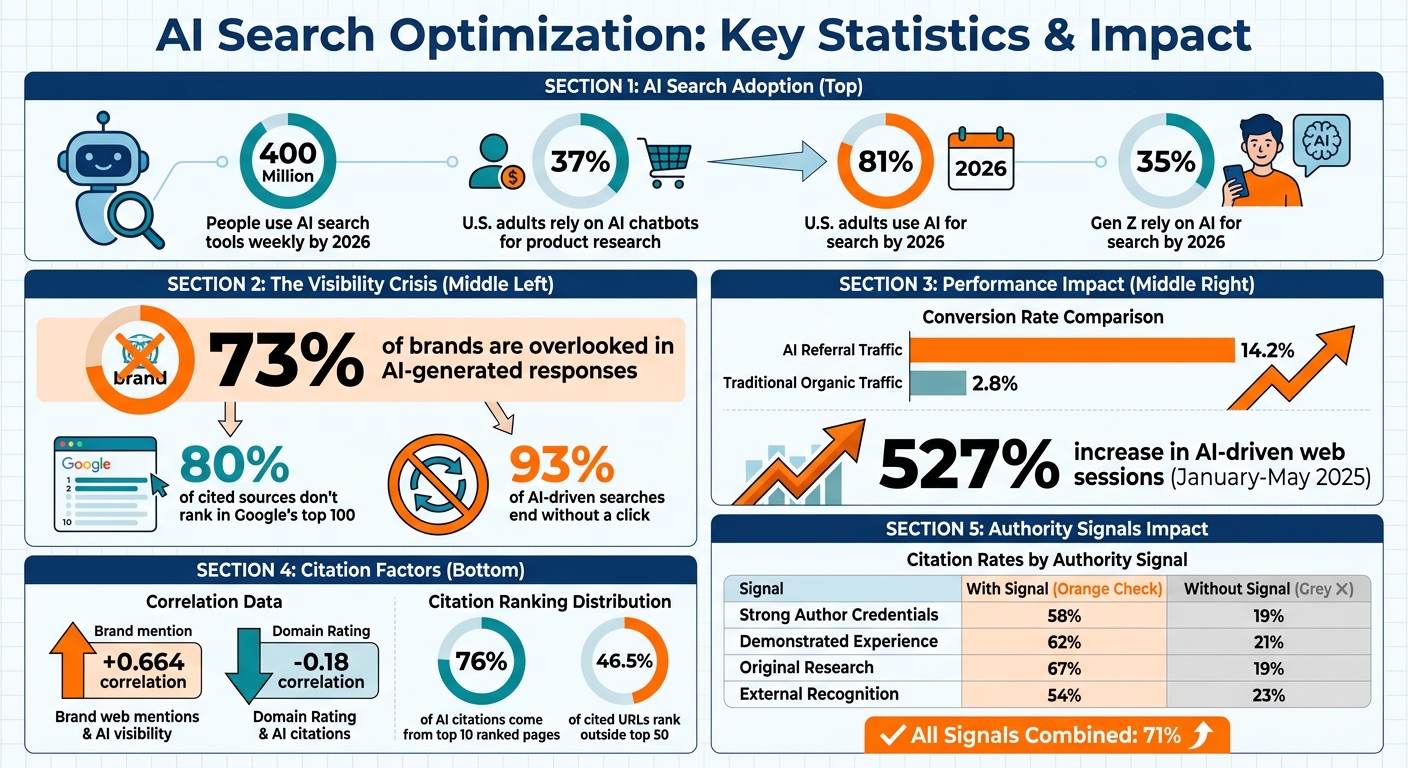
AI Search Optimization Statistics and Visibility Metrics 2026
Winning AI Search: How Brands Appear, Rank, and Convert in 2026
sbb-itb-da7512d
How to Audit Your Brand’s AI Search Visibility
Auditing your brand’s AI search visibility is essential to understanding your current position in the AI-driven landscape. Unlike traditional SEO, where rankings are tracked page by page, AI search operates on a binary level – your brand is either mentioned in the AI-generated response, or it’s completely absent. As Aditya from Sanbi.ai puts it:
"If your brand isn’t mentioned, nothing gets logged – no click, no impression, no bounce rate. The opportunity is lost."
Right now, around 73% of brands are entirely overlooked in AI-generated recommendations. This means most companies have no idea if platforms like ChatGPT, Perplexity, or Gemini are recommending, misrepresenting, or ignoring their brand altogether. Conducting a thorough audit will help you identify where your brand stands and what needs improvement.
Check Your Brand’s Presence on AI Platforms
Start by manually auditing your brand’s visibility on major AI platforms, including ChatGPT, Perplexity, Claude, Gemini, and Google AI Overviews. Use 20 to 50 targeted prompts divided into four categories:
- Informational: Questions like, "How does [your product category] work?"
- Comparative: Prompts such as, "[Your brand] vs [competitor]."
- Transactional: Queries like, "Best [product type] under $500."
- Brand-Specific: Direct searches like, "Is [your brand] reliable?"
For each prompt, note whether your brand appears, how it’s described, and if the AI links back to your website. Also, be on the lookout for "hallucinations", such as outdated pricing, incorrect features, or misrepresentations.
Next, check your robots.txt file to ensure you’re not accidentally blocking AI crawlers like GPTBot, ClaudeBot, or PerplexityBot. If these bots can’t access your site, your brand won’t show up in AI-generated responses, no matter how great your content is.
To measure your visibility, calculate your presence rate: (brand mentions ÷ total queries tested). Use this score to understand your current standing:
| Visibility Rate | Assessment | Action Required |
|---|---|---|
| 0–10% | Invisible | Immediate technical and content updates needed |
| 10–30% | Low | Address major content gaps |
| 30–60% | Moderate | Focus on optimization and improving citations |
| 60–80% | Strong | Maintain and refine your position |
| 80%+ | Dominant | Lead the market and focus on managing sentiment |
Compare Your Performance to Competitors
Evaluating your competitive position involves tracking your Share of Voice (SOV) – how often your brand is mentioned compared to competitors in AI responses. Use comparative prompts like, "What are the best [product category] tools?" or "[Your brand] vs [Competitor A] vs [Competitor B]." Note not only your mention frequency but also the order of appearance. If competitors consistently rank higher, it’s a sign that your brand may be missing critical opportunities.
Interestingly, brand web mentions strongly correlate with AI visibility (0.664), while traditional metrics like Domain Rating show a negative correlation (–0.18) with AI citations. Tools like Otterly.AI (priced at $29–$99/month) or Promptwatch (priced at $99–$579/month) can help automate competitor tracking and identify "answer gaps" – areas where competitors are mentioned but your brand is absent.
Once you’ve assessed your competitive share, monitor how quickly AI platforms reflect updates to your content and technical setup.
Monitor How Fast AI Models Reflect Your Updates
After making updates – whether technical fixes or new content – it’s important to track how quickly AI platforms incorporate these changes. For instance, updating your robots.txt file may yield results within days, while content improvements typically take four to eight weeks. Use your server logs to track visits from AI crawlers like GPTBot (OpenAI), ClaudeBot (Anthropic), PerplexityBot, and Google-Extended. If these bots aren’t visiting your site, your updates won’t be reflected in AI-generated responses.
As AI Search Tools advises:
"AI visibility takes time. You won’t see changes overnight. Track weekly or biweekly, look for trends over months, and adjust your content strategy based on what’s working."
Run "Golden Queries" weekly to monitor progress. If your brand isn’t cited within 30 days, it may indicate the need for further structural or technical adjustments. Establish a regular reporting schedule: daily for active campaigns, weekly for trend monitoring, and monthly for reviewing your overall Share of Voice.
Platforms like Spotlight can simplify this process by automating brand visibility tracking across ChatGPT, Gemini, Perplexity, and others. Spotlight provides weekly reports, identifies content gaps, and shows how quickly AI models pick up your updates, eliminating the need for manual checks across multiple platforms.
How to Structure Content for AI Algorithms
Once you’ve assessed your content’s visibility for AI, the next step is organizing it in a way that AI systems can easily process and index. Start by using semantic HTML to establish a clear content hierarchy and highlight important details effectively. Also, make sure that your core content is present in the HTML source. This is crucial because many AI crawlers struggle to interpret content rendered through JavaScript.
Tools like Spotlight can be incredibly helpful here. They allow you to monitor how accessible your content is to AI and track which of your pages get the most mentions. By identifying these patterns and any content gaps, you can refine your structure based on performance data.
How to Build Authority That AI Algorithms Recognize
AI systems evaluate your brand’s credibility before referencing it. This isn’t just about protecting your reputation – it’s about protecting theirs. If an AI cites unreliable sources, it risks losing user trust, which is why authority hinges not only on what you publish but also on how others validate your credibility online.
The goal is to meet the corroboration threshold – a point where multiple trusted sources confirm your claims. When AI models detect your brand consistently associated with relevant industry terms and authoritative sources, their confidence in citing you grows. Interestingly, branded mentions across the web are now a stronger indicator of AI visibility than traditional metrics like domain rating or backlinks.
Add Data and Citations to Your Content
AI favors content that supports its claims with verifiable data. Content featuring original research is 3.5 times more likely to be cited by AI than aggregated material. Explicitly naming your sources – like stating "According to Statista" – can make a difference, as AI engines may not always interpret hyperlinks correctly.
For example, between June and November 2025, a B2B SaaS company increased its AI citation rate from 15% to 62% by incorporating clear authority signals such as detailed author bios, updated case studies, and quarterly research reports. This effort led to a 280% surge in traffic from AI citations and boosted the conversion rate from 2.1% to 5.8%.
To maximize your chances of being cited:
- Place your strongest claims in the first third of your content, as AI often extracts citations from the beginning.
- Use confident, definitive language. For instance, write "Tool X solves this problem" instead of "You might want to consider Tool X".
- Combine references from trusted sources, like government data and industry publications, within a single piece.
Here’s how different authority signals impact citation rates:
| Authority Signal | Citation Rate (With Signal) | Citation Rate (Without Signal) |
|---|---|---|
| Strong Author Credentials | 58% | 19% |
| Demonstrated Experience | 62% | 21% |
| Original Research | 67% | 19% |
| External Recognition | 54% | 23% |
| All Signals Combined | 71% | N/A |
Source:
Once your content is fortified with data, the next step is to secure mentions in high-authority publications.
Get Mentioned in High-Authority Publications
External endorsements amplify your credibility, making your brand more visible to AI systems.
"A press placement in a top-tier publication no longer exists primarily to drive traffic; it exists to feed authoritative signals into the AI systems that will synthesize answers about your brand." – Buzz Dealer
AI models rely on entity co-occurrence – identifying your brand alongside trusted names in the same context. For instance, YouTube is referenced in 23% of Google AI Overviews, and Wikipedia is cited in 7.8% of ChatGPT’s answers.
Here’s how to secure these mentions:
- Use tools like Spotlight to identify which high-authority sources AI models already reference in your industry. Then, focus your outreach on these sites for guest placements or mentions.
- Engage authentically on Reddit by sharing actionable advice or data in relevant subreddits. These contributions can quickly influence how AI describes your brand.
- Platforms like Connectively (formerly HARO) or Qwoted allow you to provide expert commentary that earns mentions in trusted publications.
- Maintain active profiles on review platforms like G2, Capterra, and Trustpilot. Brands with strong presences on these platforms are three times more likely to be cited by ChatGPT.
Publish Case Studies and Customer Testimonials
Case studies demonstrate "Experience", a key factor in Google’s E-E-A-T framework, which AI models use to assess content quality. Unlike traditional search engines that rely on star ratings, AI systems analyze the text of reviews to identify recurring themes of reliability and effectiveness.
To make your case studies stand out:
- Present the results upfront – within the first 100–150 words.
- Use specific metrics like "340% increase" rather than vague claims of success.
- Regularly update case studies with fresh data to maintain relevance. Over 53% of content cited by ChatGPT has been updated within the last six months.
Between August 2025 and February 2026, the company Opus shifted its focus from traditional backlinks to securing mentions on high-trust domains. This strategy helped Opus claim the #1 spot for AI visibility in its industry.
Additionally, actively generate reviews on third-party platforms, as AI models use these to verify brand sentiment and claims. Implement structured data like Article schema with author markup and Organization schema with sameAs properties to help AI systems establish a clear identity for your brand.
How to Keep Brand Messaging Consistent Across Platforms
Maintaining a steady and clear brand message is essential for AI systems to correctly interpret and represent your brand identity. These systems don’t just rely on your website – they gather information from various sources like social profiles, press coverage, leadership posts on LinkedIn, customer reviews, and even podcast appearances to form a complete image of your brand. If these sources contain conflicting information, AI might either skip mentioning your brand or misrepresent it.
By 2026, 81% of U.S. adults and 35% of Gen Z will rely on AI for search. Brands that present a unified message are more likely to be accurately cited by AI. However, since AI platforms often prioritize third-party sources – like review sites or comparison articles – any discrepancies between external sources and your messaging can cause AI to favor the external narrative. This underscores the importance of aligning messaging across all areas of your organization, from marketing and PR to social media and leadership. To begin, start by clearly defining your brand identity.
Document Your Core Brand Positioning
Create a concise one-page document that outlines key details about your brand, such as your name, short and long descriptions, industry, flagship products, legal entity, founding date, founders, headquarters, and canonical "SameAs" links. Include a clear brand descriptor – two to three sentences that explain what your company does, who it serves, and what sets it apart. For example:
"[Brand] is a [location-based] [service type] specializing in [core offering] for [target audience]".
Your website’s "About" page should act as the definitive source of truth, presenting factual information rather than storytelling. Enhance this page by using Organization schema with JSON-LD structured data and the "SameAs" property to connect to verified profiles like LinkedIn, Wikipedia, or Crunchbase. Regularly review older content, press releases, and social bios to remove outdated information that could confuse AI models.
"AI models are exceptional at spotting inconsistencies… that confusion leads to omission."
- TrySight.ai
Align Messaging Across All Digital Channels
AI systems use entity recognition to build their understanding of your brand based on how consistently it’s described online. Inconsistent details create ambiguity, which can cause AI to misinterpret or skip your brand entirely to avoid inaccuracies. Ensure consistent messaging across platforms like your website, LinkedIn, Crunchbase, and Google Business Profile. With AI-driven web sessions increasing by 527% between January and May 2025 – and 93% of these searches ending without a click – it’s more important than ever to have clear and consistent brand mentions.
"AI models do not rank pages the way Google does. They synthesize answers from what they know about your brand across all sources."
- Devenup
To prevent your brand voice from drifting, include negative examples – statements or tones your brand would never use – when documenting your messaging. Additionally, consider creating an llms.txt file in your website’s root directory. This file can provide AI crawlers with a structured summary of your brand’s purpose and key details. Finally, ensure leadership team profiles and LinkedIn descriptions reinforce the company’s core positioning. Any mismatched data can linger and continue to affect how AI platforms interpret your brand.
Once your messaging is standardized, focus on replicating successful content strategies across all platforms.
Apply Successful Tactics Across Content Types
After identifying which content formats – like comparison tables or narrative explanations – result in the most AI citations, replicate these approaches consistently across your product lines. AI systems prioritize unique data, original insights, and proprietary frameworks that offer value beyond commonly available sources. Use an inverted pyramid style, placing key brand claims within the first 100–150 words of your content to make them easily accessible to AI retrieval systems.
For platforms that integrate web search, staying active with recent publications is crucial to remain in AI’s retrieval set. A practical goal is to secure 5–10 high-quality placements each month, with noticeable improvements in AI recognition typically occurring within three to six months of consistent updates. Tools like Spotlight can help you track how AI platforms interpret your brand, allowing you to identify and fix inconsistencies. Regularly ask AI systems like ChatGPT, Claude, and Gemini questions like "What is [Brand]?" or "Who is [Brand] best for?" to ensure their understanding aligns with your intended message.
"Consistency is the unlock. Start building now and let the compounding effect do its job."
- InterSnap
Conclusion
Summary of AI Search Optimization Steps
To strengthen your brand’s presence in AI-driven search, focus on four important areas: visibility, content structure, authority, and consistency. Start by auditing your current visibility on platforms like ChatGPT, Perplexity, and Gemini. This helps you establish a baseline Share of Voice and pinpoint areas where competitors might be outperforming you. Next, structure your content with clear headers and use schema markup to ensure AI models can easily process your information. Then, build authority by including data and citations in your content, securing mentions in respected publications, and maintaining profiles on review platforms like G2 and Capterra. Finally, ensure consistency by documenting your brand’s core messaging and aligning it across all digital platforms. This prevents AI models from misinterpreting or overlooking your brand.
Interestingly, while 76% of AI citations come from pages ranked in the top 10, 46.5% of cited URLs actually rank outside the top 50. Sustaining these practices demands regular monitoring to keep your brand relevant.
"Traditional SEO taught us to chase keywords and build backlinks… AI search optimization requires a different playbook entirely – one focused on content clarity, topical authority, and being present in the sources AI models trust."
- TrySight.ai
Use AI Monitoring Tools to Track Performance
AI search operates far differently from traditional SEO, with a level of volatility that can dramatically impact your results. A single adjustment in citation weighting could cut referral traffic by more than 50% in just one month. Without consistent monitoring, issues like AI hallucinations, outdated content, or a sudden drop in Share of Voice can arise. Tools like Spotlight offer solutions by tracking how AI platforms interpret your brand, measuring sentiment, and identifying competitive gaps before they hurt your visibility.
With consistent effort, you can see noticeable results within three to six months. Conduct monthly audits using 20–30 test prompts to assess whether your brand is a leading choice or just one among many. Keep in mind, different platforms update at different rates – Perplexity may reflect changes within two to six weeks, whereas ChatGPT’s base model could take several months to adjust.
"AI brand visibility optimization without measurement is guesswork."
- TrackAIMentions
FAQs
What is GEO, and how is it different from SEO?
GEO, short for Generative Engine Optimization, is all about making sure your brand gets recognized and referenced by AI-driven platforms like chatbots and virtual assistants. Think of it as the next step beyond traditional SEO.
While SEO focuses on boosting your rank on search engine results pages (SERPs), GEO takes a different approach. It’s about positioning your brand as a reliable and authoritative source within the training data and outputs of AI models. This way, when these platforms generate responses, your brand gets the spotlight.
How do I measure my brand’s AI visibility and share of voice?
To get a sense of your brand’s presence in AI-driven search results, focus on tracking how often your brand is mentioned compared to the total mentions within your industry. Tools like citation trackers or platforms that monitor mentions across AI systems – such as ChatGPT or Google AI Overviews – can make this process easier. These tools allow you to measure your share of voice and compare your performance against competitors, giving you a clearer picture of where you stand.
How can I reduce AI “hallucinations” about my brand?
To reduce the chances of AI generating inaccurate or misleading information about your brand, focus on keeping your details accurate and consistent across trusted sources. Make sure to create strong citations, gather credible reviews, and use structured data to clearly define your brand’s key attributes. Additionally, stay vigilant by monitoring for any misinformation. These actions help AI systems validate your brand information, lowering the risk of errors that could harm your reputation.

Michael Hermon
Before Spotlight, Michael led Innovation and AI at monday.com after exiting his previous startup. He learned to code at 13 at MIT and later attended Columbia’s MBA program.
https://linkedin.com/in/michaelhermon