
5 Content Gaps AI Search Reveals About Your Brand

AI search engines like ChatGPT and Google AI now prioritize clear, structured content over traditional SEO tactics. If your brand’s content doesn’t directly answer user queries, you’re likely missing out on AI-driven visibility. Here are the five key content gaps holding brands back:
- Visibility Gap: Your site ranks well on Google but is invisible in AI-generated answers due to technical foundations like blocked crawlers or poor content structure.
- Narrative Gap: Your content lacks a clear, focused perspective or original insights, making it less likely to be cited by AI.
- Topic Gap: Missing content that directly answers specific, high-value user questions means competitors get the AI citations instead.
- Format Gap: Information exists but isn’t structured in a way AI can easily extract and cite, such as missing schema markup or unclear headings.
- Source Citation Gap: AI mentions your brand but links to third-party sources because your site lacks credibility signals or structured citations.
Key Stats:
- 73% of brands are invisible in AI-generated recommendations.
- 83% of AI citations come from pages outside Google’s top 10 results.
- AI-generated summaries can reduce website clicks by 34%-46%.
Quick Fixes:
- Audit technical issues like robots.txt files and JavaScript rendering.
- Create concise, query-focused content with clear headings and schema markup.
- Ensure your brand is cited as the source by improving credibility signals and securing mentions in authoritative publications.
AI search is reshaping content strategies. Addressing these gaps now can help your brand stay competitive in an evolving digital landscape.
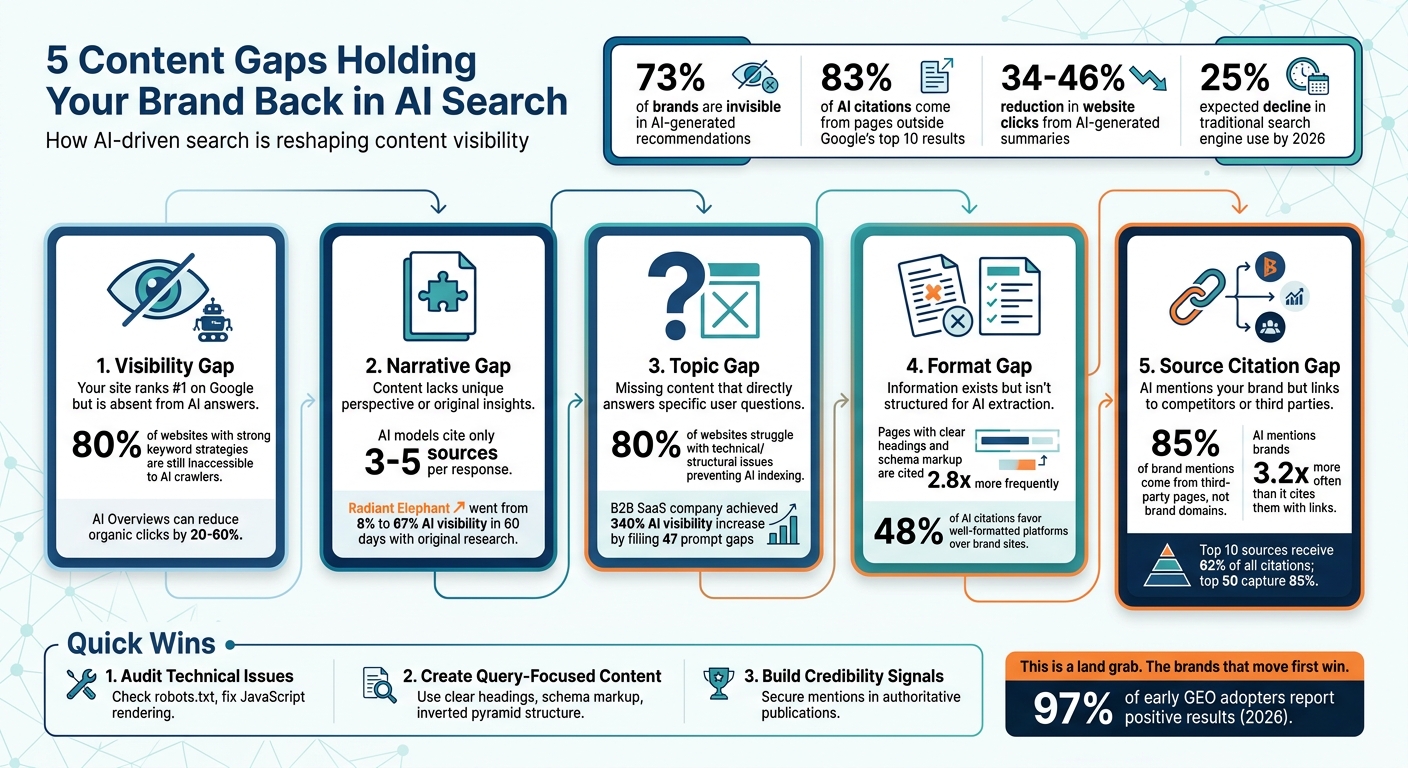
5 Content Gaps in AI Search: Key Statistics and Impact on Brand Visibility
How to be Mentioned in AI Search (Before Your Competitors Figure It Out)
sbb-itb-da7512d
1. Visibility Gap
A visibility gap happens when your brand ranks #1 on Google but is completely absent from AI-generated answers provided by tools like ChatGPT, Perplexity, or Google AI Overviews [9]. This disconnect underscores a shifting landscape where traditional SEO strategies don’t necessarily align with the requirements of AI-driven search algorithms.
The issue often stems from technical and structural barriers that prevent AI models from accessing your content. Unlike traditional search engines that rely heavily on backlinks, AI models prioritize content with clear entities and direct answers. For instance, a 2026 study revealed that nearly 80% of websites with strong keyword strategies were still inaccessible to AI crawlers like GPTBot or ClaudeBot due to technical limitations [1]. Common culprits include restrictive robots.txt files or reliance on JavaScript rendering, which many AI models cannot process.
"Fail at layer one [crawling], and nothing else matters — the content might as well not exist." – Surferstack [1]
Impact on AI Search Visibility
This gap has a tangible effect on your visibility within AI search results. AI models typically extract information from the first 100–200 words of a page, prioritizing content that delivers quick, clear answers [9]. Even if your site has high domain authority, it may be overlooked if it doesn’t meet this criteria. Additionally, Google AI Overviews, when displayed in search results, can reduce organic clicks by as much as 20% to 60%, depending on the query [9]. To stay visible, being directly cited in these AI summaries is crucial.
Relevance to Brand Reputation
AI models usually cite only 3–5 sources per response [9]. These limited citation slots act as markers of authority and trustworthiness. If competitors secure these slots, your brand risks losing credibility and audience trust. Conversely, being cited by an AI system can significantly enhance your brand’s reputation, especially as more users rely on AI platforms for recommendations.
Ease of Resolution
The good news? Fixing technical visibility gaps is relatively straightforward. Start by auditing your robots.txt file to ensure AI crawlers aren’t blocked. Address redirect chains and server errors, and implement server-side rendering to provide flat HTML versions of your pages. This is essential because many AI crawlers cannot process JavaScript [1][4].
Potential for Competitive Advantage
"This is a land grab. The brands that move first win." – AI Search Tools [9]
Early adopters who optimize their content for AI citation slots now will establish an authority that’s hard for competitors to challenge later [9]. Addressing visibility gaps today positions your brand to dominate these limited opportunities in the future.
2. Narrative Gap
Once your technical visibility is sorted, the next big piece of the puzzle is your narrative. A narrative gap happens when your brand’s content doesn’t offer a unique perspective or fresh insights. Essentially, if your content feels like it could have been pulled from any generic source, you’re leaving a gap. AI models already excel at generating broad, surface-level advice. What they look for – and prioritize – are original research, proprietary data, or expert commentary to justify citing your brand [4].
This gap becomes obvious when content feels unfocused or overly generic. AI systems are built to skip fluff and go straight for clear, structured answers. If your content meanders or lacks a strong connection to specific topics, AI may pass you over when selecting authoritative sources [9].
Impact on AI Search Visibility
Your narrative structure plays a critical role in whether AI models can extract and use your content. To stand out, your most important insights need to appear early – ideally within the first few lines. Long-winded introductions can bury your key points, making it harder for AI systems to pick up on your value.
Take Radiant Elephant as an example. In early 2026, their Creative Director Gabriel Bertolo shifted focus to publishing original research packed with quotable data. The results? Within 60 days, the brand went from appearing in 8% of AI responses for key topics to 67%. This shift also drove a 3x increase in their sales pipeline through AI discovery [7]. A well-structured narrative doesn’t just improve extraction – it positions your brand as a go-to authority.
Relevance to Brand Reputation
AI models don’t just look at how often your brand is mentioned – they assess the context of those mentions [10]. If your content lacks a strong narrative, your brand risks being cited as a secondary source rather than a key authority. On the flip side, a clear and consistent narrative builds trust and reinforces your authority in AI-generated content.
When your brand language is consistent across multiple platforms, it helps AI models describe your brand more accurately. This consistency can influence whether your mentions are framed positively, neutrally, or even critically [7].
"The greatest difference was when we realized that AI engines are looking for clarity of the original source… About two weeks after adding expert quotes and inline citations to our articles, we began showing up in AI-generated answers" – Aaron Franklin, Head of Growth at Ylopo [7]
Ease of Resolution
Addressing a narrative gap doesn’t have to mean starting from scratch. Often, it’s about tweaking your existing content to fix AI search visibility gaps [1][9]. One effective approach is adopting an inverted pyramid structure: start with a direct, concise answer before diving into details. Use headings that reflect real user questions (e.g., "How do I solve X?") instead of vague labels like "Overview" [9]. Adding specific data, expert quotes, and unique insights that aren’t widely available can make your content stand out [10][4].
Potential for Competitive Advantage
Brands that address narrative gaps early can establish Entity Authority, a status that competitors will struggle to match [9]. For instance, in April 2026, Sigma Tax Pro’s Director of Sales Ian Gardner took a proactive approach by having team members provide expert answers in niche subreddits. This consistent, authoritative presence not only increased their visibility in AI citations but also boosted branded search volume [7].
3. Topic Gap
When it comes to AI-driven search, addressing topic gaps is crucial to ensure your content provides the exact answers AI models need to cite.
A topic gap happens when your brand doesn’t have content that directly answers specific questions AI models are looking for. Unlike traditional SEO – where a single page might rank for a variety of related searches – AI models demand precise, dedicated answers. They don’t infer expertise from loosely related content. For example, if your site lacks a page explicitly answering "Is [Your Brand] SOC 2 compliant?", your brand won’t appear in AI-generated responses for that query, even if you have general content about security practices [1]. It’s a binary system: the content either exists and gets cited, or it doesn’t.
Impact on AI Search Visibility
The move from keyword-based search to prompt-based interactions has changed the game. By 2026, gap analysis focuses on identifying "prompt gaps" – those specific questions users ask AI where your competitors are cited, but you’re not [4]. A 2026 study found that nearly 80% of websites with strong keyword strategies still struggled with technical or structural issues that prevented AI crawlers from indexing their content effectively [1].
"The gap that matters now isn’t a missing keyword — it’s a missing perspective." – AI Search Tools [4]
Here’s a practical example: a B2B SaaS company offering project management software used a tool called Promptwatch to uncover 47 high-value prompts where they lacked content. By publishing 12 comparison articles and 5 case studies packed with specific metrics, their AI visibility score shot up by 340%, leading to a surge in enterprise leads [4].
Relevance to Brand Reputation
Topic gaps don’t just hurt visibility; they also affect how users perceive your brand. If your content doesn’t address key attributes like "sustainability" or "durability", AI models won’t associate your brand with these qualities when users filter by them [3]. Worse, if competitors are linked to terms like "innovative" while your brand is seen as merely "adequate", it can undermine your authority [3].
To stand out, focus on creating content that provides original research, proprietary data, or expert commentary. This approach, known as "Information Gain", gives AI models unique insights to cite. Without it, your brand risks being lumped in with generic sources.
Ease of Resolution
Fixing topic gaps is often simpler than building trust signals. Start by structuring your content using the inverted pyramid style – begin with a direct answer to the query, followed by detailed context [1][12]. Use clear headings tailored to user questions, like "Is [Brand] SOC 2 compliant?" instead of vague titles [1].
You can also use knowledge graph analysis to identify disconnected topics. For instance, if you have separate articles on "email marketing" and "automation", consider creating a piece that links them, such as "automated email sequences" [4]. Additionally, pinpoint the top 10 attributes consumers care about in your industry and produce focused content where your brand is underrepresented [3].
This targeted approach doesn’t just fill the gaps – it positions your brand as a leader in your niche.
Potential for Competitive Advantage
Spotting "white space" – areas your competitors haven’t tackled – can give you a major edge in AI recommendations [3][4]. Addressing these gaps early allows you to establish authority in areas where competitors may lag behind.
"For instance, perhaps a particular feature provides your company with a competitive advantage. You’d want to track how your brand is showing up in prompts related to this feature." – Ajdin Perco, Director of Content, Automation/AI, and Ops, Organic Growth Marketing [11]
AI models prioritize authority, precision, and Information Gain over keyword stuffing. By creating content that offers fresh insights not available in consensus sources, you position your brand as the go-to reference for AI-driven queries.
4. Format Gap
A format gap happens when your content has the right information but isn’t structured in a way that AI models can easily extract and cite. AI systems rely on modular, self-contained snippets that function as complete answers on their own [14]. Jason Roy from SEO Site Checkup refers to this as the "Utility Gap" – the difference between content that works well for human readers and content that AI systems can effectively process.
Impact on AI Search Visibility
Pages with clear headings and proper schema markup are cited 2.8 times more frequently than unstructured content [13]. Even websites with strong keyword strategies can struggle if their content isn’t formatted for AI extraction [1]. AI models break down content into "chunks", pulling out fragments that directly respond to specific questions. If your headings aren’t clear or question-based – like "How much does X cost?" instead of "Pricing Overview" – your content becomes less discoverable. This issue is critical, as AI Overviews can reduce traditional organic clicks by 20% to 60% [9]. Poor formatting not only lowers citation rates but also diminishes your brand’s authority in AI-driven search results.
Relevance to Brand Reputation
A format gap can also harm your brand’s credibility. When AI cites community platforms instead of your website, it’s often because those sources are better structured for AI extraction. Currently, about 48% of AI citations favor platforms with clearly formatted content over brand-owned sites [13].
"Visibility now depends less on reputation and more on whether content can be reused cleanly under tight constraints." – Jason Roy, SEO Site Checkup [14]
This shift means that even if your brand has expertise, it might be overlooked if your key points are buried in dense text rather than presented in concise, easy-to-extract formats.
Ease of Resolution
Closing format gaps is relatively simple. Start by adopting an inverted pyramid structure: lead with the main answer in the first 100–200 words, then provide additional details [1][9]. For comparison-based queries, use tables or bullet points to make your content easier for AI to extract [13][9]. Incorporating schema markup – like FAQPage, HowTo, or Product schema – helps AI crawlers pinpoint essential information [13][2]. Also, ensure your robots.txt file allows bots like GPTBot and ClaudeBot to access your site, and consider server-side rendering for JavaScript-heavy pages to improve accessibility [1][4].
Potential for Competitive Advantage
Optimizing your content’s format offers a clear opportunity to stand out. Unlike creating new material, this is a technical adjustment that can significantly boost citation rates [15][4][9]. By reformatting existing content into AI-friendly structures – like lists, numbered steps, and comparison tables – you position your brand as a go-to source in AI-driven search results, strengthening your authority without requiring additional content creation.
5. Source Citation Gap
A source citation gap occurs when AI mentions your brand but links to another domain – like a competitor, directory, or media outlet – instead of your own website. This happens because AI search engines prioritize extractability and verifiability over traditional ranking factors [16]. If AI can’t confidently tie a fact to your domain, it defaults to citing a more structured source, even if your brand is the original expert. The result? Your visibility and perceived authority take a hit.
Impact on AI Search Visibility
AI platforms like ChatGPT mention brands 3.2 times more often than they actually cite them with clickable links [20]. This creates what experts call an "invisible authority" effect – you provide expertise, but someone else reaps the traffic [16]. A staggering 85% of brand mentions in AI search come from third-party pages instead of the brand’s own domain [19]. AI systems often view owned content as biased, favoring third-party sources like authoritative publications, Wikipedia, or community forums [17][19]. The downside? Your expertise feeds AI responses, but your competitors or aggregators get the clicks.
Relevance to Brand Reputation
Citation gaps can erode your credibility. If AI consistently cites others while merely mentioning your brand, it signals to users that those sources are more trustworthy. Interestingly, only 12% of cited URLs rank in Google’s top ten [17], meaning strong SEO performance doesn’t guarantee AI citations. A new metric, Share of Model (SoM), tracks how often your brand is cited as the primary source in high-value AI prompts within your industry [16]. A low SoM score means you’re helping build someone else’s authority instead of your own.
"If you are not the cited authority, you are contributing to the information ecosystem without capturing the commercial value." – Agile Agency [16]
Ease of Resolution
Fixing citation gaps can significantly improve your AI search reputation. Start by creating "citable content blocks" – compact sections with query-matched headers and concise 40–70 word summaries that AI can easily extract [16]. Use schema markup (Organization, Person, Service) to strengthen entity signals, helping AI recognize your brand as the canonical source [16]. Focus on earned media by securing mentions in top-tier outlets like Forbes or TechCrunch, as these are weighted heavily by AI for authority [17][18]. Also, keep your content updated – pages not refreshed quarterly are three times more likely to lose AI citations [19].
Potential for Competitive Advantage
Optimizing for AI citations can give you a major edge. AI citations follow a power law distribution, where the top 10 sources in a niche receive 62% of all citations, and the top 50 sources capture 85% [18]. For example, in March 2026, a B2B SaaS company discovered a 32% gap in industry publication citations compared to its competitors, despite strong SEO rankings. Over six months, they worked with a PR agency and published original research on industry trends. By pitching data-driven stories to 15 target publications and securing 8 features, the company boosted its AI citations by 340% and raised its Source Diversity Score from 2 to 6 unique source types [18]. This shift from traditional PR to "machine relations" – where AI systems become part of the target audience – shows how addressing citation gaps can create a competitive advantage [17]. Tackling these gaps should be a key part of your content strategy, which can be streamlined using a WordPress plugin for AI search optimization.
How to Fix Content Gaps
Start by auditing your AI search visibility, building on the gaps identified earlier. Test 20–40 queries across platforms like ChatGPT, Perplexity, and Gemini. Use branded prompts, competitor comparisons, and customer-focused questions to identify where your content is missing. Tools like Spotlight can simplify this process by tracking up to 300 prompts per report across six major AI platforms, highlighting missing citations automatically.
Once you’ve identified the gaps, focus on what matters most for your business. Not all missing citations are equally important. Prioritize prompts with high search volume that tie directly to revenue-generating topics. For instance, in 2026, a B2B SaaS company discovered 47 high-value gaps and addressed them by fixing technical issues like redirect chains and creating 12 comparison articles plus 5 case studies. The result? Over 90 days, their AI visibility score jumped from 23 to 61, with AI search driving 18% of their total organic traffic [4]. Evaluate gaps based on factors like prompt volume, competitive difficulty, and relevance to high-intent buyer questions. This prioritization guides your next steps for technical and content improvements.
Address technical issues first. Make sure your robots.txt file isn’t blocking AI crawlers like GPTBot or ClaudeBot. Also, check that JavaScript-heavy pages render correctly for AI bots – services like Prerender.io can help if needed [1]. Fixing these issues often delivers quick wins, as outdated configurations still block AI crawlers on 80% of websites with otherwise strong content [1].
After that, create AI-friendly content. Start with a clear, concise answer within the first 100–150 words of your content. Use headings that align with actual user queries, and implement FAQ or HowTo schema markup [6][7]. As AI models evolve, these steps keep your content aligned with current best practices.
Finally, monitor and adjust regularly. AI citation patterns change over time, so ongoing AI visibility monitoring is key. Spotlight’s weekly reports, for example, measure citation frequency, source diversity, and your competitive positioning across major AI platforms. Their Pro plan ($499/month) even offers API access and custom properties, enabling you to integrate AI visibility metrics into your analytics tools. With 32% of digital marketing leaders naming Generative Engine Optimization as a top priority for 2026, and 97% reporting positive results from early efforts [8], regular monitoring turns content gap analysis into a long-term advantage rather than a one-time fix.
Conclusion
AI search has reshaped how brands get discovered, pulling together information from various sources to provide direct answers. If your content doesn’t clearly address specific questions, you risk being invisible – even if you hold the top spot on Google [10]. The five content gaps we’ve discussed – visibility, narrative, topic, format, and source citation – are critical to whether your brand gets featured in AI-driven responses or ignored entirely. These insights are the foundation for building a forward-thinking strategy.
This shift is happening fast. By 2026, traditional search engine use is expected to decline by 25% as more users turn to AI chatbots. Meanwhile, AI-generated summaries could reduce click-through rates by as much as 34% to 46% [5]. In this new landscape, being directly cited in an AI response is more impactful than a high ranking on a traditional search results page. Right now, 73% of brands are missing from AI-generated recommendations [5], creating a huge opportunity for those ready to adapt.
To bridge these gaps, take a systematic approach. Make sure AI crawlers can access your content, develop material that offers unique insights beyond what AI can aggregate, and build credibility through mentions in respected industry outlets. By addressing these areas, brands can position themselves to thrive as AI search evolves.
Spotlight provides tools to track AI visibility with weekly updates on citation frequency, source diversity, and competitive standing. This turns content gap analysis into an ongoing, actionable strategy.
"Many brands don’t realize they’re losing ground until they’ve already been replaced in the recommendations that matter most." – Sight AI [10]
Brands that act now will build the authority and trust signals needed to succeed in the AI-driven search era. Waiting too long risks losing relevance in the recommendations that shape consumer decisions.
FAQs
How do I check if AI crawlers can access my site?
To make sure AI crawlers can access your website, begin with a technical audit to spot potential obstacles, such as improperly configured robots.txt files or crawl restrictions. Utilize diagnostic tools to assess whether AI-specific crawlers like GPTBot or ClaudeBot can navigate your site effectively. Additionally, reviewing your server logs can provide insights into which bots are visiting and whether any pages are being blocked. Fixing these problems can enhance your site’s visibility in AI-driven search results.
What content gets cited most often in AI answers?
AI tends to favor content that is well-researched, insightful, and thorough. This typically includes:
- Unique research that provides fresh data or perspectives.
- Expert insights showcasing deep knowledge of the topic.
- Organized and detailed information, presented in a clear and logical way.
Rather than focusing on keyword-stuffed material, AI models lean toward sources that deliver real depth and quality.
How can I get AI to link to my site, not third-party sources?
To get AI to link to your site rather than third-party sources, focus on producing well-structured, authoritative, and entity-rich content. Make sure your site showcases expertise on specific topics by presenting detailed, well-organized information. It’s also helpful to study citation trends to spot areas where content is lacking. Then, refine your material to address these gaps by answering specific questions and offering fresh insights. AI models are drawn to content that provides original viewpoints and effectively addresses common user queries.

Michael Hermon
Before Spotlight, Michael led Innovation and AI at monday.com after exiting his previous startup. He learned to code at 13 at MIT and later attended Columbia’s MBA program.
https://linkedin.com/in/michaelhermon