
What Is AI Visibility and Why Does It Matter?
AI visibility is about how often and favorably your brand appears in responses generated by AI tools like ChatGPT, Claude, and Google AI Overviews. Unlike traditional search engines that show a list of links, AI tools provide direct answers, often highlighting only 3–5 brands. This shift changes how businesses need to approach online discovery.
Key points:
- AI tools make decisions for users instead of offering multiple options.
- 31% of Gen Z users now start searches on AI platforms, bypassing search engines.
- Traditional SEO success doesn’t guarantee AI visibility. For example, 88% of Google AI citations don’t overlap with top organic results.
- Metrics like mention rate, sentiment, and citation rate are critical for measuring AI visibility.
- Brands need to focus on structured data, original content, and content optimization tools to improve visibility.
If your brand isn’t visible to AI, you risk being left out of the conversation entirely. Monitoring your presence through AI visibility resources is essential for maintaining a competitive edge. The way forward is clear: optimize for AI platforms or risk losing ground to competitors.
5 Ways to Increase AI Visibility and Get Found in AI Search
sbb-itb-da7512d
What Is AI Visibility?
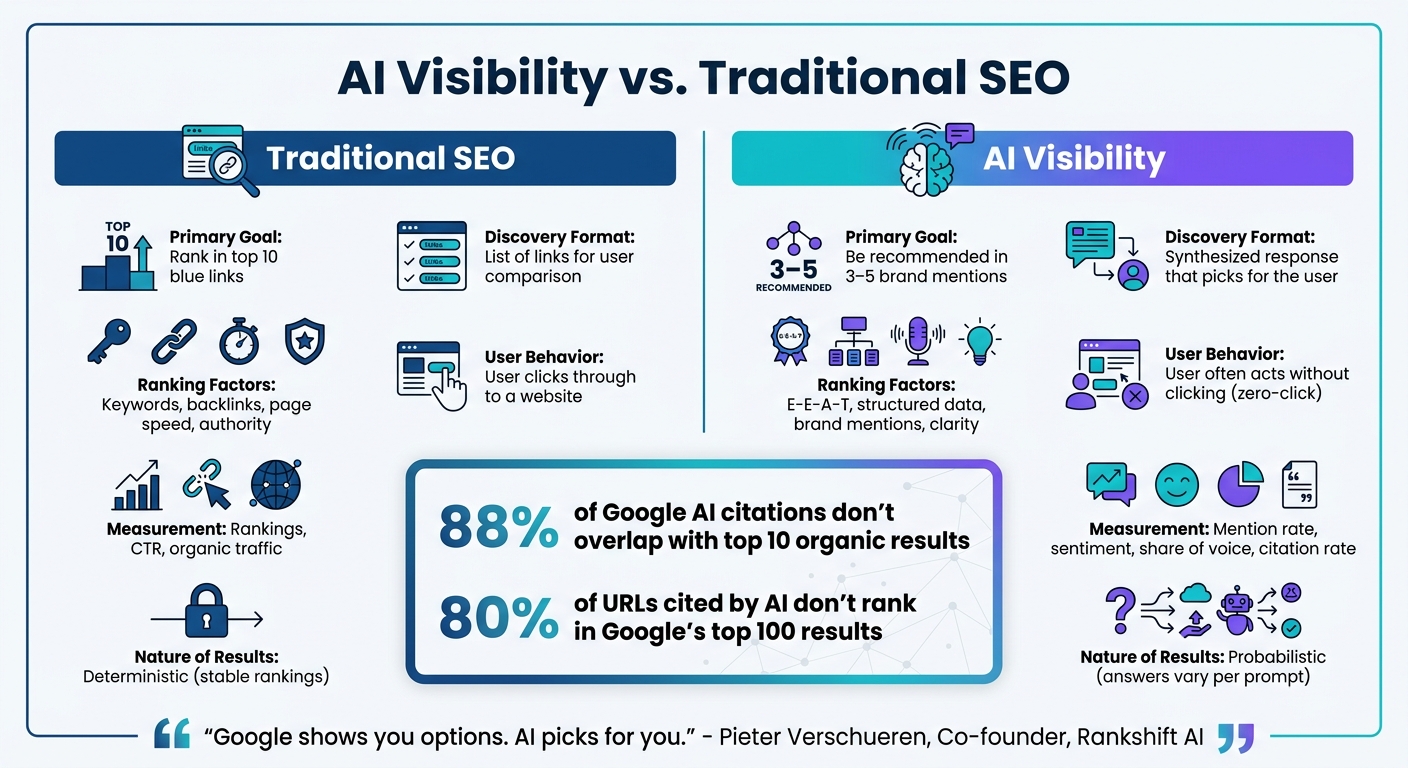
AI Visibility vs Traditional SEO: Key Differences and Metrics
AI visibility refers to how often, accurately, and favorably your brand appears in responses generated by AI tools like ChatGPT, Claude, Perplexity, Gemini, and Google AI Overviews [1]. Unlike traditional search rankings, AI visibility isn’t about where your site lands on a results page – it’s about whether an AI platform considers your brand credible enough to include in its responses.
This visibility is shaped by how well AI systems interpret and trust your brand. Since these platforms rely on probabilistic models, the results can vary widely. For example, the chances of seeing the same brand recommendations for the same query are less than 1 in 100 [2].
Neil Patel, a well-known digital marketing expert, sums it up perfectly:
"In the AI era, visibility isn’t about rankings, it’s about being cited." [1]
Let’s break down the key factors that influence AI visibility.
Core Components of AI Visibility
Several factors determine how AI platforms perceive and feature your brand:
- Mention Rate: This measures how frequently your brand appears in relevant AI-generated answers [1]. The more often it’s mentioned, the more discoverable your brand becomes.
- Accuracy and Resolution: This ensures the AI correctly identifies your brand and accurately describes its offerings. Misrepresentation or inconsistent messaging can lead to errors, causing the AI to miscategorize or omit your brand [3][5].
- Sentiment: AI platforms often reflect the tone found in their training data – whether positive, neutral, or negative. Sentiment is influenced by external factors like reviews, forum discussions, or press coverage, and negative impressions can linger for months [1][7].
- Attribution and Citation: This tracks whether the AI includes clickable links or references to your content. Structured data, clear headings, and concise answers can help AIs better extract and cite your material [2][4].
- Prominence: This refers to the position of your brand in AI recommendations. Since most AI tools only mention 3–5 brands per query, appearing at the top is crucial [1].
These components collectively shape your brand’s visibility in AI-driven environments and highlight how this approach differs from traditional SEO strategies.
AI Visibility vs. Traditional SEO
AI visibility and traditional SEO operate on entirely different frameworks. SEO focuses on ranking specific web pages, while AI visibility revolves around how well the broader concept of your brand is understood and presented [2][4].
The user experience also varies. Traditional search gives users a list of links to explore, while AI platforms synthesize information into a single, complete response. As Pieter Verschueren, Co-founder of Rankshift AI, explains:
"Google shows you options. AI picks for you." [2]
Metrics have also shifted. SEO tracks rankings, click-through rates, and organic traffic. In contrast, AI visibility is measured by factors like mention rate, sentiment, share of voice, and citation rate. While SEO prioritizes keywords, backlinks, and domain authority, AI visibility places importance on E-E-A-T (Experience, Expertise, Authoritativeness, Trustworthiness), structured data, brand mentions, and clarity [1][3].
Here’s a side-by-side comparison:
| Dimension | Traditional SEO | AI Visibility |
|---|---|---|
| Primary Goal | Rank in top 10 blue links | Be recommended in 3–5 brand mentions |
| Discovery Format | List of links for user comparison | Synthesized response that picks for the user |
| Ranking Factors | Keywords, backlinks, page speed, authority | E-E-A-T, structured data, brand mentions, clarity |
| User Behavior | User clicks through to a website | User often acts without clicking (zero-click) |
| Measurement | Rankings, CTR, organic traffic | Mention rate, sentiment, share of voice, citation rate |
| Nature of Results | Deterministic (stable rankings) | Probabilistic (answers vary per prompt) |
Interestingly, research reveals that 88% of citations in Google AI Mode don’t appear in the top 10 organic results for the same search, and 80% of URLs cited by AI don’t even rank in Google’s top 100 results [3][6]. This underscores that excelling in traditional SEO doesn’t guarantee strong AI visibility.
Lily Ray, VP of SEO at Amsive Digital, captures the shift well:
"AEO/GEO is not an overhaul or abandonment of SEO. Instead, it represents a new system for competing for, capturing, and measuring success across AI platforms." [1]
Why AI Visibility Matters for Brands
AI visibility is becoming a critical factor in how brands are discovered and evaluated. With 65% of users now starting their product research using AI tools instead of traditional search engines [5], being included in AI-generated responses can directly influence your revenue.
Consider this: ChatGPT handles over 100 million daily queries, Perplexity processes 15 million searches per day, and Google’s AI Overviews appear in about 60% of search results [5]. If your brand isn’t part of these AI-driven conversations, you risk being invisible to a growing audience. This shift also brings new challenges in managing your brand’s reputation.
Protecting and Building Brand Reputation
AI platforms don’t just list brands – they shape how audiences perceive them. Depending on the data they pull, an AI model might describe your brand as a "leader", an "alternative", or even a "budget option." Worse, they might include warnings that could sway potential customers [8].
These platforms scan thousands of online sources to form an understanding of your brand, including your offerings, target audience, and reliability. If the information they find is inconsistent or unclear, your brand could be misrepresented – issues that may not show up in your traditional analytics [5].
Mentions alone aren’t enough – sentiment matters. AI systems mirror the tone of their training data, which includes reviews, forums, and press coverage. Negative impressions can linger for months, subtly discouraging customers. On the other hand, positive, consistent information from authoritative sources like Reddit, YouTube, G2, and major news outlets helps build trust with AI models [2].
Reaching Your Target Audience
AI platforms are transforming how people discover and choose brands. Unlike traditional search engines that provide a list of options, AI tools synthesize information into a single recommendation. This shortens the buyer journey, making it crucial for brands to secure a spot in the AI’s response. Without that inclusion, your brand risks being overlooked entirely [8]. With over 800 million people seeking product recommendations from AI tools weekly [9], the stakes are high.
AI-driven recommendations often lead to higher conversion rates because the technology pre-qualifies your brand based on a user’s specific needs [2]. For instance, in early 2026, LinkedIn’s marketing team, led by Inna Meklin and Cassie Dell, launched an "AI Search Taskforce." They shifted their focus from traditional organic traffic to AI-specific metrics like citation rates and brand mentions [2].
Maintaining Competitive Position
AI visibility isn’t just about audience reach – it’s also about staying ahead of competitors. The AI landscape operates on a winner-take-most principle, where top brands dominate 85–97% of relevant prompts, leaving smaller brands with only 5–10% visibility [2]. Success here isn’t always tied to budget or size but rather to how well AI models understand and trust your brand.
Take the case of GMB Briefcase, a local SEO software. In January 2026, an audit revealed that while the brand had 57% visibility for branded terms, it achieved 0% Share of Voice for high-intent queries like "top tools for Google My Business automation." AI models simply didn’t recognize the brand in these competitive searches [5].
Brands that act now to strengthen their AI visibility will gain a lasting advantage. As Trysight.ai put it:
"The question isn’t whether to optimize for AI search engines – it’s how quickly you can establish strong visibility before your market becomes saturated with competitors doing the same." – Trysight.ai [8]
Data supports this urgency. Brands with over 32,000 referring domains are 3.5× more likely to be cited by ChatGPT than those with fewer than 200. Additionally, pages not updated in over three months are more than 3× as likely to lose AI visibility [2]. The key to success lies in expanding your brand’s digital footprint, keeping content up-to-date, and closely monitoring AI performance. The brands that prioritize this now will be the ones AI platforms recommend when it counts most.
How to Measure AI Visibility
Measuring AI visibility takes a different path compared to traditional SEO methods. Instead of focusing on keyword rankings or organic traffic, the emphasis shifts to whether AI platforms mention your brand, how they describe it, and how often your brand appears in responses. As Neil Patel explains:
"In the AI era, visibility isn’t about rankings, it’s about being cited." [1]
AI visibility boils down to being one of the three to five brands recommended in a synthesized response [1]. But here’s the catch: when a model update is released, your visibility can fluctuate by as much as 40–60% overnight [1]. This makes regular monitoring and new metrics essential to keep up with AI’s evolving recommendations.
Key Metrics for AI Visibility
To understand how your brand performs on AI platforms, you need to track a few critical metrics:
- Mention Rate (Visibility Rate): This is the percentage of relevant prompts where your brand appears. For example, if your brand shows up in 45 out of 100 queries, your Mention Rate is 45% [1].
- Position: This measures where your brand is ranked in AI recommendations. Being listed first is crucial, as first positions convert 3.2 times better than subsequent ones [11].
- Sentiment Score: This evaluates the tone AI uses when describing your brand – positive, neutral, or negative. It’s not just about being mentioned but about how well the description aligns with your brand’s intended image [10][11].
- Share of Voice (SOV): This compares how often your brand is mentioned versus competitors in your category [11][5]. One example showed a tool with a 57% visibility rate for branded terms but 0% SOV for high-intent queries, proving that a high Mention Rate doesn’t always guarantee strong recommendations.
Other useful metrics include:
- Citation Rate: Tracks how often AI platforms link directly to your website as a source [11][1].
- Engine Coverage: Measures your brand’s presence across AI platforms like ChatGPT, Gemini, Perplexity, and Claude. Brands appearing on four or more platforms are 2.8 times more likely to be cited by ChatGPT compared to those on only one [1].
| Metric | Poor | Average | Good | Excellent |
|---|---|---|---|---|
| Citation/Mention Rate | <20% | 20–40% | 40–60% | 60%+ |
| Position Score (1–10) | <4 | 4–6 | 6–8 | 8+ |
| Net Sentiment Score | <0 | +10 to +40 | +40 to +70 | +70 to +100 |
| Engine Coverage | 1 platform | 2 platforms | 3 platforms | 4+ platforms |
These metrics can work together as a combined indicator for easier evaluation.
AI Visibility Score
To simplify tracking, many brands consolidate these metrics into a single AI Visibility Score. This composite score assigns weight to each component:
- Citation Rate: 40% (mentions are the foundation)
- Position Score: 30% (ranking impacts conversions)
- Sentiment Score: 20% (tone influences perception)
- Engine Coverage: 10% (platform reach matters) [11]
This score gives a clear snapshot of your brand’s visibility across AI platforms and helps refine your strategy for maintaining a strong presence.
Start by auditing 15–20 high-intent, non-branded queries across multiple AI engines. Record your brand’s mention rates and sentiment [12][10]. Then, analyze 3–5 key competitors using the same prompts to see where they might have an edge over you [12].
How to Improve AI Visibility
Once you’ve evaluated your brand’s current standing, the next step is refining your approach. Unlike standard SEO practices, improving AI visibility demands a broader strategy. It’s not just about ranking for keywords – it’s about establishing a digital presence that AI models recognize as both reliable and authoritative.
Optimizing Content for AI Platforms
When it comes to AI platforms, context beats keywords. Creating in-depth guides (often exceeding 2,000 words) can position your brand as an expert in your field [13]. Start by ensuring a solid technical framework: incorporate Schema.org markup, create an llms.txt file, and integrate IndexNow to help AI systems index and interpret your content accurately [13][14].
Structure your content with conversational, question-driven headings (H2/H3) that reflect natural language. For example, use headings like "What CRM should I use for a real estate team of 5?" instead of generic titles like "Best CRM Software." In your opening paragraphs, clearly explain your product and its target audience – this clarity is something AI models prioritize [14].
Boost your authority by increasing citations on trusted platforms like G2, Capterra, and respected industry publications. This multi-platform approach helps AI systems validate your credibility. As Conor Baker, Content Marketing Manager at Conductor, puts it:
"Success isn’t about rankings, keywords, and organic traffic anymore. To drive success, brands need to prioritize visibility across all search experiences and optimize with the goal of improving mentions and citations within AI responses." [15]
Consistency matters too. Use your brand name, product names, and category terms uniformly across all content. Develop detailed use case documentation tailored to specific industries or workflows (e.g., "How SaaS companies use [Product] to reduce onboarding time"). Additionally, create comparison pages like "Product A vs. Competitor B", since AI models often reference these for alternative queries [14].
Finally, use tools like Spotlight to track and refine these strategies with a free LLM Readiness Report, ensuring your efforts lead to sustained visibility.
Using Spotlight to Monitor and Improve AI Visibility
Once your content is optimized, monitoring its impact is essential. Spotlight provides a centralized dashboard to track brand visibility, sentiment, and positioning across major AI chatbots, including ChatGPT, Gemini, Perplexity, Grok, Claude, Copilot, and Google AI Overviews. This is particularly important given that about 65% of online discovery now starts with AI chatbots instead of traditional search engines [16].
Spotlight’s prompt discovery feature uses proprietary data to identify the exact questions potential customers are asking about your industry. As Michael Hermon, Founder of Spotlight, explains:
"Spotlight helps you identify the most relevant and searched prompts related to your business using proprietary data sources and advanced methods to uncover what potential customers are actually asking AI models." [16]
The platform also analyzes LLM data sources to identify content likely to be cited by AI models. It offers AI-optimized content drafts, seamless integration with tools like WordPress via plugins, and highlights content gaps along the customer journey – pinpointing areas where your brand might be overshadowed by competitors [16].
For managing your reputation, Spotlight tracks branded prompts to flag negative mentions, giving you the chance to address potential issues before they escalate. It also integrates with Google Analytics 4, enabling you to measure traffic driven by AI models. By tracking metrics like mention rate, sentiment, and position, Spotlight connects AI visibility directly to business outcomes, helping you navigate the challenges of fluctuating AI recommendations with real-time data [16].
Conclusion
AI visibility is now a make-or-break factor for brands. With 65% of users starting their product research with AI tools instead of traditional search engines [5], and platforms like ChatGPT handling over 100 million daily queries [5], the way buyers discover products has completely changed. The old "search and click" model has been replaced by a new reality: "be seen, mentioned, and chosen" [2]. If your brand isn’t part of the AI-generated answer, you’re out of the game before the buyer even knows you exist.
The risks of ignoring AI visibility are already evident. Since the introduction of AI Overviews, click-through rates on top organic results have dropped by 32% [17], and predictions suggest that zero-click searches could exceed 70% by 2025 [17]. Even a #1 ranking on Google won’t guarantee visibility in AI-driven platforms. As more users rely on AI assistants instead of traditional search engines, organic traffic metrics lose their value, hiding the real risks to your pipeline [5]. Worse, outdated or incomplete information could lead AI models to misrepresent your brand [5].
Addressing these challenges requires action.
"Google shows you options. AI picks for you." – Pieter Verschueren, Co-founder, Rankshift AI [2]
The good news? AI visibility is something you can actively improve. Focus on structuring your content for quick and accurate extraction, maintaining a strong digital presence, and regularly updating your information to stay relevant. Tools like Spotlight can help you track mentions across platforms like ChatGPT, Gemini, and Perplexity, pinpointing where competitors are outperforming you and offering actionable steps to close those gaps [18][19].
The competitive landscape has shifted, and the rules are new. Brands that prioritize AI discovery and ensure they’re part of the conversation will lead the way.
FAQs
How is AI visibility different from SEO?
AI visibility and SEO may seem similar at first glance, but they differ in both focus and how success is measured. SEO is all about improving your rankings on search engine results pages (SERPs). It’s focused on ensuring your content appears prominently when users search for relevant keywords.
On the other hand, AI visibility takes a different approach. It’s about making sure your brand is accurately mentioned and recommended in AI-generated responses on platforms like chatbots or AI tools. While SEO is concerned with search result placement, AI visibility focuses on how AI systems integrate and present your brand in their responses. This can significantly impact how people discover your brand and perceive its reputation.
What can I do if AI tools describe my brand incorrectly?
If AI tools misrepresent your brand, it’s important to take action to set things right. Start by ensuring your website and digital platforms consistently showcase accurate branding. Use clear, authoritative content that reflects your identity. Regularly monitor your brand’s presence in AI-driven platforms using specialized tools to catch any inaccuracies before they spread.
If problems continue, consider reaching out to the support teams of the relevant AI platforms. Additionally, refining your SEO and content strategies can help improve how your brand is represented online.
How do I track AI visibility across multiple AI platforms?
To keep tabs on AI visibility across different platforms, leverage tools designed to track metrics like brand mentions, query activity, and citation sources. Automating your reporting process can simplify the task of gathering data from platforms such as ChatGPT or Gemini, ensuring all relevant information is in one place.
Start by defining the key queries you want to monitor. Then, analyze the responses these platforms generate and connect the findings to your business goals. This approach allows you to pinpoint gaps, measure your share of voice, and fine-tune your content to improve visibility across AI-powered platforms.

Michael Hermon
Before Spotlight, Michael led Innovation and AI at monday.com after exiting his previous startup. He learned to code at 13 at MIT and later attended Columbia’s MBA program.
https://linkedin.com/in/michaelhermon