
AI Search vs Traditional SEO: What Marketers Need to Know

AI search is changing how people find information. While search engines like Google still drive most traffic, tools like ChatGPT and Claude are reshaping visibility by delivering direct answers without users clicking links. For marketers, this means a shift from ranking high in search results to being cited in AI-generated responses.
Key Takeaways:
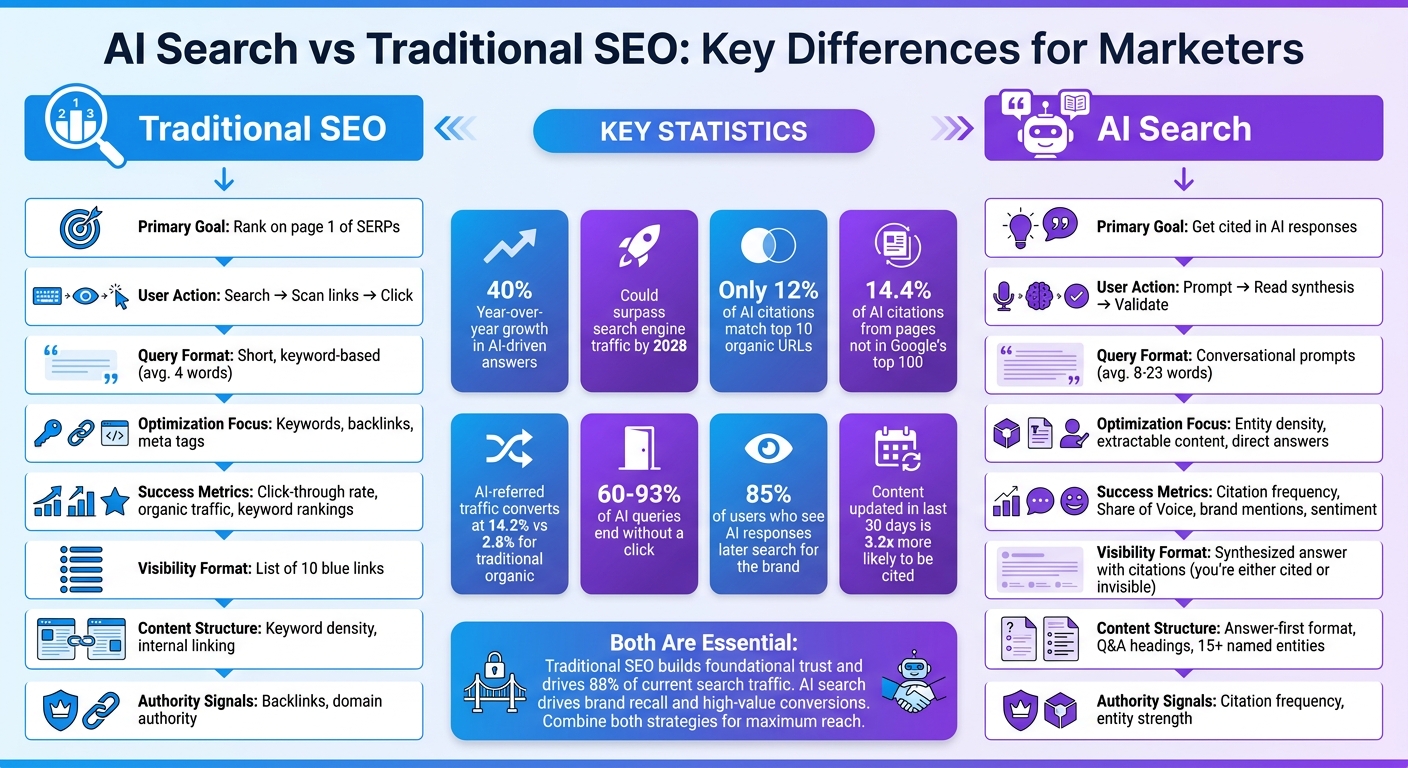
- Search Behavior is Changing: AI-driven answers are growing 40% year-over-year and could surpass search engine traffic by 2028.
- Different Goals: SEO focuses on rankings and clicks; AI search prioritizes citations and brand mentions.
- Optimization Approaches Differ: SEO relies on keywords and backlinks, while AI search requires concise, extractable content designed for recommendation systems and AI visibility.
- Performance Metrics: SEO measures traffic and rankings, while AI search tracks citation frequency and brand sentiment.
Quick Comparison:
| Aspect | SEO Focus | AI Search Focus |
|---|---|---|
| Goal | Rank on SERPs | Get cited in AI responses |
| User Action | Click-through | Read synthesis, validate |
| Optimization | Keywords, backlinks | Entity density, direct answers |
| Metrics | Traffic, CTR | Citations, sentiment |
Both methods are essential. SEO builds foundational trust, while AI search drives brand recall and high-value traffic. Combining both strategies ensures maximum reach and impact.
AI Search vs Traditional SEO: Key Differences for Marketers
How AI Search Differs from Traditional SEO
Goals and User Experience
Traditional SEO has always focused on getting pages to rank high, aiming for clicks. AI search, on the other hand, delivers answers directly in response to user queries, often eliminating the need for clicks altogether [3][4].
This shift changes how users interact with search results. In a traditional setup, users browse a list of links, choose one, and click through. With AI search, users are presented with a synthesized answer immediately and may only click on a citation link if they want to verify the information or explore further [5]. As one expert aptly stated:
"Traditional SEO gets you ranked. AI visibility gets you cited. Both matter, but they measure different things." – AI Search Tools Guide [5]
In this new landscape, users form opinions about brands based on the AI-generated response itself. Clicks, if they happen, occur later in the process [5]. This makes being cited directly in AI responses the key to increasing brand awareness.
Let’s explore how this impacts visibility in search results.
Visibility in AI Results vs SERPs
Traditional SEO follows a clear structure: the goal is to rank among the top 10 results on Google’s search engine results page (SERP). Moving up from page 2 to page 1 can significantly boost traffic. AI search, however, works differently. You’re either cited or completely invisible – there’s no in-between [4].
Interestingly, the overlap between traditional rankings and AI citations is minimal. Only 12% of AI citations match the exact URLs that appear in the top 10 organic results for the same query [6]. Even when looking at the domain level, just 20% of citations come from websites listed in the top 10 traditional results [6]. Surprisingly, 14.4% of AI citations come from pages that don’t even rank in Google’s top 100 [7].
Why is there such a gap? AI engines don’t just rely on keyword rankings. They conduct multiple related queries behind the scenes, pulling information from various sources [6]. Instead of focusing on entire pages, they extract specific passages, grabbing relevant chunks of content. This approach explains why platforms like YouTube have become the second most frequently cited external source in AI search results [6].
These differences in how visibility works lead to unique user behaviors and optimization strategies.
Optimization Targets and User Actions
The way users interact with traditional SEO and AI search dictates how brands should optimize their content. Traditional SEO often focuses on short, keyword-based queries averaging around four words. AI search, however, responds to longer, conversational prompts averaging eight words [2]. For example, analysis of the brand Petlibro showed that while its Google rankings were based on 4-word keywords, its AI citations came from prompts averaging 8 words [2].
Success metrics also differ. Traditional SEO measures success by click-through rates and organic traffic. In contrast, AI search success is tied to how frequently your content is cited and how often your brand is mentioned in AI-generated responses [4][1]. This shift has led marketers to adopt a new mindset, moving from “click-through” to “trust-through.” The idea is that even without clicks, being recommended by AI can still add value to your brand [1].
Understanding these differences is essential to adapting your strategy to meet changing search habits.
| Aspect | Traditional SEO | AI Search |
|---|---|---|
| Primary Goal | Rank on page 1 of SERPs | Get cited in AI responses |
| User Action | Search, scan links, click [5] | Prompt, read synthesis, validate [5] |
| Success Metric | Click-through rate, organic traffic | Citation count, brand mentions [4][1] |
| Query Type | Keyword-based, 4 words average [2] | Conversational, 8 words average [2] |
| Content Focus | Keyword optimization | Entity and extractability optimization |
| Visibility Format | List of 10 blue links [4] | Synthesized answer with citations [4] |
sbb-itb-da7512d
Why "AI Search is Just SEO" is a Dangerous Lie
Keyword Research vs Prompt Discovery
Building on the differences in visibility and interaction, the methods for uncovering content opportunities vary significantly.
Traditional SEO Keyword Research
In the SEO world, keyword research is the backbone of strategy. Marketers rely on specialized tools to pinpoint search terms with high traffic potential, assess competition, and find a balance between ranking opportunities and traffic generation. These keywords are typically short and fragmented, often referred to as "keywordese", with an average length of about four words [8].
These tools analyze historical search data, offering insights like monthly search volume, cost-per-click (CPC), and keyword difficulty. Once identified, marketers optimize content to rank for these terms, keeping a close eye on performance through SERP rankings and organic traffic metrics.
AI Search Prompt Discovery
AI search, on the other hand, calls for a completely different playbook. Instead of focusing on high-volume keywords, marketers need to identify the conversational prompts that lead AI systems to recommend specific brands. These prompts are much longer – averaging 23 words – and often resemble detailed problem statements, complete with contextual details and constraints [8].
As Sergei Rogulin, Head of Organic & AI Visibility at Semrush, explains:
"Prompt research is the process of identifying and tracking the questions that cause AI systems to compare options and recommend specific brands." – Sergei Rogulin [9]
To uncover these prompts, marketers use techniques like persona prompting, where they instruct AI systems to assume a specific customer persona (e.g., "Act as a frustrated HR manager") to simulate real-world queries [8]. Platforms like Reddit and Quora, as well as customer service logs, provide additional insights into how users naturally describe their problems. For instance, in early 2026, Dover Saddlery utilized an AI toolkit to reveal search queries to refine its attributes for comparison. The brand discovered that AI systems favored them not for broad category keywords but for their operational strengths, such as a wide product range and reliable, fast delivery [9].
Interestingly, a majority of AI prompts – between 65% and 85% in early 2026 – did not align with any keywords found in traditional search databases [10]. Marketers also need to consider query fan-out, where AI engines break down a single, complex prompt into several smaller queries to generate a comprehensive response [8].
Next, we’ll explore how these distinct research methods shape unique content optimization strategies.
Comparison Table: Queries vs Prompts
| Feature | Traditional SEO Keyword Research | AI Search Prompt Discovery |
|---|---|---|
| Primary Goal | Identify terms to rank | Identify prompts that trigger brand recommendations |
| Query Format | Short, fragmented queries ("keywordese") | Conversational sentences |
| Average Length | Approximately 4 words | Approximately 23 words |
| Core Metrics | Search volume, CPC, keyword difficulty | Brand mentions, citations, sentiment, share of voice |
| Research Tools | Keyword research tools | AI search optimization platforms |
| User Intent | Informational, navigational, transactional | Conversational, task-based, constraint-heavy |
| Data Source | Historical search trends and clickstream data | AI chat logs, community forums, and persona simulation |
Content Optimization Methods
If you want your content to perform well, you need to tailor your approach depending on whether you’re targeting traditional SEO or AI-driven search. These two methods share the goal of boosting brand visibility but require very different strategies to get there.
Optimizing for Traditional SEO
Traditional SEO focuses on the basics: keywords and backlinks. This means integrating target keywords into title tags, meta descriptions, and headings. Backlinks from high-authority websites remain a cornerstone for building credibility. Internal links also play a role by distributing authority across your site. And while keyword density isn’t as critical as it used to be, it still helps signal relevance.
Content structure is another key factor. A clear hierarchy and well-organized layout make your pages easier to navigate and understand. On top of that, technical elements like fast loading times and mobile-friendly designs are essential for staying competitive.
Creating AI-Optimized Content
AI search engines, on the other hand, operate differently. As Marco Di Cesare, Founder of Loamly, explains:
"AI search engines are not web directories. They are recommendation systems." [11]
This means your content needs to be designed for extraction rather than just ranking. Start with an inverted pyramid structure: lead with a concise, direct answer (40–60 words) and then expand with supporting details. AI models often extract and cite specific chunks of content, so make each section self-contained.
Entity density replaces traditional keyword density as a priority. Including 15 or more named entities in your content can increase your chances of being cited by 4.8x.[11] Using Q&A-style headings instead of generic ones like "Overview" can also double your citation opportunities.[11] And here’s a pro tip: get straight to the point in the first 30% of your content – this approach captures 44.2% of AI citations.[11]
Recent updates matter too. Pages refreshed within the last 30 days are 3.2x more likely to be cited by AI tools, with 76.4% of ChatGPT’s top-cited pages falling into this category.[11][12]
Don’t forget the technical side. Make sure AI crawlers like GPTBot and ClaudeBot aren’t blocked in your robots.txt file. Use detailed schema markup (like FAQ, HowTo, or Article with JSON-LD), as 82% of cited domains rely on it.[11] You might also want to add an llms.txt file to point AI crawlers toward your most relevant content.[11]
Comparison Table: Optimization Strategies
Here’s a quick breakdown of how traditional SEO and AI optimization stack up:
| Focus Area | Traditional SEO Approach | AI SEO Equivalent |
|---|---|---|
| Research | Identify keywords users type into search engines | Discover conversational prompts entered in AI tools |
| On-Page | Optimize title tags and internal linking | Craft content for easy extraction with direct answers |
| Technical | Enhance crawlability and speed | Ensure AI crawlers can access and render content |
| Authority | Build backlinks from high-authority domains | Earn digital PR and brand mentions across the web |
| Measurement | Track rankings and organic traffic | Monitor citation share and sentiment analysis |
Performance Metrics for AI Search and Traditional SEO
As we’ve explored visibility and optimization strategies, it’s clear that measuring performance must evolve alongside these emerging paradigms. AI search introduces a new way of thinking about performance compared to traditional SEO. Adam Heitzman, Co-Founder of HigherVisibility, sums it up well:
"That monthly SEO report you’ve been running for years? It’s telling an increasingly incomplete story." [14]
The difference is stark. Traditional SEO relies on metrics like clicks and traffic to measure success – rankings drive traffic, and traffic drives conversions. On the other hand, AI search revolves around visibility, where citations and mentions can build brand awareness, even if users never visit your site [13].
Traditional SEO Metrics
Traditional SEO focuses on performance in search engine results pages (SERPs) and user interactions on your website. Key metrics include:
- Keyword rankings: Track where your site appears for target search terms.
- Click-through rate (CTR): Measure how many users click on your listing.
- Organic traffic: Gauge the volume of visitors coming from search engines.
- Backlinks: Assess your site’s authority based on external links.
- Technical performance: Monitor factors like page load speed, mobile compatibility, and crawl errors.
These metrics are well-suited for understanding how users interact with SERPs and your site. But AI search requires a different set of tools to measure its impact.
AI Search Metrics
AI search changes the game because user behavior is different. Between 60% and 93% of AI-driven queries end without a click to any website [13]. As a result, tracking how often AI tools mention your brand becomes critical. Here are some key metrics for AI search:
- Citation frequency: Measure how often AI tools reference your brand in their responses.
- AI Share of Voice (SOV): Quantify the percentage of AI responses that mention your brand.
- Branded query volume: Track the increase in branded searches on Google, as 85% of users who see AI responses later search for the brand [13].
- Sentiment analysis: Understand how AI tools describe your brand – are you seen as a leader or just another option? As Wil Reynolds from Seer Interactive warns:
"AI visibility on its own is a vanity metric… a raw ‘you were mentioned 40 times’ number tells you almost nothing without context." [15]
- Prompt coverage: Evaluate how often your brand appears across relevant category prompts.
- AI crawler activity: Check server logs for bots like GPTBot, ClaudeBot, and PerplexityBot to identify pages that might soon be cited [15].
AI-referred traffic also stands out for its quality. It converts at 14.2%, significantly higher than the 2.8% average for traditional organic search. Plus, these sessions last 8% longer and have a 23% lower bounce rate [13].
Comparison Table: Performance Metrics
| Metric Category | Traditional SEO | AI Search |
|---|---|---|
| Primary Goal | Rankings and clicks | Citations and brand recall |
| Visibility Measure | Keyword position (1–10) | AI Share of Voice (SOV) |
| Authority Signal | Backlinks and domain authority | Citation frequency and entity strength |
| User Action | Click-through rate (CTR) | Answer accuracy and sentiment |
| Traffic Source | Organic sessions (GA4/GSC) | LLM referral traffic and branded search lift |
| Content Signal | Keyword density and on-page SEO | Reusability and topical depth |
A practical tip: Use GA4 to create custom segments for referral traffic from sources like chatgpt.com, perplexity.ai, and claude.ai. This helps you distinguish high-converting AI traffic from traditional organic sources, enabling better resource allocation [13].
How to Use Spotlight for AI Search Optimization
Spotlight provides a structured way to monitor, refine, and safeguard your brand’s presence across major AI platforms like ChatGPT, Gemini, Perplexity, Grok, and Claude.
Using Spotlight for Prompt Discovery
A key challenge in AI search optimization is figuring out which user prompts to target. Unlike traditional SEO, which focuses on keyword research, AI search revolves around understanding conversational prompts. Spotlight simplifies this by analyzing over 2.4 million AI search results to identify valuable prompts and group them into topics relevant to your brand [18].
Spotlight focuses on three primary prompt types: recommendations, comparisons, and problem-solving queries. Through an AI visibility audit, which takes about 2–3 hours, you can establish your brand’s current presence in AI search results [16].
The platform also tracks Share of Voice, a metric that measures the percentage of AI responses featuring your brand. As TrackAIMentions explains:
"Share of Voice – what percentage of AI responses to your target keywords include your brand – is a concrete number you can track monthly" [17].
Once you’ve identified the most important prompts, you can adjust your content to make it more "quotable." This involves reworking marketing copy into clear, factual statements that AI models can easily extract and reference. Technical tweaks, like using an llms.txt file to guide AI crawlers and implementing IndexNow for quicker content discovery, can further improve your AI search performance [16].
Changes to your Share of Voice typically become noticeable within 3 to 6 months, although platforms like Perplexity may show results in as little as 2 to 6 weeks [17]. This focus on prompts works smoothly alongside the performance metrics covered earlier.
Tracking Brand Visibility Across AI Platforms
After optimizing your content, Spotlight helps you track your brand’s visibility across various AI platforms. It monitors mentions on eight major platforms – including ChatGPT, Google AI Mode, Grok, Gemini, Claude, Perplexity, Copilot, and Google AI Overviews – by simulating user queries regularly [18]. Spotlight measures three key metrics:
- Mention Rate: The percentage of responses that include your brand.
- Mention Rank: Your brand’s position within AI-generated responses.
- Citation Behavior: The external links cited by AI models.
This detailed tracking reveals how mention rates differ across platforms. For instance, Claude mentions brands in 97.3% of responses, while Google’s AI Overviews include mentions in only 48.5% [18]. You can also compare your performance across platforms and integrate this data with Google Analytics to track website traffic generated by AI chatbot mentions [18].
Managing Brand Reputation in AI Search
Managing your brand’s reputation in AI search is just as important as improving visibility. AI models don’t just mention your brand – they describe it. Spotlight evaluates how AI models portray your brand, analyzing sentiment to provide a numerical score for perception. Based on Spotlight’s review of 1.8 million brand mentions, 80.6% are neutral, 18.4% are positive, and only 1% are negative [18].
Additionally, Spotlight identifies the third-party sources and citations AI models use to shape their responses. This transparency allows you to correct outdated or inaccurate information that could be affecting your brand’s narrative. By spotting content gaps, Spotlight helps guide the creation of AI-optimized content. You can also compare SEO tools designed for this purpose to find the best fit for your workflow. With 89% of B2B buyers reportedly using generative AI tools for research and decision-making [19], managing your reputation in AI search has never been more important.
Combining AI Search and Traditional SEO
Why You Need Both Approaches
Thinking of AI search and traditional SEO as separate strategies is a mistake that could cost you. Search engines still drive about 88% of all search traffic [23], but traffic from large language models is expected to overtake traditional organic search by 2028 [2]. The reality is, your audience uses both – search engines and AI platforms – to find what they need.
These two approaches work together rather than competing. Marco Di Cesare, Founder of Loamly, sums it up perfectly:
"Traditional SEO gets you in the pool. AI SEO determines whether you are recommended from the pool. You need both." [11]
Traditional SEO lays the groundwork – things like site health, backlinks, and domain authority – which AI models rely on as trust signals when deciding which sources to reference. However, relying solely on organic rankings isn’t enough. For instance, 80% of sources cited in Google’s AI Overviews don’t come from top organic results [21]. Plus, visitors referred by AI are 4.4 times more valuable than the average organic search visitor [23], with conversion rates for sign-ups being 11 times higher [11]. Ignoring either channel means missing out on significant revenue opportunities.
To make the most of both, you need a clear, actionable plan.
Action Plan for Marketers
Here’s a 90-day hybrid plan to help you combine AI search and traditional SEO effectively:
- Days 1–30: Audit your top-performing keywords using Google Search Console. Test those same keywords as conversational prompts in AI tools like ChatGPT, Claude, Gemini, and Perplexity. This will help you see where your brand shows up – and where it doesn’t [21].
- Days 31–60: Optimize high-traffic pages with an "answer-first" structure. Place key takeaways and definitions at the top of sections, as 44.2% of ChatGPT citations come from the first 30% of a page’s content [20]. Add structured data like FAQ and Organization schema to make your content easier for AI models to understand. Use tools like IndexNow to speed up content discovery across platforms [21][22].
- Days 61–90: Build authority signals that AI models recognize. Launch digital PR campaigns to secure mentions on high-authority websites, participate in relevant subreddits, and publish original research that AI platforms are likely to cite [21]. Allow AI crawlers like GPTBot and ClaudeBot in your robots.txt file, and monitor your Share of Voice across platforms using Spotlight, alongside traditional SERP rankings. Update core content regularly – content updated within the last 30 days is 3.2 times more likely to be cited by AI than older material [11].
FAQs
How do I know if AI tools are citing my brand?
To figure out if AI tools are referencing your brand, keep an eye on how often your content shows up in AI-generated responses. Pay attention to mentions, citation frequency, and source selection across various AI platforms. Make sure your content includes clear entities and appears in reputable third-party publications – this increases the chances of being cited. Regularly reviewing your brand’s presence in AI responses can give you a better understanding of its reach and impact.
What should I change on existing pages to earn more AI citations?
If you’re aiming to get cited by AI models, it’s all about structuring your content to match what they look for. Here’s how you can do it:
- Start with concise, answer-first writing: AI tools often prioritize content that gets straight to the point. Begin your sections with clear answers or summaries before diving into details.
- Use question-based headers: Framing your headers as questions helps AI easily identify and extract relevant information.
- Implement schema markup: Adding schema markup to your pages helps search engines and AI models better understand your content.
Additionally, make sure your content is factual, well-organized, and covers topics thoroughly. Pages that deliver clear, direct answers and maintain semantic completeness are far more likely to be cited by AI systems.
How can I track ROI when AI answers don’t drive clicks?
Tracking ROI in AI-driven search requires focusing on specific metrics that reveal your content’s impact. Look at citation rates, brand mentions, and source references in AI-generated responses. These metrics show how frequently AI systems recognize and use your content.
Another key area is source selection accuracy, which helps assess your brand’s perceived authority. Tools are emerging to measure these aspects, offering valuable insights into your brand’s visibility and influence – even when direct website traffic is low.

Michael Hermon
Before Spotlight, Michael led Innovation and AI at monday.com after exiting his previous startup. He learned to code at 13 at MIT and later attended Columbia’s MBA program.
https://linkedin.com/in/michaelhermon