
Top AI Content Generators Optimized for Ranking in ChatGPT Answers in 2026

AI-driven search is reshaping how brands gain visibility. By 2026, tools optimized for Generative Engine Optimization (GEO) are essential for ensuring your content gets cited in AI-generated answers. Traditional SEO isn’t enough anymore – brands must focus on creating content tailored for AI models like ChatGPT, which reference only 2–7 domains per response and often ignore Google’s top 100 rankings.
Here’s a quick look at three leading tools for AI content optimization:
- Spotlight: Specializes in AI visibility resources like GEO scoring, brand perception tracking, and multi-model integration. Pricing starts at $199/month.
- Jasper AI: Combines SEO, AEO, and GEO strategies with tools for brand governance and answer-first writing. Focuses on Bing indexing and content reliability.
- Writesonic: Prioritizes fact density and citable content with tools like Action Center and Article Writer 7.0. Starts at $199/month.
Quick Comparison
| Tool | Key Features | Starting Price |
|---|---|---|
| Spotlight | GEO scoring, integrates with GA4, tracks 8 LLMs | $199/month |
| Jasper AI | SEO + AEO + GEO, Bing-focused, strong brand tools | $199/month |
| Writesonic | Fact-dense content, AI visibility tools, 10-platform tracking | $199/month |
To stay relevant in AI-driven search, focus on platforms that align with user queries and optimize for AI preferences.
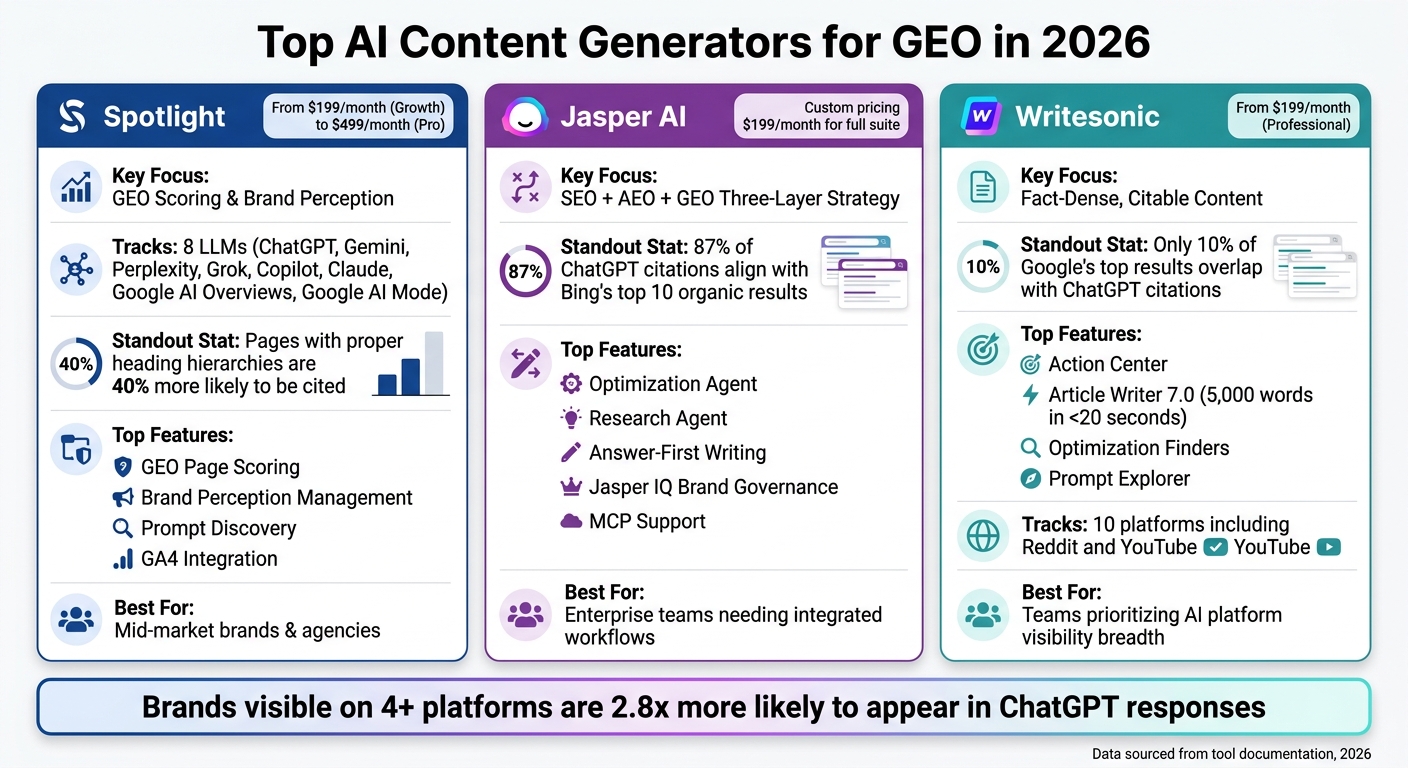
Top AI Content Generators for GEO: Spotlight vs Jasper AI vs Writesonic (2026)
The ultimate guide to AEO: How to get ChatGPT to recommend your product | Ethan Smith (Graphite)
sbb-itb-da7512d
1. Spotlight
Spotlight is designed specifically for GEO – a strategy focused on securing citations in AI-generated answers rather than just achieving a high rank in search results. Its approach involves reverse engineering to identify the exact sources and content patterns that language models like ChatGPT rely on. From there, it provides tailored recommendations to help your content enter the citation pool [3].
One standout feature is GEO Page Scoring, which evaluates your web pages against AI model requirements. It assigns a score and offers targeted suggestions for improvement. For instance, research shows that pages with proper heading hierarchies are 40% more likely to be cited [1]. This highlights the importance of clear and organized content structure.
Spotlight also includes Brand Perception Management, which tracks how third-party sources describe your brand, and Prompt Discovery, which analyzes query volume to uncover the user questions that drive AI interactions. Together, these tools guide you in focusing your content efforts where they’ll have the most impact.
For U.S.-based marketing teams, Spotlight integrates effortlessly with tools like Google Analytics 4, Google Search Console, and WordPress. These integrations allow for direct publishing of AI-optimized drafts and link citation data to website traffic and conversions.
Spotlight is trusted by well-known brands such as Samsung, monday.com, and Papa John’s. Pricing starts at $199/month for the Growth plan, which includes 100 prompts and tracks five AI models, including ChatGPT. The Pro plan, priced at $499/month, offers additional features like prompt volume data, API access, and support for a sixth model. Opting for annual billing provides about a 20% discount. For enterprise clients needing daily reporting across all eight monitored platforms – ChatGPT, Gemini, Perplexity, Grok, Google AI Overviews, Google AI Mode, Copilot, and Claude – a Custom plan is available. This plan includes a dedicated GEO strategist [3].
With its combination of detailed scoring, advanced features, and seamless integrations, Spotlight equips your brand to excel in AI-driven visibility, setting the stage for the next tools in this lineup.
2. Jasper AI
Jasper AI takes a unique approach to content optimization for ChatGPT by employing a three-layer strategy: SEO for baseline visibility, Answer Engine Optimization (AEO) for creating answer-first snippets, and Generative Engine Optimization (GEO) to establish content as a trusted reference in responses generated by large language models (LLMs) [5]. Together, these layers aim to enhance the reliability and visibility of content.
At the heart of Jasper’s strategy is its Optimization Agent, which analyzes content against top-ranking search results. This tool identifies missing data, flags structural issues (like improper use of H-tags), and ensures that ChatGPT can easily extract critical details. Complementing this is the Research Agent, designed to pull in authoritative sources that align with AI preferences in 2026. Megan Dubin, Senior Manager of Content and Thought Leadership at Jasper AI, explains:
"Generative engine optimization (GEO) is the practice of optimizing content so that LLMs like ChatGPT and Gemini cite it as a trusted source in their responses." [5]
Jasper also employs an "answer-first writing" approach, which involves starting sections with a clear, concise answer of 40–60 words. This style, combined with workflows that prioritize Bing indexing, makes it easier for ChatGPT to extract content verbatim. Given that 87% of ChatGPT citations align with Bing’s top 10 organic results [7], Jasper emphasizes Bing indexing and verification through Bing Webmaster Tools. This method ensures content is well-positioned for AI-driven extraction.
To maintain brand consistency, Jasper IQ acts as a centralized repository for tone-of-voice guidelines, U.S.-specific messaging frameworks, and compliance standards. This ensures that every piece of AI-generated content reflects the authority signals valued by ChatGPT. Mason Johnson, Technical Product Marketing Manager at Jasper AI, highlights the importance of this:
"In an increasingly AI-powered search environment that prioritizes established authority and content reliability, maintaining a fully true-to-brand voice across the entire content library is more critical than ever." [6]
Jasper AI’s tools and strategies emphasize both technical accuracy and brand alignment. Additionally, its support for the Model Context Protocol (MCP) and API integrations makes it compatible with existing U.S. marketing tools, offering a seamless fit for teams relying on standard analytics and publishing platforms.
3. Writesonic
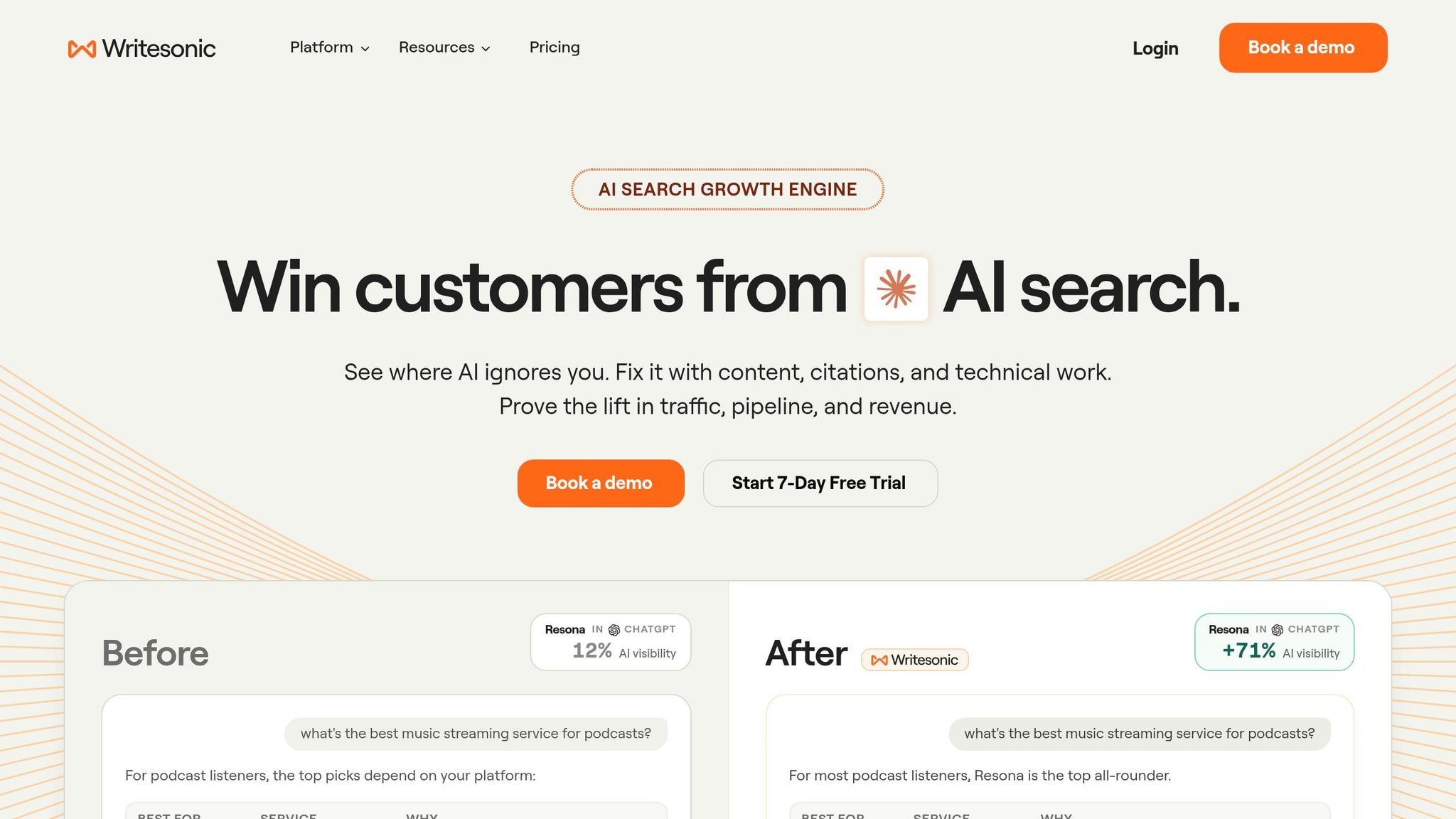
Writesonic takes a different approach with its Generative Engine Optimization (GEO), focusing on making content citable rather than just rankable. This matters because only 10% of Google’s top results overlap with ChatGPT citations [8]. Traditional SEO may not always secure brand mentions, but Writesonic’s strategy aims to bridge that gap with practical, measurable improvements.
The platform’s Action Center identifies and addresses optimization gaps like missing comparison tables, mismatched titles and content, or poorly placed answers. It fixes these issues with just one click. Combine this with Article Writer 7.0, which can generate research-backed drafts of up to 5,000 words in less than 20 seconds [11], and you’ve got a tool that streamlines content creation for AI-driven extraction.
A key focus for Writesonic is fact density. The platform encourages content that includes source-backed statements – phrased as "According to [Source]…" – to minimize the risk of hallucinations by language models [8]. Its Optimization Finders ensure descriptions are self-contained, key takeaways are concise, and expert quotes are included to enhance E-E-A-T signals. Drishti Chawla, Head of Growth at Writesonic, explains:
"AI models cite the most extractable page from a pool of credible sources – not necessarily the highest-ranked or best-written one." [10]
This technical approach delivers real results. For instance, in early 2026, Simon, Head of Marketing at Maestra, used Writesonic’s GEO and AI visibility tools to establish a brand presence from scratch. Within just 60 days, Maestra went from zero AI visibility to securing multiple six-figure deals, including one worth over $350,000 in Annual Contract Value (ACV) [9].
To align with AI-driven search trends, Writesonic integrates seamlessly with popular U.S. marketing tools like Google Search Console, Google Analytics, Ahrefs, WordPress, Zapier, and Make.com [9]. Its Prompt Explorer identifies real ChatGPT queries based on U.S. market data and language, ensuring content aligns with actual user intent. Full GEO features, including Brand Presence Tracking and AI Platform Visibility, are available starting at $199/month on the Professional plan [11].
Pros and Cons
Here’s a breakdown of the strengths and weaknesses of each tool to help you decide which one fits your needs best.
| Tool | Pros | Cons |
|---|---|---|
| Spotlight | Tracks brand perception across 8 LLMs; integrates natively with GA4; offers custom perception properties on Pro/Custom plans; trusted by major brands like Samsung and Papa John’s [3] | Doesn’t include AI crawler logs or Reddit/YouTube citation tracking; daily reporting only available on the Custom plan; Growth plan limits reports to 100 prompts [3][4] |
| Jasper AI | Combines SEO, AEO, and GEO strategies; "Brand IQ" ensures strong brand governance; agentic workflows keep content fresh at scale; ideal for enterprise teams [5] | Lacks detailed real-time visibility dashboards; GEO is part of a broader strategy, not a standalone tool; full suite requires custom pricing [4][5] |
| Writesonic | Offers daily tracking through web UI crawling (not just APIs); Query Fanouts show how LLMs process prompts; tracks 10 platforms, including Reddit and YouTube [12][13] | Less focused on brand perception management; advanced features like AI Traffic Analytics require custom pricing [12][13] |
Each tool has its own strengths, depending on your priorities. Spotlight’s omission of Reddit and YouTube tracking might be a dealbreaker for some, while Writesonic’s web-crawling approach offers visibility into how user-facing content is generated by ChatGPT [13]. Jasper AI, on the other hand, shines for large organizations needing integrated workflows and brand governance, though its extensive features may be more than smaller teams require.
Conclusion
If you’re aiming to fine-tune how AI represents your brand, Spotlight offers tailored solutions. With multi-model tracking and native GA4 integration, it’s a great fit for mid-market brands and agencies looking to connect AI visibility with measurable business results.
That said, success goes beyond just picking the right tool. Brands that show up on four or more platforms are 2.8 times more likely to appear in ChatGPT responses [2]. For 2026, the winning strategy combines improving your AI search visibility with well-structured content across both owned and third-party platforms. This approach ensures your brand not only stands out in ChatGPT responses but also leads the way in shaping AI-driven search standards for the future. This shift is critical as AI is replacing traditional search patterns for modern consumers.
FAQs
What is GEO, and how is it different from SEO?
GEO, or Generative Engine Optimization, is all about ensuring that AI platforms – like ChatGPT – reference your content in their responses. While SEO focuses on improving rankings in traditional search engine results, GEO shifts the spotlight to making your content the go-to source for AI-generated answers.
Here’s the key difference: SEO aims to boost your visibility on search engines like Google, while GEO ensures your content is recognized and cited by AI tools. Though GEO draws from SEO fundamentals – like creating high-quality content and building authority – it takes things a step further. It emphasizes structuring your content specifically so AI systems can identify and prioritize it, aiming for visibility in AI outputs rather than just search engine rankings.
How can Spotlight increase my chances of being cited in ChatGPT answers?
Spotlight boosts your chances of being cited in ChatGPT responses by guiding you to produce structured and authoritative content. It also helps you secure third-party citations and spot areas where your AI visibility might be lacking. By aligning your content with AI-driven search algorithms, Spotlight ensures higher relevance and improved accuracy.
What content changes help pages get cited by AI models more often?
To get your content noticed and cited by AI models, aim for clear, concise, and easily extractable answers. Incorporate structured data, such as FAQ schema, and organize your content with question-based headings. Additionally, keep your information updated regularly to ensure it remains relevant and aligns with AI algorithms. These strategies can boost your visibility in AI-powered search results.
Related Blog Posts

Michael Hermon
Before Spotlight, Michael led Innovation and AI at monday.com after exiting his previous startup. He learned to code at 13 at MIT and later attended Columbia’s MBA program.
https://linkedin.com/in/michaelhermon